Give me a break; I am not changing my style — Queiroz hits back at critics
Carlos Queiroz has hit back at criticism of his approach to football, insisting that after 47 years in coaching, his philosophy remains simple: win.
 Black News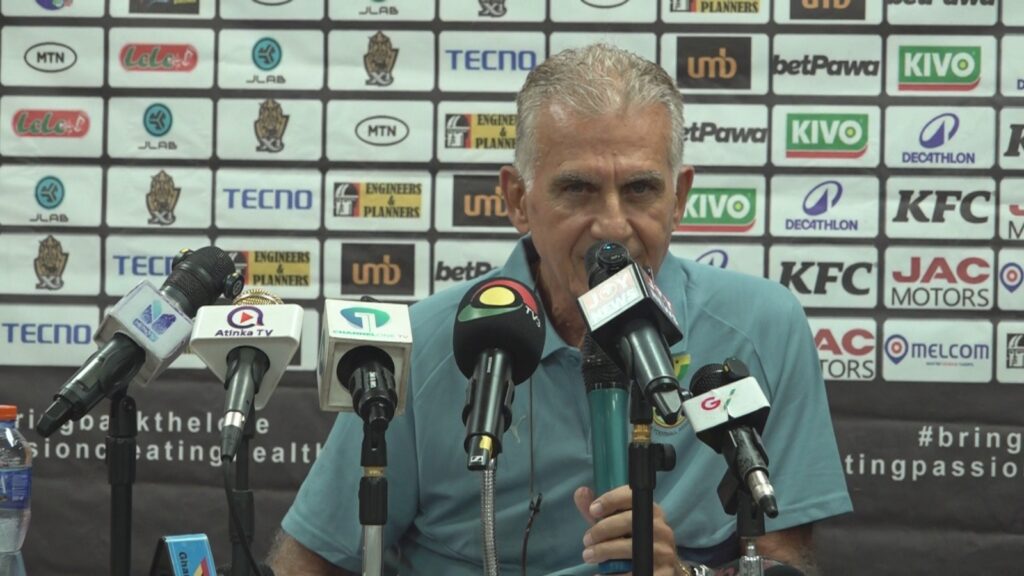
Carlos Queiroz has hit back at criticism of his approach to football, insisting that after 47 years in coaching, his philosophy remains simple: win.
The experienced coach says discussions about style often overlook the fundamental demand placed on coaches and players — producing results.
Queiroz argues that coaches are ultimately judged by whether they win, rather than by whether their teams conform to a particular aesthetic.
“No, look, to be clear, I want you to understand one thing. My style of football, and I think what most of the people in the world appreciate, is the winning style.
“I never saw coaches and players and national teams or clubs, they win the treble when they lose.
“Tell me one coach in the world that lost his job because of his style. Can you tell me one name of his style of play?
“I only know coaches that lose their jobs because they don’t win. About style, I mean, the winning style, the winning makes the style. The winning makes the fashion. That’s the law of the game for more than 100 years.”
The Portuguese coach says his ideal scenario would be to have his team in constant possession, but acknowledges that football is inherently competitive and possession cannot always be controlled.
“So, the other thing that I’m never tired to say is I wish I could start every single game with a ball, with my team with a ball, and during 90 minutes, never give them the ball, or, sorry, I only give them the ball when we score and they have the right to start the game again. But it’s not possible. It’s a competitive world.”
Queiroz points to some of Europe’s biggest clubs as evidence that even teams associated with particular philosophies have evolved over time.
“Look at the big teams, they are changing. When you see today [Man] City, and even Paris Saint-Germain and Barcelona, step by step, small details, they are changing the style. Of course, when you put 10 years, 15 years, of one specific work, of one culture, of one mentality, when you choose the right players to make the interpretation of that culture, the way of play, you can reach a certain level.”
But he insists that his own philosophy has not changed and will not change now.
“But, again, sorry, my friend, there is one thing that keeps me in the job for 47 years.
“And it is not after 47 years that I will change my style, which is winning. So, every single game, I play for winning.”
For Queiroz, however, winning does not mean adhering rigidly to one tactical formula. He says how a team achieves that objective must be determined by the circumstances of each match and the players available.
“How I have to do that is something that, in the game, with the players, we have to decide.”
The veteran coach says his teams are expected to attack when they have possession and look for ways to score. But when the opposition has the ball, he wants his players to fight to regain it.
“We have the ball, we have to attack. We have the ball, we have to find one way to score. We don’t have the ball…You think in the World Cup, when we don’t have the ball, it is because it is my wish? Give me a break.
“Playing in the World Cup, I don’t have the ball. What I can… It is to prepare my players to fight, fight, fight, until we have the ball again.”
Queiroz rejects the suggestion that this approach amounts simply to defensive football, arguing that winning possession is itself part of the attacking process.
“And you call it defence. I don’t call it defence. I call it fight and attack to have the ball in order to have the chance to score.”
He accepts that coaches and observers may interpret the game differently but says the reality of a competitive match means no coach can simply dictate who has possession.
“But you have your interpretation, I have mine. I cannot go inside the pitch and say, wait a minute, referee, I have my ball here and I want to give it to my boys. I can’t do that.”
Instead, Queiroz says his responsibility is to prepare his team for both phases of the game — with and without possession.
“So, what I can do is to prepare the team for these two moments in the game. We have the ball, we attack, and we try to score, we try to win. When you don’t have the ball, hey, my friends, I don’t care. You have to defend.
“And do it together. In the end, I can tell you one thing. After 47 years, my style of winning, it is what keeps me in the job.”