I Offered Life
Editor’s note: Moment interviewed JoJo Drake Kalin hours after the May 21, 2025, killings of two young Israeli embassy employees The post I Offered Life appeared first on Moment Magazine.
 Black News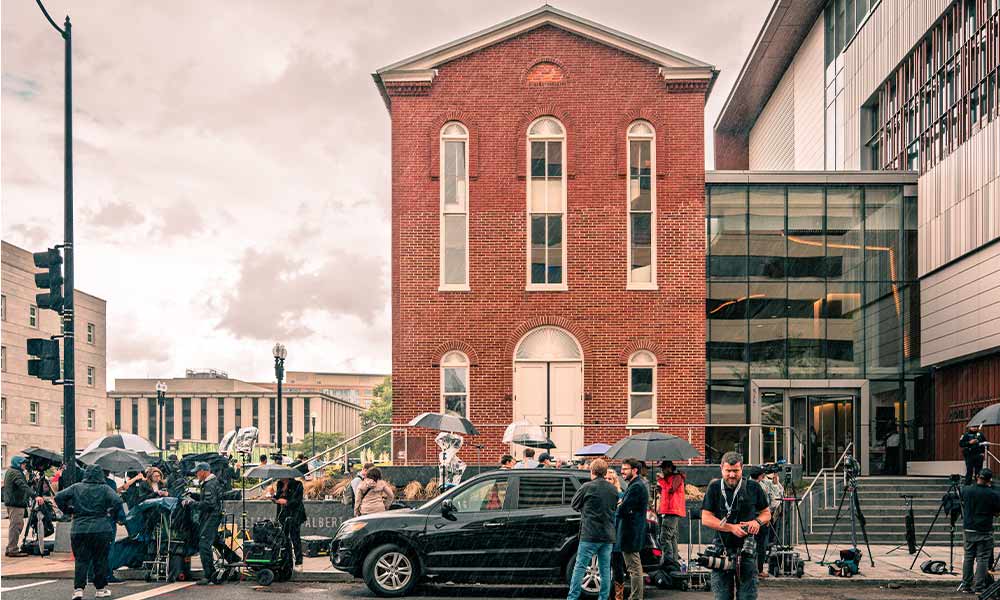
Editor’s note: Moment interviewed JoJo Drake Kalin hours after the May 21, 2025, killings of two young Israeli embassy employees outside an event she had helped organize at the Capital Jewish Museum in Washington, DC. One year later, Drake Kalin reflects back on the events of that night and how they have rearranged how she looks at the world.
I didn’t think of it as a moral decision at the time. I thought someone needed water.
He looked shaken, unsteady, like someone who had just witnessed something frightening. I assumed he was an innocent bystander, someone unfortunately caught in whatever had just happened outside the museum.
I hadn’t heard the gunshots myself. I was in the elevator. My husband, friends and colleagues had. We chalked it up to DC city crime and never imagined that we were being targeted. Here we were in a Jewish venue, attending an American Jewish Committee event for young professional diplomats at a time when antisemitic crime had skyrocketed, but none of that crossed our minds.
As someone involved in organizing the evening, I knew the man before me wasn’t an attendee. I assumed he had come inside seeking safety. But I did what I have been taught to do: I offered care. “Do you need water?” I asked. “That would be great,” he said. I handed him a cup, our fingers brushing in the exchange.
I did not come out healed. But I came out choosing. Choosing to remain in relationship to this life, to this people, to this story.
Only later did I understand who he was. That he was not a bystander, but the one who had pulled the trigger. That two people, Sarah Milgrim and Yaron Lischinsky, were dead. That what I had interpreted as distress was, in fact, the emotional aftermath of a murderous act of antisemitic terror. That I had offered water, the most elemental symbol of life, to someone who had just taken two lives.
I have replayed that moment—the offering and handing off of the plastic cup of water—more times than I can count, not because I would change what I did, but because I am still learning what it means.
In Judaism, we are taught to welcome the stranger, to extend care even before we know who stands before us. It is one of the tradition’s most repeated commandments. I was married in front of a wall that bears that very verse: “Love the stranger, for you were a stranger” (Deuteronomy 10:19). At the time, it felt like a beautiful idea, even aspirational. I did not yet understand how much it would ask of me.
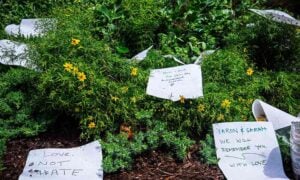
Judiciary Square, Washington, DC, the day after the shooting.
I am a Jew by choice. I have always understood my conversion as an expansion of my identity, not a narrowing, something my mother-in-law helped me see early on. I have always loved the line from the Book of Ruth, “Where you go, I will go,” a declaration of choice as much as devotion.
What I understood less, until now, nearly a year after the tragic deaths of Sarah and Yaron, was what exactly I was choosing to go toward.
I used to think of my Jewish identity as something distinct, as if there were those who were born into this story and those who chose it. But I was taught otherwise by a rabbi in Tel Aviv who told me that, in truth, we are all Jews by choice. Some of us arrive there differently, but the act of staying, the act of saying yes again and again, is shared.
Choosing Judaism means choosing a people bound not only by tradition and joy, but by paradox, by teachings that ask us to hold compassion and vulnerability at once, to remain openhearted in a world that continually tries to harden our hearts. It means choosing a future in which my children may inherit not just stories and rituals, but fear. That is the part no one says plainly. Or perhaps it is the part you cannot fully understand until you have lived it.
In the immediate aftermath of May 21, 2025, I wrote constantly. Out of respect for the families of those who were killed, and given the weight of what had happened, I kept my writing private and didn’t post on social media about what I had been through. At the same time, I found myself leaning more deeply into Jewish life. That first Shabbat after the attack, I made challah. Not as a gesture, but as a quiet insistence on continuity. For me, the most meaningful response to the antisemitism I had just faced was robust semitism.
This, along with all the writing—the questions and observations I needed to put somewhere outside my body—was, in part, a frantic bid for control. But it was also a way of saying: This happened. I was there. I am still here.
When other acts of antisemitic violence appeared in the news—one just two weeks later when a man threw Molotov cocktails at a group of Jews in Boulder, CO, who were marching for the return of the Israeli hostages—my body reacted before my mind could contextualize it. I would spiral, briefly but unmistakably, a kind of emotional vertigo. I began to understand something I hadn’t before, how trauma reverberates, how it attaches itself to other moments, other stories, how it refuses to stay contained. The body truly keeps score.
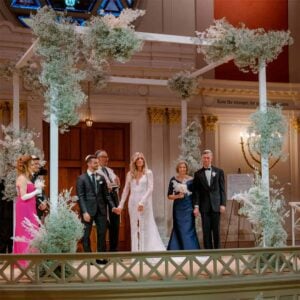
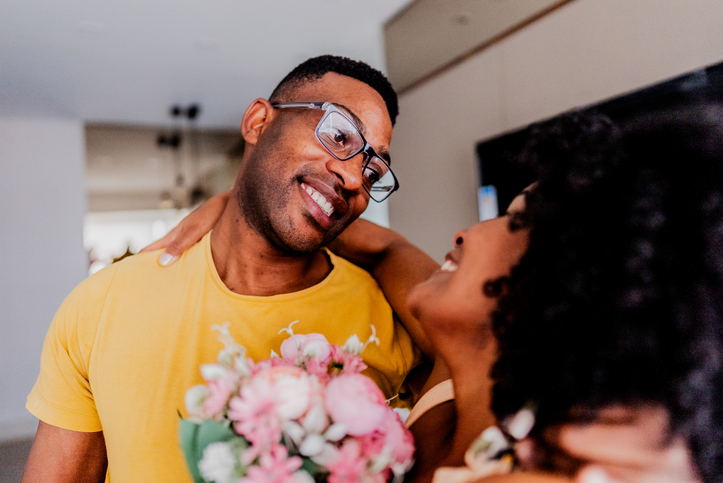
Drake Kalin’s wedding.
Milestones also felt different. I remember standing at a wedding that summer after the museum attack, watching a couple beneath the chuppah, and feeling something in me catch. Weddings had always moved me, but this was something else, an awareness layered over joy, a quiet reckoning with what had been taken. Sarah and Yaron were meant to be there, too, about to build a life, to stand beneath a chuppah, to begin something. They never got to. That knowledge did not stay abstract. It followed me, settling into moments that were once uncomplicated.
None of this has gone away. The events of May 21, 2025, indelibly rearranged me. But something else has begun to take shape, not in place of the fear but beside it.
In the language of trauma, this might be called post-traumatic growth. I am wary of that phrase. It can sound too neat, too resolved. But something in me did shift. Looking a homicidal maniac in the eye recalibrates your sense of threat. Things that once felt overwhelming fall away, and what remains is both clearer and more unsettling. The world does not become safer, it becomes more real. And within that clarity, I have felt something else emerge, a kind of urgency, a refusal to defer the life I want to live.
Two weeks after the attack, I returned to the mikvah, the Jewish ritual bath used for spiritual transition and renewal. The same place I had gone for my conversion mikvah and where I had immersed before my wedding. The ritual is deliberate. You wash every part of your body. You attend to yourself fully, no shortcuts, no rushing. After trauma, that is not a small ask. Then you step into the water and immerse completely, no part left untouched. For a moment, you are suspended, and then you emerge. I did not come out healed. But I came out choosing. Choosing to remain in relationship to this life, to this people, to this story. Choosing, even now, not to turn away.
The first anniversary of the Capital Jewish Museum shooting will fall on Shavuot, the holiday of receiving the Torah, or more precisely, of choosing it. Not Moses on the mountain but the people at its base saying yes. It is also when we read the story of Ruth, a convert who becomes part of the Jewish people, not by birth but by commitment.
I think about Ruth’s words differently now. The “where” she refers to is no longer abstract for me.
I have thought about what it means to bring children into this, to choose this life for them, knowing what they might face. That question feels more lived in now. To know that what I am choosing will not end with me, to feel it moving forward, already taking shape, has sharpened the stakes in ways I am still learning to hold.

There is a version of the future in which my future children would not have to carry this particular kind of fear. I am aware of that. And I am choosing this one anyway.
I choose it because what they would inherit is not only fear. It is also peoplehood, memory and a stubborn, enduring joy. There is simply nothing that compares to Jewish joy. It is the ability to hold contradictions, to carry grief and celebration in the same body, to insist on meaning even when meaning is not guaranteed.
I still think about that glass of water, about the instinct to give it, about the fact that I did not hesitate.
I don’t know what it means, fully. I’m not sure it resolves into something clean or instructive. But I know this: That moment belongs to my humanity, not to his violence.
(Image credits: Ted Eytan (CC BY-SA 2.0) and courtesy JoJo Drake Kalin)
The post I Offered Life appeared first on Moment Magazine.