Kenyan lawyers boycott court over judiciary corruption claims
Lawyers across Kenya on Wednesday boycotted court proceedings in protest against alleged corruption and a lack of accountability within the Judiciary, intensifying pressure for reforms in a move that has drawn attention across East Africa. The nationwide boycott, called by the Law Society of Kenya (LSK), saw advocates stay away from courts as they demanded […] The post Kenyan lawyers boycott court over judiciary corruption claims appeared first on The Observer Media Ltd.
 Black News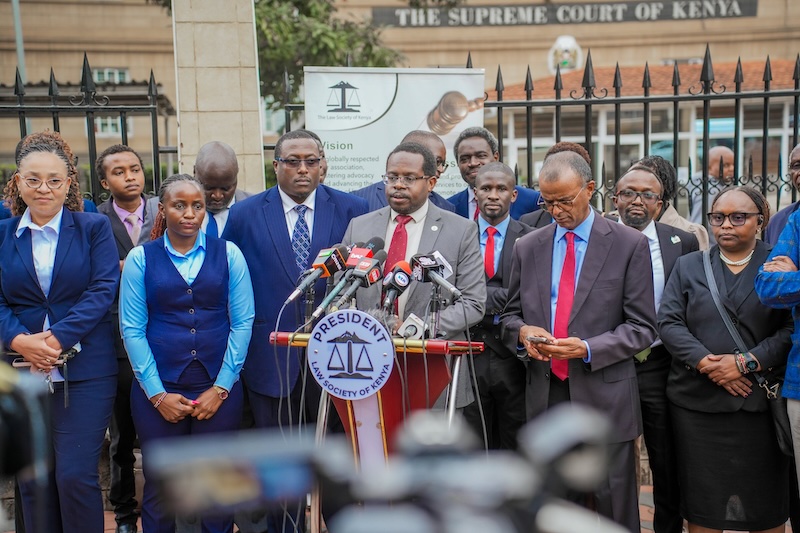

Lawyers across Kenya on Wednesday boycotted court proceedings in protest against alleged corruption and a lack of accountability within the Judiciary, intensifying pressure for reforms in a move that has drawn attention across East Africa.
The nationwide boycott, called by the Law Society of Kenya (LSK), saw advocates stay away from courts as they demanded stronger accountability mechanisms for judges and judicial officers.
The protest comes amid growing debate across the region over the integrity of judicial institutions. In neighbouring Uganda, concerns over prolonged court processes, the trial of civilians in military courts and allegations of politically motivated prosecutions have frequently attracted criticism from lawyers and civil society groups.
Speaking outside the Supreme court in Nairobi, LSK president Charles Kanjama said the boycott was being observed across the country and urged advocates to remain united until their concerns were addressed.
He said the LSK Council and members of the Senior Counsel Bar would meet the Judicial Service Commission (JSC) on July 31 to discuss reforms aimed at strengthening accountability within the Judiciary.
“The campaign for judicial accountability must be seen through to its conclusion,” Kanjama said.
Senior counsel Philip Murgor said the legal fraternity had united behind the boycott because those entrusted with administering justice must themselves be held accountable.
Former LSK president Faith Odhiambo questioned what she described as attempts to shield judges from disciplinary proceedings before the JSC.
“How can we trust our courts if they can stop JSC hearings against corrupt judges? Judicial independence does not mean judicial officers are above the law,” she said.
Senior counsel Ahmednasir Abdullahi accused some judicial officers of perpetuating corruption and vowed the boycott would continue until meaningful reforms were implemented.
Former LSK presidents Nelson Havi and Erick Theuri also backed the protest, calling for stronger oversight of judicial officers and urging Kenyans to support efforts to restore public confidence in the courts.
East Africa Law Society president Ramadhan Abubakar echoed the calls, saying accountability should apply equally to all arms of government.
“Just as the judiciary holds the executive and legislature accountable, it must also be subject to scrutiny where legitimate concerns arise,” he said.
Abubakar also urged Kenya’s Ethics and Anti-Corruption Commission (EACC) to thoroughly investigate allegations of corruption involving judges and magistrates.
The boycott coincided with the arrest of senior principal magistrate Martin Kinyua Mutegi and principal probation officer Julius Irungu Njogu by the EACC over allegations that they solicited a KShs 170,000 (about Shs 4.9 million) bribe from a businessman in exchange for a favourable probation report ahead of sentencing in a fraud case.
Investigators said the pair were arrested after allegedly receiving KShs 150,000 (about Shs 4.3 million) in marked currency during a sting operation. Following the arrests, Chief Justice Martha Koome suspended Mutegi from judicial duties and announced disciplinary proceedings.
“The allegations are grave and, if proved, constitute a serious violation of the law, the Judicial Code of Conduct and Ethics, and the values that underpin the administration of justice,” Koome said.
She reaffirmed the Judiciary’s zero-tolerance stance on corruption, saying judicial officers could not be expected to uphold the law while engaging in criminal conduct.
Despite the boycott, Kenya’s Judiciary said courts remained operational, although some cases had been adjourned because advocates failed to appear.
The LSK warned that it would escalate the industrial action if the July 31 meeting with the Judicial Service Commission fails to deliver concrete commitments on judicial reforms.
The post Kenyan lawyers boycott court over judiciary corruption claims appeared first on The Observer Media Ltd.