NAWEC’s WASIB project to boost water supply within GBA
Omar Sanneh, WASIB project coordinator for and head of NAWEC Water and Sewerage Business Unit, described Serrekunda as a central hub for the project’s short-term activities. He explained that works in the area include the replacement of an old elevated water tank, construction of a new 1,000 cubic metre ground reservoir, and rehabilitation of existing storage facilities to boost overall capacity. “We are not only replacing aging infrastructure but also expanding our storage capacity to improve efficiency and continuity of supply,” Sanneh said, noting that the Serrekunda plant plays a key role in supplying water to surrounding communities and the capital, Banjul. He revealed that the project also involves the installation of new transmission pumps to replace aging equipment currently in use, as well as the drilling of deep aquifer boreholes described as a first for The Gambia. These boreholes, which reach depths of between 450 and 600 metres, are expected to provide a more secure and less contamination-prone source of water compared to the shallow aquifers currently in use. “The impact of this project will be significant,” Sanneh added. “We expect improved service delivery, better efficiency and more reliable water supply across the Greater Banjul Area.” Despite initial timelines targeting completion by late 2026, Sanneh disclosed that the project is now expected to be finalised in the first quarter of 2027 due to some delays. Also speaking, Lorane Rebut, project officer for the French Development Agency (AFD) in The Gambia, said the agency has been working with the Gambian government since 2021 as she emphasised that the funding provided by the French Government is in the form of a grant, aimed at supporting sustainable water and sanitation improvements. Rebut added that the project is being implemented in line with international safety and sanitation standards to ensure a lasting and meaningful impact on the population. Angharad Pagnon for ANTEA group consultant for the project, assured that all works are being carried out in line with international standards, with emphasis on quality, durability and long-term sustainability. Newly constructed tanks, she noted, are expected to last between 25 to 40 years. For residents across the Greater Banjul Area, where water supply challenges have long been a concern, the project offers renewed hope for a more stable and efficient system. She emphasised that they will remain committed to delivering a project that will significantly improve access to safe and reliable water for communities across the region. Sainabou Jagne, senior water assets manager, NAWEC, outlined what is expected in the first phase of the Water and Sanitation Improvement for the Gambia Basin (WASIB) project. The WASIB project is funded through a grant from the French Development Agency (AFD), with NAWEC working alongside international consultants and contractors to implement the works. Officials said the project also includes upgrades to pipelines and network systems to support improved distribution.
 Black News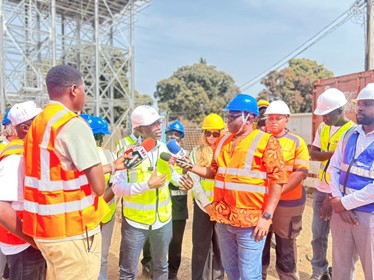


Omar Sanneh, WASIB project coordinator for and head of NAWEC Water and Sewerage Business Unit, described Serrekunda as a central hub for the project’s short-term activities.
He explained that works in the area include the replacement of an old elevated water tank, construction of a new 1,000 cubic metre ground reservoir, and rehabilitation of existing storage facilities to boost overall capacity.
“We are not only replacing aging infrastructure but also expanding our storage capacity to improve efficiency and continuity of supply,” Sanneh said, noting that the Serrekunda plant plays a key role in supplying water to surrounding communities and the capital, Banjul.
He revealed that the project also involves the installation of new transmission pumps to replace aging equipment currently in use, as well as the drilling of deep aquifer boreholes described as a first for The Gambia.
These boreholes, which reach depths of between 450 and 600 metres, are expected to provide a more secure and less contamination-prone source of water compared to the shallow aquifers currently in use.
“The impact of this project will be significant,” Sanneh added. “We expect improved service delivery, better efficiency and more reliable water supply across the Greater Banjul Area.”
Despite initial timelines targeting completion by late 2026, Sanneh disclosed that the project is now expected to be finalised in the first quarter of 2027 due to some delays.
Also speaking, Lorane Rebut, project officer for the French Development Agency (AFD) in The Gambia, said the agency has been working with the Gambian government since 2021 as she emphasised that the funding provided by the French Government is in the form of a grant, aimed at supporting sustainable water and sanitation improvements.
Rebut added that the project is being implemented in line with international safety and sanitation standards to ensure a lasting and meaningful impact on the population.
Angharad Pagnon for ANTEA group consultant for the project, assured that all works are being carried out in line with international standards, with emphasis on quality, durability and long-term sustainability.
Newly constructed tanks, she noted, are expected to last between 25 to 40 years.
For residents across the Greater Banjul Area, where water supply challenges have long been a concern, the project offers renewed hope for a more stable and efficient system.
She emphasised that they will remain committed to delivering a project that will significantly improve access to safe and reliable water for communities across the region.
Sainabou Jagne, senior water assets manager, NAWEC, outlined what is expected in the first phase of the Water and Sanitation Improvement for the Gambia Basin (WASIB) project.
The WASIB project is funded through a grant from the French Development Agency (AFD), with NAWEC working alongside international consultants and contractors to implement the works. Officials said the project also includes upgrades to pipelines and network systems to support improved distribution.