Potholes Matter to all Victorian. So does the bigger picture.
3 mins read by Andrew Gai A pothole can turn an ordinary drive to work…
 Black News

3 mins read by Andrew Gai

A pothole can turn an ordinary drive to work or school into a bill for a new tyre or a damaged wheel. For families already stretching their budgets, that is a real cost. Potholes deserve the attention they are getting in Victoria’s election campaign. So do the road and rail improvements that are changing how people get around.
There is a tendency in politics to focus on the negatives because negativity attracts attention, sells headlines and can even win votes. However, a fair and balanced assessment of any government’s performance requires us to acknowledge both what hasn’t been done and what has been achieved.
As an African Australian who calls Melbourne home, I see this debate through the everyday experiences of families in Melbourne’s outer suburbs. In places such as Wyndham and Melton, where many African Australian families have made their homes, a reliable road can be the difference between getting to a shift on time and starting the day with a breakdown. People who are new to an area are also less familiar with stretches of road where damage keeps recurring. That makes timely repairs and clear warnings all the more important.
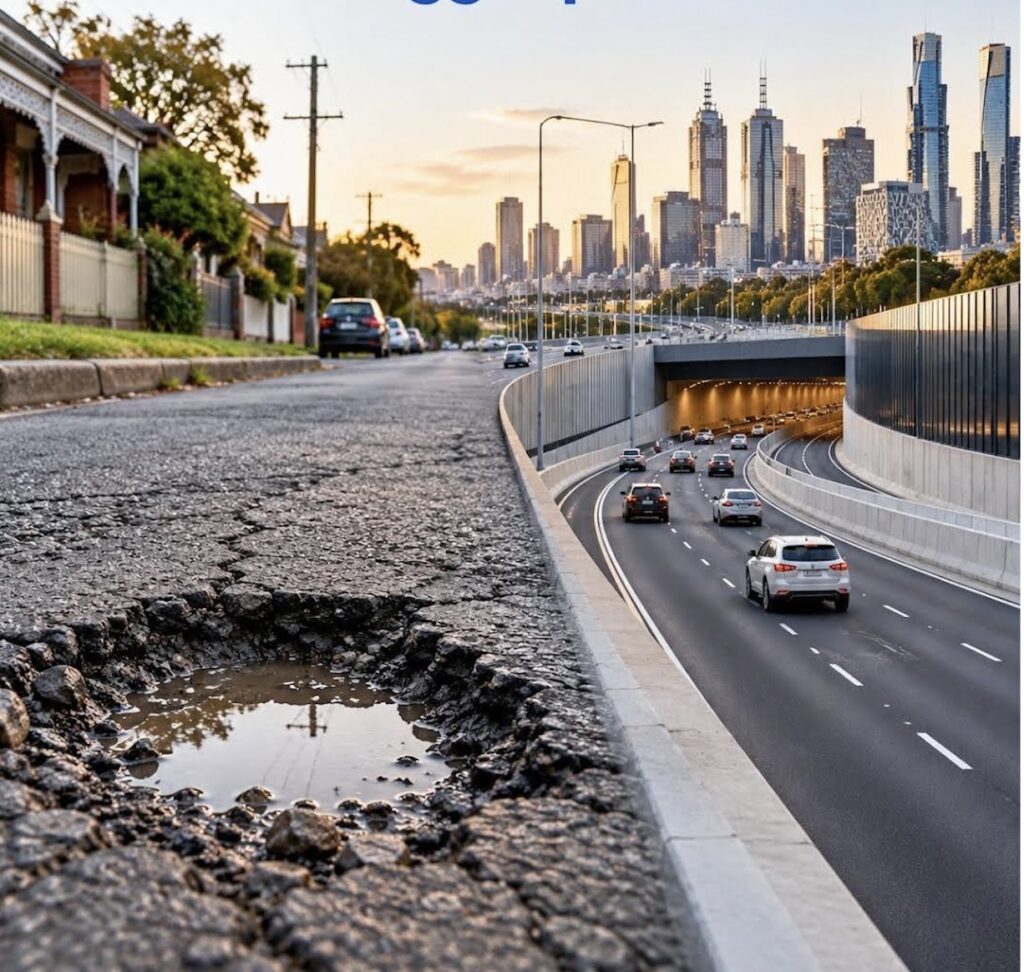
Victoria is building big, but there is more work to be done
The costs deserve more attention, too. When a pothole damages a car, motorists should be able to find out easily who manages the road, how to report the damage, and whether they can claim compensation. When families are paying registration fees and already feeling the pressure of rising living costs, they are entitled to expect properly maintained roads and a claims process they can understand.
In Cranbourne, I’ve lost count of how many roundabouts have been replaced with upgraded intersections. We’ve seen work on Frankston–Cranbourne Road, Narre Warren–Cranbourne Road, Thompsons Road, Berwick–Cranbourne Road and the South Gippsland Highway. These are roads local families use every day to get to work, drop children at school and visit relatives. The changes are part of the government’s record and deserve to be weighed alongside the roads that still need attention.
Across Melbourne, the West Gate Tunnel and Wurundjeri Way extension have added new routes for motorists. Level crossing removals have changed how people move through many suburbs, and the Metro Tunnel has created a direct rail connection through the city between Melbourne’s south-east and north-west. The next question for many outer-suburban families is how reliably they can get from home to the station, especially early in the morning or after a late shift.
That matters to international students, recently arrived workers and anyone building a life in a city they are still learning to navigate. African Victorians bring many different experiences to this debate. Some will be voting for the first time. Others have voted in Victoria for decades. Residents who are ineligible to vote can still raise concerns with their local MPs, report recurring problems and contribute to public consultations. Their experience of using these roads and services deserves to be heard too.

Become a contributor of AMA today and share your views, opinions and expertiese with the community
Both Labor and the Liberals have made road maintenance commitments during the campaign. I drove along the Hume Highway in August and again in October, and I noticed an improvement. What I want to see from whoever forms government is a maintenance plan that lasts beyond polling day, with clear priorities for roads that repeatedly deteriorate and a way for communities to see when repairs will happen.
Many of us who migrated to Australia know what it means to build a home in a new country. Victoria is where we raise our children, run businesses, work and volunteer. We have every reason to speak up about the services our families and communities rely on.
As the election approaches, I encourage voters to look around their own neighbourhoods and ask three questions. What has improved? What still needs attention? What is each party committing to deliver, and how will we know it has followed through?
We can recognise progress without ignoring problems, just as we can demand improvements without dismissing achievements.
Potholes deserve urgent repairs. A fair verdict on the government also takes in the upgraded intersection, the removed level crossing and the train that makes a cross-city trip easier. All of those things shape how we get around Victoria, long after the election campaign is over.
About the Author: Andrew Gai is a Community advocate, former member of the Victorian African Communities Committee, and Co-founder of the South Sudanese-Australian Academic Society Inc.