Space odyssey
Satellites are unlocking opportunities for millions of Africans who don’t have internet access The post Space odyssey appeared first on African Insider.
 Black News
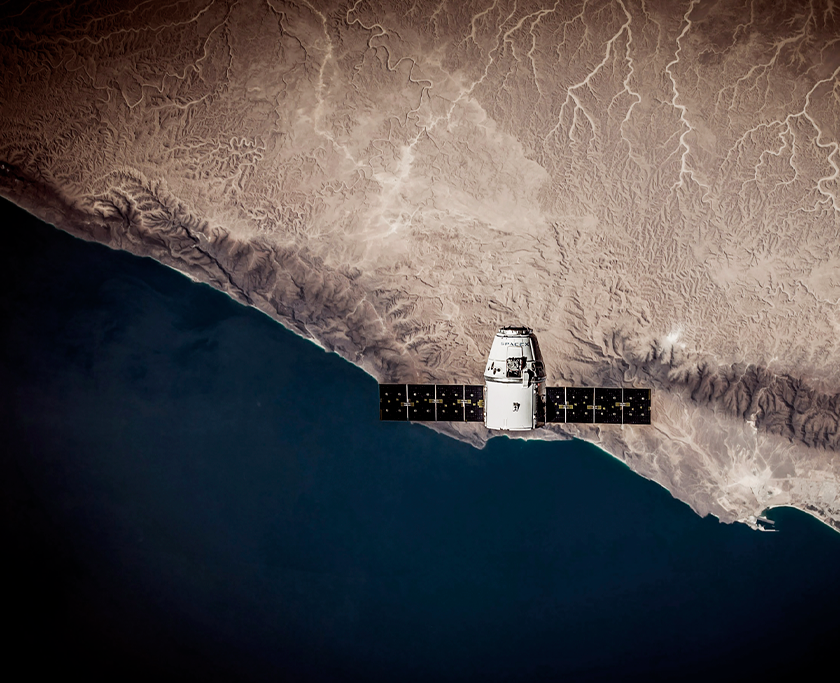
About 10 years ago, satellite high-speed broadband connectivity brought farmers and rural communities in the Northern Cape closer to the outside world. A two-year deal between Square Kilometre Array South Africa and Vox Telecom meant up to 300 homes in an isolated region of the Karoo had access to broadband connectivity through satellite services and could make calls and access broadband data services.
Satellite technology has advanced considerably since then, but what has stayed the same is that rural areas remain a major beneficiary. For years, farmers and rural businesses had to contend with unreliable or non-existent connectivity, while cable theft and unstable networks disrupted services, resulting in lost revenue and compromised safety.
The introduction of Ka-band high-throughput satellites (HTS) offered uncapped data plans in the more isolated regions, which improved operations. Low Earth orbit (LEO) satellite technology has taken things a step further. Analyst JP Landman explains that because the satellites orbit closer to Earth than geostationary (GEO) satellites, they offer lower latency, making connections more responsive. He says LEO networks are especially useful in remote places because satellites can reach almost every part of the country without much infrastructure investment needed, unlike fibre and mobile phone towers, as companies often can’t afford to build and run networks in hardto-reach places.
This has proved a game-changer for households, farmers, mining organisations and tourism operators in far-flung regions, where satellites are increasingly not only providing connectivity, but also enabling data-driven decision-making. LEO satellite technology allows ‘smart’ farmers to act on their data in real time, and it gives agricultural, mining, tourism and hospitality, renewable energy and commercial businesses the foundation they need to adopt automation, AI and internet of things (IoT) tools.
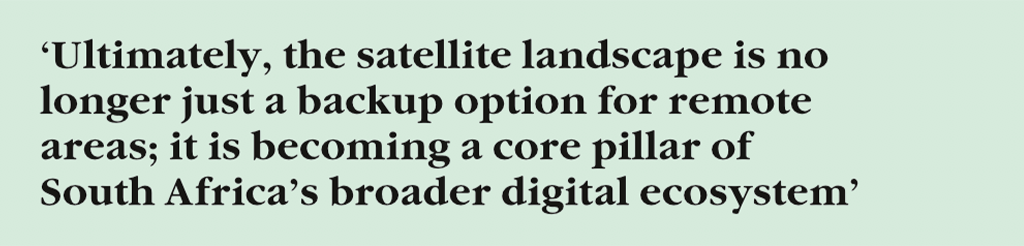
The market is also expected to grow even further, with technology research and advisory firm BMIT anticipating business-to-business satellite terminals to nearly treble, from around 27 500 in 2024 to more than 75 000 by 2029, driven by sectors such as retail, banking, mining, agriculture and eco-tourism. ‘Ultimately, the satellite landscape is no longer just a backup option for remote areas; it is becoming a core pillar of South Africa’s broader digital ecosystem,’ says Christopher Geerdts, MD of BMIT. ‘As LEO constellations mature, satellite technology will play a pivotal role in closing the digital divide while unlocking billions in value for operators and enterprises.’
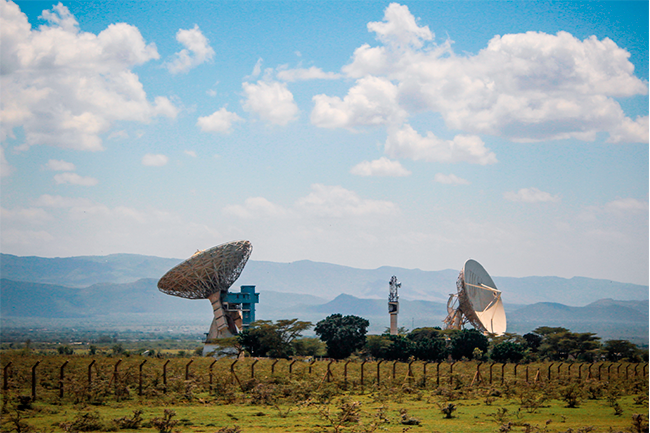
Satellite technology has enabled far-flung regions to access the internet more easily and more cheaply
Earlier this year, it was announced that Amazon’s satellite internet venture, Amazon LEO, will make its African debut in South Africa in 2027. This will be done through an agreement with Herotel, one of the country’s largest fixed internet service providers, which will use the satellite technology to offer a new service called evry. According to Reuters, Amazon LEO and Herotel believe their partnership will ‘help address a longstanding connectivity gap’ in South Africa. ‘This collaboration is about breaking down barriers and unlocking opportunity for millions of people who don’t yet have reliable access for work, education or the services they depend on,’ says David Zapolsky, Amazon chief of global affairs and legal officer.
The deal comes as Starlink remains unable to launch commercial services in the country because it still needs a licence from Icasa, which requires operators to have 30% black ownership.
World Wide Worx CEO and technology expert Arthur Goldstuck recently told My Broadband that while Amazon is unlikely to catch up to Starlink in terms of network capacity and customer count anytime soon, he anticipated that Amazon LEO should provide a significant improvement over traditional satellite broadband.
He added that Amazon LEO could launch at a price similar to Starlink in several Southern African countries, but the use of a local resale channel may raise the total cost. ‘Herotel will have to cover installation, support and its own margin. The strongest selling point will be legal, locally supported broadband for underserved areas,’ said Goldstuck. ‘That said, a fully authorised local service may compare well with the cost and inconvenience of using Starlink through unofficial roaming arrangements.’ While not supported in South Africa, Starlink’s roaming service has until recently worked in the country, allowing those with kits registered in other countries to access it locally.
While Starlink may not have an official presence in South Africa, it has made its mark in other countries on the continent. Paratus Essential Access, which is powered by Starlink, has been designed by pan-African telco Paratus Group to ‘deliver priority connectivity to remote communities and emergency services across Africa’. Murang’a County in Kenya is one area that’s benefited, with the roll-out in the region connecting 170 healthcare facilities. It’s reported that access to healthcare was improved for approximately 1.2 million residents, many of whom live in rural communities. The project is regarded as one of the largest connected telemedicine programmes not only in Kenya but also in Africa, with Paratus Kenya MD Joseph Kibwott calling it a ‘lifeline for rural communities’.
South Africa, which plans to strengthen its local space industry through the National Space Strategy, is aiming to play a leading role in fostering space development across the continent.
Last year its neighbour Botswana became the latest Southern African country to head to space when the Botswana International University of Science and Technology (BIUST), in partnership with Dragonfly Aerospace, successfully launched its first national satellite, Botsat-1. Owned and operated in Botswana and developed in collaboration with regional and international partners, the mission enables real-time data reception and analysis that will support national policies in agriculture, climate monitoring and urban planning. BIUST’s vice-chancellor called the launch ‘a defining moment’ for the country. ‘This project strengthens our country’s role in space research and enhances our ability to monitor and manage our natural resources.’
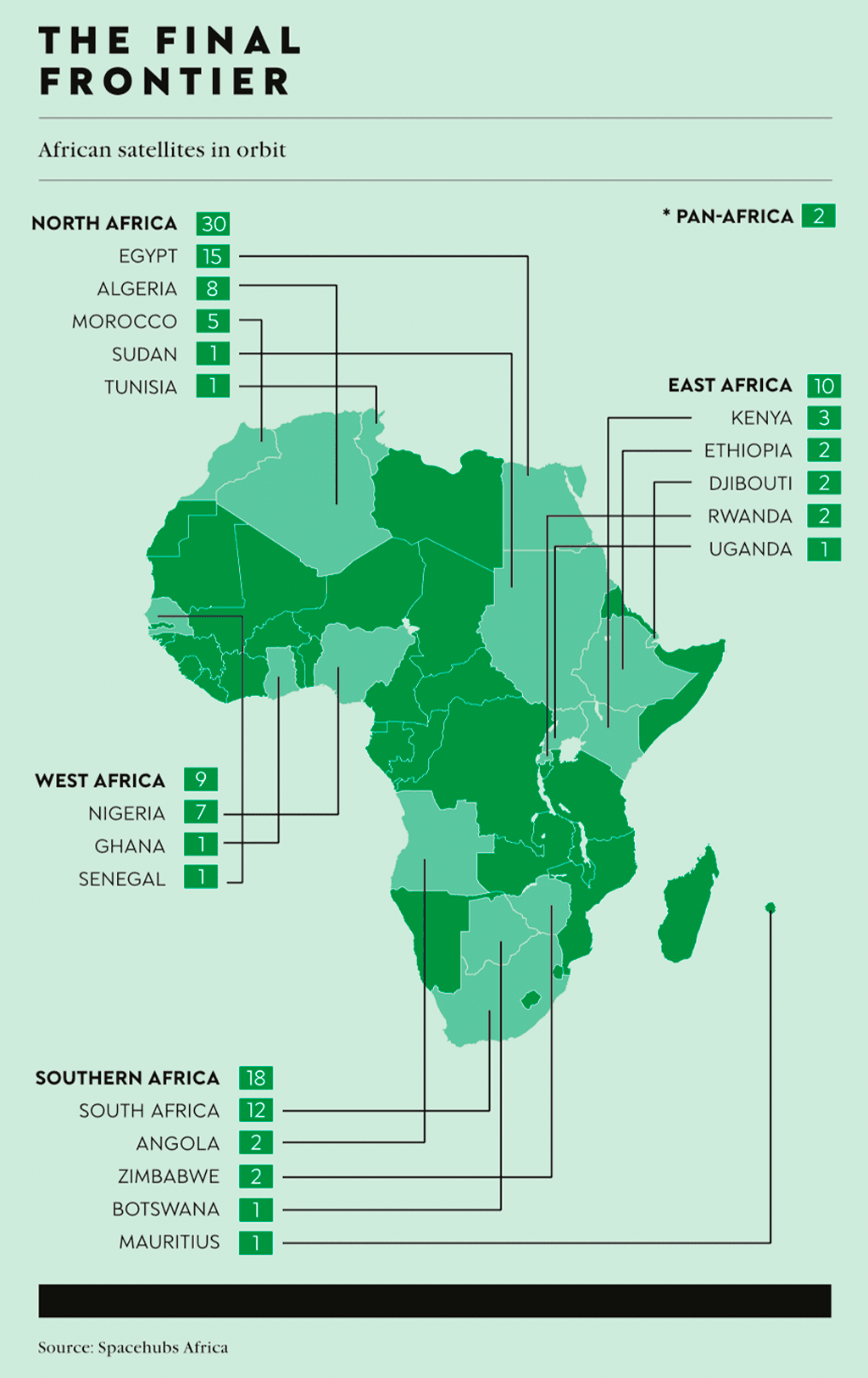
Dragonfly Aerospace in Stellenbosch played a pivotal role in South Africa’s most recent satellite launch, in February 2023. South Africa has launched 12 satellites since 1999, but this was its first commercial imaging satellite, with the bus structure manufactured and assembled locally.
The satellite monitors up to 1 million square kilometres of land daily using 11 specialised spectral bands to support sustainable farming. The LEO satellite delivers critical data worldwide as it gathers imagery for the US firm EOS Data Analytics, a global provider of AI-powered satellite intelligence.
The captured images contain important information for mapping, seasonal planning, soil moisture, yield prediction and more. The company says the data will help prevent the excessive use of pesticides and fertilisers, reduce food waste and address the effects of climate change on agricultural and forest lands.
South Africa’s homegrown satellite capabilities extend to something tangible for farmers with the creation of GeoMaize, a satellite-based crop-monitoring system that gives them early warnings of water stress, nutrient deficiencies and pests.
The system combines optical imagery from Sentinel-2 with thermal data from Landsat-8, using free, analysis-ready datasets from Digital Earth Africa. It then monitors maize fields across the regions, and this data is fed into machine-learning models that classify maize fields and detect stress before it becomes visible. Farmers receive SMS alerts in local languages, and they can use a mobile app with dashboards, AI-guided advice and yield forecasts, turning advanced technology into practical farming solutions where losses are drastically reduced.
Satellites have become invaluable as they connect remote communities and assist a range of industries. As technology and space capabilities develop, it seems the sky is the limit.
By Philippa Byron
Image: Unsplash, iStock
The post Space odyssey appeared first on African Insider.