Sudan’s War Was Not a Breakdown. It Was the System Working.
In April 2023, the immediate trigger for Sudan’s war was not an ideology, not an election, and not a border dispute. It was an airport. The Merowe air base, located in northern Sudan, had served as the Rapid Support Forces’ primary logistics hub for gold exports. When the Sudanese Armed Forces moved to incorporate it into a joint command structure with Egypt, RSF commander Mohamed Hamdan Dagalo — known as Hemedti — understood what was actually at stake: not just a military asset, but the artery through which his organisation’s financial independence flowed. Fighting broke out within weeks. This matters […] The post Sudan’s War Was Not a Breakdown. It Was the System Working. appeared first on African Arguments.
 Black News
In April 2023, the immediate trigger for Sudan’s war was not an ideology, not an election, and not a border dispute. It was an airport.
The Merowe air base, located in northern Sudan, had served as the Rapid Support Forces’ primary logistics hub for gold exports. When the Sudanese Armed Forces moved to incorporate it into a joint command structure with Egypt, RSF commander Mohamed Hamdan Dagalo — known as Hemedti — understood what was actually at stake: not just a military asset, but the artery through which his organisation’s financial independence flowed. Fighting broke out within weeks.
This matters because it shows something the standard narratives consistently miss. The war is not a story of state collapse. It is a story of how the state itself created the forces it can no longer control.
The Logic of Outsourced Violence
For decades, Sudanese governments managed the country’s vast and restless periphery not through integration, but through delegation. Armed groups were tolerated, resourced, and at times actively created to project force in areas where the regular army could not or would not operate. The arrangement was transactional: loyalty and coercive capacity in exchange for money, recognition, and space.
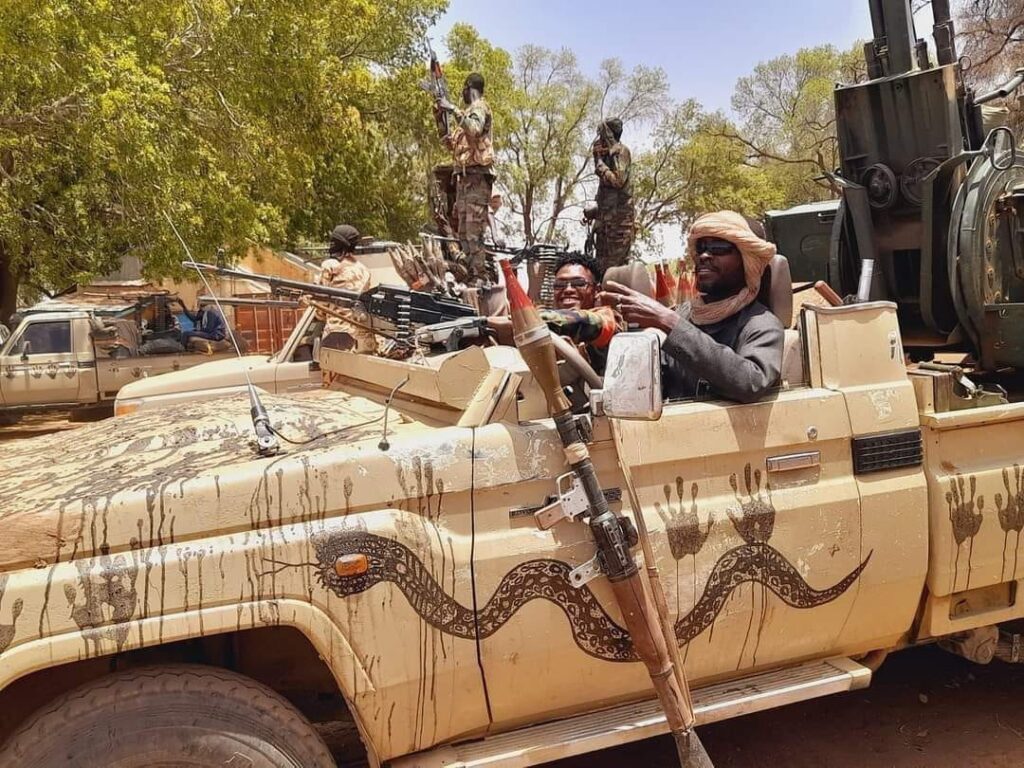
Armed fighters in Darfur in western Sudan (2024). Credit: Sudan War Monitor.
The Janjaweed militias of Darfur were the clearest expression of this logic. Recruited primarily from Arab pastoralist communities — the Rizeigat and allied groups — they were deployed against non-Arab populations during the Darfur conflict of the early 2000s with catastrophic consequences. The strategy worked, in the narrow sense that it suppressed the insurgency. It also produced what its architects apparently did not anticipate: a hardened, battle-experienced paramilitary force with its own command networks, its own grievances, and its own sense of what it was owed.
The RSF was not a departure from this system. It was the system formalised. In 2013, the Janjaweed were restructured into the Rapid Support Forces, given legal status, integrated into the national security architecture, and placed under a single commander. Hemedti, who had risen through the militia ranks, was now an official figure — attending state functions, signing agreements, representing Sudan abroad.
What the regime had created, it believed it could manage.
Three Thresholds
Once violence is handed over, it stops coming back — but not all at once. In the RSF’s case, control slipped away in three steps, each one making the next harder to reverse.
The first was independent resources. Darfur sits atop significant gold deposits, and the RSF established effective control over key mining areas, particularly around Jebel Amer. This gave the organisation a revenue stream that did not pass through Khartoum. It could pay its fighters, procure weapons, and sustain operations without depending on state transfers.
The second was an external sponsor. The United Arab Emirates became the RSF’s principal foreign backer — providing financial flows, weapons, and political cover. Gold extracted in Darfur moved through Chad and other transit points to UAE markets. In return, Hemedti offered the Emirates a reliable armed partner in a strategically important country. This relationship insulated the RSF from economic pressure that Khartoum might otherwise have applied.
The third was legitimacy — not the international kind, but the local kind that comes from distributing resources, providing order, and presenting oneself as an alternative authority. In the areas it controlled, the RSF built rudimentary governance structures. It positioned itself not merely as a military force but as a political actor with a constituency.
By the time the Merowe dispute crystallised in early 2023, all three conditions were in place. The state was no longer managing the RSF. It was competing with it — and it had spent a decade helping the RSF build the capacity to compete.
The Periphery that Reproduces the Centre
Hemedti has consistently framed the RSF as the voice of marginalised communities — the Rizeigat, the broader Baggara confederation, and peoples long excluded from Khartoum’s distribution of wealth and power. The grievance is real. Sudan’s post-colonial history is largely a history of the centre extracting from the periphery while returning little. Resentment runs deep and is historically earned.
But the RSF’s conduct in Darfur makes that framing impossible to accept as a complete picture. After the fall of El Fasher in October 2025, mass killings of Masalit and Fur civilians were documented by multiple independent sources — ethnic targeting that recalled the Janjaweed atrocities of 2003–2005, which international courts characterised as genocide.
This is the pattern, not the exception: a peripheral force, once it has the resources and autonomy to act freely, does not dismantle the logic of the centre. It reproduces it — with the identities of perpetrators and victims reversed, and without even the restraints of formal governance.
What the Current Situation Actually Shows
The standard narrative of a conflict without winners and without end does not fully fit the situation as the war approaches its third year. The SAF has made significant territorial advances — recapturing most of Khartoum, Omdurman, Bahri, and parts of Gezira and Sennar. A conventional army with air power and the capacity to mobilise has demonstrated that hierarchical military force still matters.
At the same time, the RSF holds most of Darfur and shows no sign of military collapse. Its external support remains intact, its resource base is intact, and it has begun constructing parallel administrative structures in areas it controls.
This is not chaos without shape. It is the outline of partition — a de facto division between a SAF-controlled centre and east, and an RSF-controlled west. Whether that partition eventually hardens into something permanent, or whether one side achieves a decisive military breakthrough, depends significantly on factors outside Sudan: whether UAE support for the RSF continues at current levels, whether the Russian naval base agreement translates into meaningful military assistance for the SAF, and whether any external actor chooses to apply serious pressure on the sponsors rather than the proxies.
What Stabilisation Actually Requires
Most peace efforts focus on negotiations between the SAF and the RSF. This misses the core issue.
The RSF did not become autonomous because of a negotiating failure. It became autonomous because it developed the ability to operate without the state — and that ability was built over a decade, step by step.
Any serious attempt at stabilisation would have to address the foundations of that autonomy directly:
— gold supply chains running out of Darfur
— financial flows through the UAE
— regional logistics networks through eastern Libya
These are not secondary details. They are what sustain the conflict. As long as they remain intact, agreements between the main parties are unlikely to hold — because the conditions that made those parties what they have remained unchanged.
*
Sudan is not just a war that spiralled out of control. It is a system in which control itself no longer returns. What was handed over cannot be taken back. And that is why the war continues.
The post Sudan’s War Was Not a Breakdown. It Was the System Working. appeared first on African Arguments.