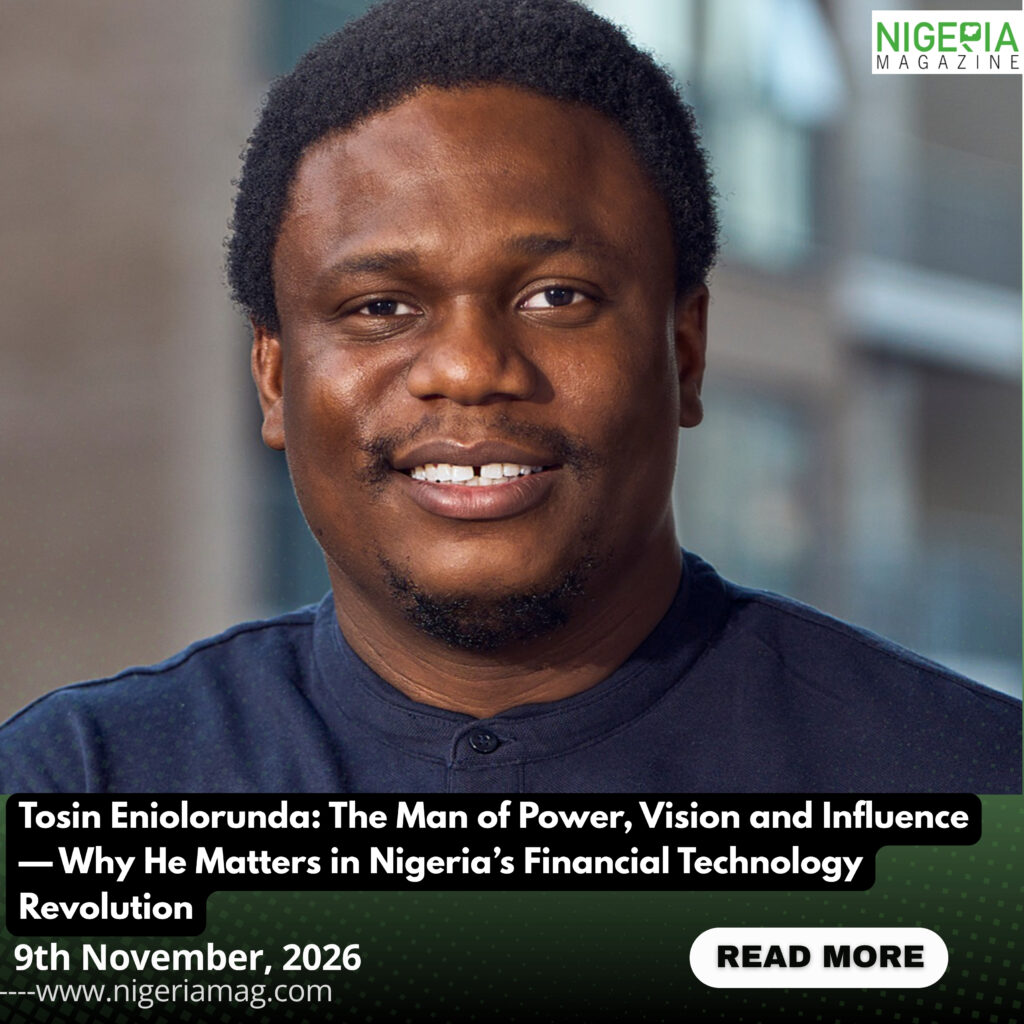
Tosin Eniolorunda: The Man of Power, Vision and Influence — Why He Matters in Nigeria’s Financial Technology Revolution ????????
By Moses Chibuike Ezechukwu An in-depth look at how Tosin Eniolorunda, founder of Moniepoint, has emerged as one of Nigeria’s influential technology entrepreneurs, transforming financial services for businesses and individuals while building a company with growing significance in Africa’s digital economy. Who Is Tosin Eniolorunda? In Nigeria’s growing technology industry, few entrepreneurs have built a […]
 Black News
By Moses Chibuike Ezechukwu
An in-depth look at how Tosin Eniolorunda, founder of Moniepoint, has emerged as one of Nigeria’s influential technology entrepreneurs, transforming financial services for businesses and individuals while building a company with growing significance in Africa’s digital economy.
Who Is Tosin Eniolorunda?
In Nigeria’s growing technology industry, few entrepreneurs have built a business with the kind of everyday visibility that Tosin Eniolorunda has achieved. His name may not be as familiar to the average Nigerian as those of some of the country’s wealthiest businessmen, but the company he leads has become part of everyday commercial life.
Eniolorunda is the co-founder and Group Chief Executive Officer of Moniepoint Inc., a financial technology company providing payment services, banking solutions, credit and business management tools. Its services support businesses ranging from small neighbourhood shops to larger commercial enterprises. (Moniepoint Inc.)
So, what makes him a man of power?
The answer goes beyond money. It lies in his ability to build technology, influence how businesses operate, attract investors and develop a company that plays an important role in Nigeria’s financial system.
His story also offers a useful lesson about modern power: in today’s economy, influence does not always come from owning oil wells, controlling political offices or inheriting a business empire. Sometimes, it comes from building the infrastructure that millions of people rely on.
His Greatest Strength Is Building Solutions to Real Problems
One of the most important aspects of Eniolorunda’s journey is his technical background.
He studied mechanical engineering at Obafemi Awolowo University before building a career in software development and financial technology. He subsequently worked at Interswitch, where he gained experience in developing payment technology and understanding the challenges facing financial institutions. (Nairametrics)
That experience helped prepare him for entrepreneurship.
In 2015, Eniolorunda and his former colleague Felix Ike established TeamApt, a company that developed technology solutions for financial institutions. The business later expanded into services that directly addressed the needs of merchants and consumers, eventually growing into the Moniepoint brand. (Nairametrics)
This transition is significant.
Rather than simply creating another technology product, the business moved towards solving problems that Nigerians encountered in their daily financial activities.
Small business owners needed reliable ways to receive payments. Customers wanted convenient access to financial services. Merchants needed better ways to manage transactions and keep their businesses running.
Eniolorunda’s business recognised these needs and developed products around them.
That is one of the foundations of his influence: the ability to identify a problem, build a solution and make that solution useful to a large market.
Moniepoint Has Given Him Significant Economic Influence
To understand Eniolorunda’s position in Nigeria’s business landscape, it is necessary to examine the company he has helped build.
Moniepoint’s influence extends beyond mobile applications. Its infrastructure supports digital payments, merchant banking, point-of-sale transactions and other financial services.
According to the company’s published 2025 year-in-review figures, Moniepoint served more than six million businesses and provided banking services to over 16 million individuals. The company also reported processing more than ₦30 trillion in transactions during the year. These are company-reported figures rather than independently audited conclusions presented here. (Moniepoint Year in Review)
Consider what those figures mean in practical terms.
A trader needs to receive payment for goods. A supermarket needs to process customer transactions. A pharmacy needs a convenient way to accept digital payments. A distributor needs to move money between accounts to maintain the supply of products.
When the infrastructure connecting these activities works reliably, businesses can operate more efficiently.
When it fails, the consequences can spread across numerous transactions and customers.
This is where Eniolorunda’s influence becomes particularly interesting. By leading a company operating at this scale, he helps shape the technology and services on which many businesses depend.
It does not mean he personally controls every transaction or determines Nigeria’s entire financial system. Rather, it means that the business he leads occupies an important position within the country’s digital payments ecosystem.
In a modern economy, that position represents considerable commercial influence.
He Understands the Importance of Small Businesses
Another reason Eniolorunda deserves attention is the company’s focus on small and medium-sized enterprises.
Nigeria’s economy is sustained by millions of entrepreneurs, including market traders, shop owners, wholesalers, restaurant operators and independent service providers.
Many of these businesses operate with limited resources. Access to credit can be difficult, financial records may be incomplete, and managing daily transactions can consume valuable time.
Moniepoint has attempted to address some of these challenges by combining payment services with business banking, lending and management tools. Its expansion into these areas reflects a broader understanding that merchants need more than a device for accepting payments. (Moniepoint Inc.)
For example, a provision store owner who receives digital payments and maintains better transaction records may find it easier to monitor sales and understand the business’s cash flow.
Access to appropriate credit may also help an eligible business owner purchase additional stock or expand operations.
These benefits are not automatic, and digital financial services cannot eliminate every challenge facing Nigerian entrepreneurs.
Nevertheless, they can provide tools that make business management easier.
This is an important part of Eniolorunda’s business strategy.
Instead of focusing exclusively on wealthy customers or large corporations, his company has built products for businesses that are central to everyday commerce.
That decision has helped connect its growth to the needs of a broad segment of the Nigerian economy.
His Success Demonstrates the Power of Technology in Africa
For years, discussions about Africa’s economic potential have often centred on natural resources, agriculture and traditional industries.
Those sectors remain important, but technology has created another route through which African entrepreneurs can build influential companies.
Eniolorunda’s journey illustrates this possibility.
His business began with technology solutions for financial institutions before expanding into a much larger financial services operation.
In October 2024, Moniepoint announced a $110 million funding round that reportedly valued the company at more than $1 billion, earning it unicorn status. The investment attracted international attention to Nigeria’s fintech sector. (Financial Times)
Reaching that valuation was significant because it demonstrated that a company built around solving financial problems in Nigeria could attract major international investment.
However, a company’s valuation should not be confused with its founder’s personal wealth.
A valuation reflects the estimated worth of the business under particular investment conditions. It does not reveal exactly how much the founder owns, how much cash he has available or the value of his personal assets.
Nevertheless, building a company that attracts investment at this level is a substantial entrepreneurial achievement.
It also sends a message to younger Nigerians: expertise, problem-solving and a willingness to build for a large market can create opportunities beyond traditional career paths.
His Influence Extends Beyond Business Transactions
Power is not measured by money alone.
It can also be measured by the ability to influence how people think, how organisations operate and how future entrepreneurs approach their work.
In May 2026, Channels Television reported that Eniolorunda spoke at The Platform Nigeria about self-mastery, goal-setting and the importance of building organisational structures around business objectives. He also discussed the internal challenges entrepreneurs face, including anxiety and the need for clarity of purpose. (Channels Television)
These themes offer another perspective on his leadership.
Building a successful company requires more than identifying a profitable idea. It requires making difficult decisions, assembling capable teams, maintaining operational discipline and responding to changing market conditions.
It also requires accepting that a founder cannot personally perform every task as the organisation grows.
For Nigerian entrepreneurs, this is a particularly valuable lesson. A business may begin with the founder’s individual talent, but long-term growth depends on systems, people and processes that can operate beyond one person’s direct involvement.
Eniolorunda’s experience provides an example of why organisational development matters alongside technical expertise.
His public influence, therefore, comes partly from the business he has built and partly from the lessons other entrepreneurs can draw from that experience.
Why He Can Be Described as a Man of Power
The phrase man of power can mean different things depending on the context.
In politics, it may describe someone who influences government decisions. In traditional business, it may refer to a person who controls substantial assets or commands a large corporate network.
In technology, power can take a different form.
It can come from creating a platform that businesses use every day, employing people, attracting capital, developing essential infrastructure and influencing the direction of an industry.
By this definition, Eniolorunda has established a meaningful position in Nigeria’s financial technology sector.
His influence is built on several interconnected factors:
Technical expertise: His background in software and financial technology helped prepare him to build products for the financial services industry.
Entrepreneurial vision: He helped transform a technology services business into a major financial technology company.
Commercial reach: Moniepoint serves millions of businesses and individuals, according to its published figures.
Investor confidence: The company’s fundraising history demonstrates that international investors have been willing to commit substantial capital to its growth.
Economic relevance: Its services support payments and financial operations across numerous businesses.
Together, these factors explain why Eniolorunda deserves attention when discussing influential Nigerian entrepreneurs.
However, a balanced analysis must recognise that his success also reflects the work of co-founders, employees, investors, business partners, regulators and customers. Building a major company is rarely the achievement of one individual alone.
His leadership matters, but the organisation’s collective effort matters too.
The Challenges That Will Test His Leadership
Despite its achievements, Moniepoint faces the same fundamental question confronting every growing financial technology company: how can it maintain customers’ trust while expanding its operations?
Financial services depend heavily on reliability, security and accountability.
Customers expect transactions to be processed correctly. Merchants need dependable access to their money. Businesses must protect themselves against fraud, while financial institutions must comply with relevant regulations.
As a company grows, these responsibilities become more demanding.
Competition is another challenge. Nigeria’s fintech market includes banks, payment processors and digital financial services companies competing for customers, merchants and business opportunities.
Moniepoint must continue improving its products, protecting customer information and maintaining service quality if it wants to sustain its position.
Expansion beyond Nigeria also introduces additional complexities, including different regulatory environments, customer expectations and competitive conditions.
These challenges are important because influence built on trust can be difficult to maintain if customers begin to question the reliability of the services they depend on.
Ultimately, Eniolorunda’s legacy will not be determined by growth figures alone. It will also depend on the company’s ability to remain useful, responsible and resilient over time.
More Than a Successful Entrepreneur
Tosin Eniolorunda’s story demonstrates that modern power can be built through knowledge, technology and the ability to solve problems at scale.
He has helped build a company that supports financial transactions and business operations across Nigeria. Through Moniepoint, he has contributed to the growth of digital financial services and demonstrated the commercial potential of technology developed to address African market needs.
His journey is particularly relevant to young Nigerians who want to build businesses in a difficult economic environment.
It shows the value of developing expertise, understanding customers, solving practical problems and building organisations capable of growing beyond their founders.
But the most important lesson may be that influence is not simply about becoming wealthy or controlling a large company. It is also about creating something that people find useful and that can continue to deliver value over time.
So, is Tosin Eniolorunda a man of power?
From the perspective of entrepreneurship, technology and economic influence, the answer is yes. His position comes not from political office or public controversy, but from building a business with a substantial role in Nigeria’s financial technology ecosystem.
His greatest achievement may ultimately be the example he sets: that an idea grounded in technical knowledge, practical problem-solving and disciplined execution can grow into an organisation with national significance.
For Nigeria’s next generation of entrepreneurs, that is a lesson worth paying attention to.