Uganda Govt Confirms Shutting Down Media Houses
By Black Star News Photos: YouTube Screenshots In the immediate aftermath of the Gen Yoweri Museveni-chaired June 29, 2026 first Cabinet meeting of his newly-constituted government for the 2026–2031 term, Government has come out to own up to the events of June 28 that saw a dramatic closure of NTV-Uganda, Daily Monitor newspaper and their affiliated media outlets. The cabinet meeting marks the official start of implementing the ruling National Resistance Movement (NRM) administration’s agenda for the next five years. According to a release from the Uganda Media Centre, the meeting follows the swearing-in of the new administration on June 8, 2026, and a 10-day Cabinet Induction Retreat held at the National Leadership Institute (NALI), Kyankwanzi. The retreat which was officially opened by Museveni on June 15, 2026, was designed to orient both newly-appointed and returning ministers on government priorities, leadership principles, public service ethics and the strategic direction of the new administration. It also provided an opportunity for Cabinet members to align themselves with the NRM’s development agenda and the government’s strategic priorities for the 2026–2031 term. The June 30 press statement signed by the newly-appointed ICT and National Guidance minister, Justine Lumumba Kasule says military raid and eventual closure of the media outlets were sanctioned by Gen Museveni, and that “government will inform the public once the inquiry has been concluded”. According to the minister, “The events of 28th June 2026 that led to the disruption of operations at Nation Media Group were occasioned by a Security-Led Inquiry instructed by HE Yoweri Kaguta Museveni, President of the Republic of Uganda. The inquiry involves the Uganda Peoples’ Defence Forces, the Criminal Investigations Directorate at the Uganda Police Force, other security agencies and experts.” The Nation Media Group outlets were closed on June 28 wee morning. Subsequent of which Museveni’s son, Gen Muhoozi Kainerugaba, the Senior Presidential Advisor on Special Operations who heads the military and the Patriotic League of Uganda (PLU); a political pressure group, then tweeted, thus; “NTV and Monitor are being shut down today!…Both NTV and Monitor will not reopen without my permission…In Uganda, I DO NOT believe in a free press. The press should be guided by cadres of the revolution.” Yet more PLU tweets would follow later. In the early morning of June 28, PLU spokesman, veteran journalist Andrew Mwenda, posted saying PLU leadership would reopen the media houses. “I have just held discussions with Gen Muhoozi Kainerugaba @mkainerugaba and we, as leaders of PLU, have agreed that we shall reopen both Daily Monitor and NTV soon. However, we shall first have discussions with the management of both sister companies. I will inform them when we can have this meeting.” Always lying in wait, the PLU muscular statement prompted past-immediate government spokesperson and ruling NRM MP representing Older Persons from Eastern Uganda, Ofwono Opondo, into asking who ordered NTV Uganda and Daily Monitor to shut down. Was it PLU of Gen Muhoozi Kainerugaba or the NRM government of his father, Gen Museveni? “Was it #PLU or @GovUganda that took the action to close the two media houses? Or maybe let us know if the @NRMOnline that Ugandans elected on 15th January 2026 is no more, and we just settle down?” veteran journalist-turned-politician Ofwono Opondo asks. Uganda went for the general elections in January. Ofwono Opondo wonders where PLU derives its powers to run affairs of the country and also questions what law NTV Uganda and Daily Monitor could have broken, arguing that “even if they are accused of bias, media bias is not, in itself, a criminal offence warranting their closure”. Ofwono Opondo goes on to ask: “…Is it an offense or crime in Ugandan law books for a media house or person to be biased against the state or gov[ernment]? Please cite one.” The Leader of the Opposition in Parliament, Joel Ssenyonyi, addressed the Speaker in the House on the matter on June 30. “Rt Hon Speaker, you made it clear in your remarks shortly after being declared Speaker, that the media should be able to operate freely and those media houses that had been banned from accessing Parliament eventually returned. Today we see the same media houses belong[ing] to Nation Media Group being shut down arbitrarily because they are holding us leaders accountable,” Ssenyonyi told new Speaker Jacob Marksons Oboth. Oboth’s predecessor, Anita Among, had banned Nation Media Group from covering Parliament. “UCC [Uganda Communications Commission] which is the regulatory body has said it does not know the circumstances under which the closure happened, but that it will investigate. Colleague leaders, it is in the best interest of all of us to see that institutions are functional, and that the rule of law is respected. May we all,” Ssenyonyi sought to explain
 Black News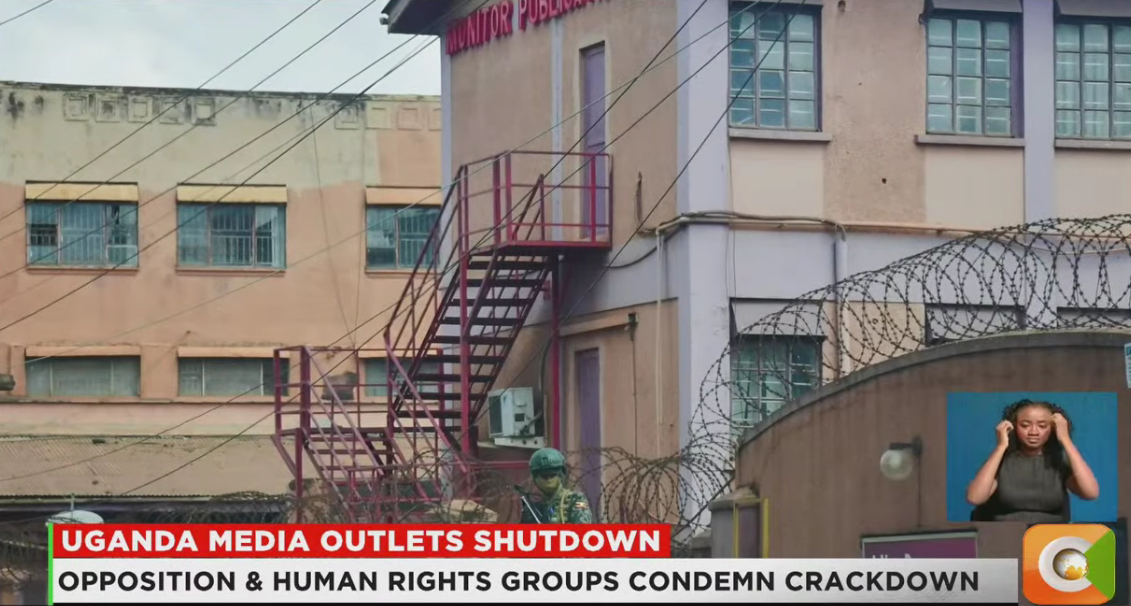

By Black Star News
Photos: YouTube Screenshots
In the immediate aftermath of the Gen Yoweri Museveni-chaired June 29, 2026 first Cabinet meeting of his newly-constituted government for the 2026–2031 term, Government has come out to own up to the events of June 28 that saw a dramatic closure of NTV-Uganda, Daily Monitor newspaper and their affiliated media outlets.

The cabinet meeting marks the official start of implementing the ruling National Resistance Movement (NRM) administration’s agenda for the next five years. According to a release from the Uganda Media Centre, the meeting follows the swearing-in of the new administration on June 8, 2026, and a 10-day Cabinet Induction Retreat held at the National Leadership Institute (NALI), Kyankwanzi. The retreat which was officially opened by Museveni on June 15, 2026, was designed to orient both newly-appointed and returning ministers on government priorities, leadership principles, public service ethics and the strategic direction of the new administration. It also provided an opportunity for Cabinet members to align themselves with the NRM’s development agenda and the government’s strategic priorities for the 2026–2031 term.
The June 30 press statement signed by the newly-appointed ICT and National Guidance minister, Justine Lumumba Kasule says military raid and eventual closure of the media outlets were sanctioned by Gen Museveni, and that “government will inform the public once the inquiry has been concluded”.
According to the minister, “The events of 28th June 2026 that led to the disruption of operations at Nation Media Group were occasioned by a Security-Led Inquiry instructed by HE Yoweri Kaguta Museveni, President of the Republic of Uganda. The inquiry involves the Uganda Peoples’ Defence Forces, the Criminal Investigations Directorate at the Uganda Police Force, other security agencies and experts.” The Nation Media Group outlets were closed on June 28 wee morning. Subsequent of which Museveni’s son, Gen Muhoozi Kainerugaba, the Senior Presidential Advisor on Special Operations who heads the military and the Patriotic League of Uganda (PLU); a political pressure group, then tweeted, thus; “NTV and Monitor are being shut down today!…Both NTV and Monitor will not reopen without my permission…In Uganda, I DO NOT believe in a free press. The press should be guided by cadres of the revolution.”
Yet more PLU tweets would follow later. In the early morning of June 28, PLU spokesman, veteran journalist Andrew Mwenda, posted saying PLU leadership would reopen the media houses. “I have just held discussions with Gen Muhoozi Kainerugaba @mkainerugaba and we, as leaders of PLU, have agreed that we shall reopen both Daily Monitor and NTV soon. However, we shall first have discussions with the management of both sister companies. I will inform them when we can have this meeting.”
Always lying in wait, the PLU muscular statement prompted past-immediate government spokesperson and ruling NRM MP representing Older Persons from Eastern Uganda, Ofwono Opondo, into asking who ordered NTV Uganda and Daily Monitor to shut down. Was it PLU of Gen Muhoozi Kainerugaba or the NRM government of his father, Gen Museveni? “Was it #PLU or @GovUganda that took the action to close the two media houses? Or maybe let us know if the @NRMOnline that Ugandans elected on 15th January 2026 is no more, and we just settle down?” veteran journalist-turned-politician Ofwono Opondo asks. Uganda went for the general elections in January.
Ofwono Opondo wonders where PLU derives its powers to run affairs of the country and also questions what law NTV Uganda and Daily Monitor could have broken, arguing that “even if they are accused of bias, media bias is not, in itself, a criminal offence warranting their closure”. Ofwono Opondo goes on to ask: “…Is it an offense or crime in Ugandan law books for a media house or person to be biased against the state or gov[ernment]? Please cite one.”
The Leader of the Opposition in Parliament, Joel Ssenyonyi, addressed the Speaker in the House on the matter on June 30.
“Rt Hon Speaker, you made it clear in your remarks shortly after being declared Speaker, that the media should be able to operate freely and those media houses that had been banned from accessing Parliament eventually returned. Today we see the same media houses belong[ing] to Nation Media Group being shut down arbitrarily because they are holding us leaders accountable,” Ssenyonyi told new Speaker Jacob Marksons Oboth. Oboth’s predecessor, Anita Among, had banned Nation Media Group from covering Parliament.
“UCC [Uganda Communications Commission] which is the regulatory body has said it does not know the circumstances under which the closure happened, but that it will investigate. Colleague leaders, it is in the best interest of all of us to see that institutions are functional, and that the rule of law is respected. May we all,” Ssenyonyi sought to explain, “regardless of our different political parties, strive to see this happen!”
Museveni’s son-in-law, Odrek Rwabwogo, who chairs the Presidential Advisory Committee on Exports and Industrial Development, has so far expressed “extreme worries to the core about the direction the country is taking”. He asks Ugandans to unite and speak out. “Uganda’s greatest threats are not always floods, wars, or economic shocks. Sometimes they are hidden in how we think, lead, execute and organize ourselves. I share three silent threats Uganda must confront: Weak execution, Elite disunity and Declining public leadership,” Rwabwogo said on June 27.