Egypt's most promising gold project, once considered too risky by a Canadian miner, launches soon
The Egyptian Marawat Gold Project, once labelled as risky by Canadian miner Aton Resources, is set to begin production in less than a year.
 Black News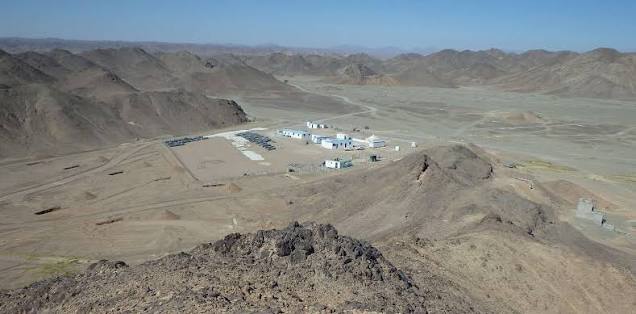
![Egypt's most promising gold project, once considered too risky by a Canadian miner, launches soon [Source: Aton Resources]](https://ocdn.eu/pulscms/MDA_/0cad72a933987872e5484cc1628011fc.jpg)
The Egyptian Marawat Gold Project, once labelled as risky by Canadian miner Aton Resources, is set to begin production in less than a year.
- The Marawat Gold Project in Egypt, once seen as risky by Aton Resources, is scheduled to start production in 2027.
- It is a 50/50 joint venture between EMRA and Canadian company Aton Resources, covering about 57 square kilometers in the Eastern Desert.
- Since commencing exploration in 2009, Aton has identified around 160,000 ounces of gold plus other minerals such as silver, copper, and zinc.
- Aton faced regulatory challenges in Egypt, highlighting the need for both geological expertise and perseverance in navigating complex local systems and regulations.
The project, which is primarily intended to attract mining investments and provide direct and indirect job opportunities, will begin production in 2027, according to a statement by the Ministry of Petroleum and Mineral Resources.
DON’T MISS THIS: Egypt inaugurates a major industrial complex with plans for a €25-40 million railway wagon factory
Via the statement, the ministry also revealed that the project is one of Egypt's most promising gold mining ventures.
The project, located in the Arabian-Nubian Shield in the Eastern Desert, is being developed through a strategic cooperation between EMRA and the Canadian mining company mentioned earlier.
The project, which is a 50/50 joint venture between both partners, spans a concession area of about 57 square kilometers.
Aton commenced exploration activities in 2009, subsequent to securing the Abu Marawat concession in 2007.
Since then, the corporation has completed extensive drilling campaigns, delineating an estimated resource of approximately 160,000 ounces of gold, alongside silver, copper, and zinc.
According to Geologist Yasser Ramadan, Chairman of the Egyptian Mineral Resources Authority (EMRA), the Abu Marawat project serves as a viable model for the Ministry of Petroleum and Mineral Resources' strategy to establish contemporary mining operations.
This approach balances the optimal utilization of mineral resources with environmental protection, thereby enhancing production and increasing the value added to the national economy, as seen on the website of the State Information Service.
He further emphasized the strong endorsement of the Minister of Petroleum and Mineral Resources, Karim Badawi, who regards the mining sector as a critical pillar of Egypt's economic development.
Furthermore, he reaffirmed EMRA's commitment to providing all necessary facilitation and overcoming operational challenges to ensure the project's timely execution in accordance with the highest technical and environmental standards.
This project, which was originally slated to begin production midway into 2026, once presented a slight concern for its Canadian partner.
Challenges faced by the Canadian miner in Egypt
The Canadian mining journal reported that Aton Resources stood at the edge of achieving what few foreign companies have accomplished in Egypt: commercial gold production, despite the perils of frontier mining.
![Abu Marawat deposit [Source: Aton Resources]](https://ocdn.eu/pulscms/MDA_/b8d159f732b6a53f0316fc61537dbec8.jpg)
"We've been in Egypt a long time, and we've seen the system evolve," Mark Campbell, Aton's late CEO, said in a past interview.
"It hasn't always been easy. We've dealt with regulatory delays, changes to mining law, and the usual challenges that come with working in a developing market. But we stayed because we believe in the geology and, increasingly, in the direction of reform."
According to Peter Marrone, the CEO of the Canadian firm, Allied Gold Corporation, Egypt's geology draws investors, but the larger system, which includes governance standards, official engagement, and regulatory consistency, creates major obstacles.
"Investors need to know the rules are going to hold over time," he said.
"The rocks are promising, but without predictability and transparency, even technically simple projects can become complicated very quickly," he added.
Aton's nearly two-decade navigation of Egypt's regulatory framework illustrates a fundamental reality of frontier mining: success demands equivalent measures of political perseverance and geological expertise.
The company's experience demonstrates that while technical proficiency is indispensable, it represents only one facet of the total requirements.
The remainder entails navigating cultural nuances, fostering inter-agency governmental relationships, and maintaining rigorous fiscal discipline throughout protracted development cycles that can challenge the resolve of even the most patient investors.