“Emotionally Disturbed Person”: NYPD Footage From Investigation Into Death Of Adrian Cevallos Released
Photos: Body-Cams NEW YORK – New York Attorney General Letitia James today released footage from two body-worn cameras that her office obtained as part of its ongoing investigation into the death of Adrian Cevallos, who died on August 3, 2024 following an encounter with members of the New York City Police Department (NYPD) in Queens. Warning: These videos contain content that viewers may find disturbing. At 8:36 p.m. on August 3, NYPD officers responded to 911 calls reporting what the NYPD refers to as an “emotionally disturbed person” on 62nd Street between 53rd Avenue and 53rd Drive in Queens. When officers arrived, they encountered Mr. Cevallos. Video appears to show that Mr. Cevallos attempted to strike one of the officers, and the officers attempted to place him in handcuffs. During the struggle to handcuff Mr. Cevallos, one officer deployed his Taser. Mr. Cevallos became unresponsive in an ambulance on the way to a hospital and was pronounced dead at the hospital. The Office of Special Investigation (OSI) of the Attorney General’s Office released footage from two body-worn cameras that officers were equipped with during the incident. The release of this footage follows Attorney General James’ directive that camera footage obtained by her office during an OSI investigation be released to the public to increase transparency and strengthen public trust in these matters. Pursuant to New York State Executive Law Section 70-b, OSI assesses every incident reported to it where a police officer or a peace officer, including a corrections officer, may have caused the death of a person by an act or omission. Under the law, the officer may be on-duty or off-duty, and the decedent may be armed or unarmed. Also, the decedent may or may not be in custody or incarcerated. If OSI’s assessment indicates an officer may have caused the death, OSI proceeds to conduct a full investigation of the incident. The release of this footage is not an expression of any opinion as to the guilt or innocence of any party in a criminal matter or any opinion as to how or whether any individual may be charged with a crime. Editor’s Note: After you watch these two videos, ask yourself this question: why did one of these officers think it was necessary to Tase a seemingly intoxicated Mr. Cevallos—who is barely able to stand up, while the others are tackling him? Is it because these cops just love pulling anything with a trigger? In the state this man was in, isn’t it ridiculous to tell us he “attempted to strike one of the officers.” Is that why they attempted to arrest him, or was it for something else? It is doubtful the 911 caller thought these cops would end up body-slamming and eventually killing an “emotionally disturbed person.” Why was there not mental health professionals dispatched here? It will be interesting to see if the Taser was a factor in Mr. Cevallos’ death. We also often don’t really know what happened in the redacted portions of these videos.
 Black News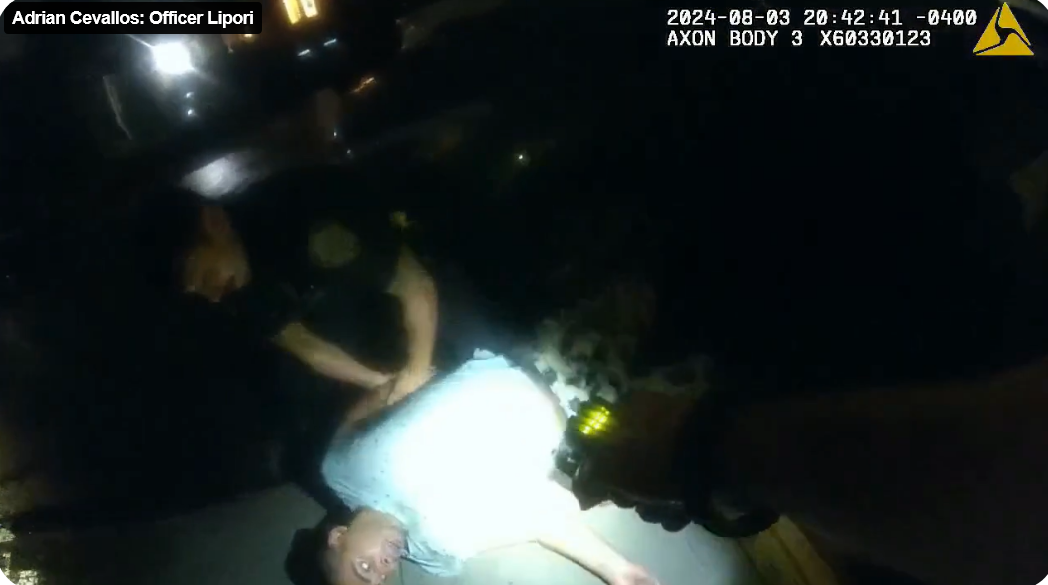


Photos: Body-Cams
NEW YORK – New York Attorney General Letitia James today released footage from two body-worn cameras that her office obtained as part of its ongoing investigation into the death of Adrian Cevallos, who died on August 3, 2024 following an encounter with members of the New York City Police Department (NYPD) in Queens.
Warning: These videos contain content that viewers may find disturbing.

At 8:36 p.m. on August 3, NYPD officers responded to 911 calls reporting what the NYPD refers to as an “emotionally disturbed person” on 62nd Street between 53rd Avenue and 53rd Drive in Queens. When officers arrived, they encountered Mr. Cevallos. Video appears to show that Mr. Cevallos attempted to strike one of the officers, and the officers attempted to place him in handcuffs. During the struggle to handcuff Mr. Cevallos, one officer deployed his Taser. Mr. Cevallos became unresponsive in an ambulance on the way to a hospital and was pronounced dead at the hospital.
The Office of Special Investigation (OSI) of the Attorney General’s Office released footage from two body-worn cameras that officers were equipped with during the incident. The release of this footage follows Attorney General James’ directive that camera footage obtained by her office during an OSI investigation be released to the public to increase transparency and strengthen public trust in these matters.
Pursuant to New York State Executive Law Section 70-b, OSI assesses every incident reported to it where a police officer or a peace officer, including a corrections officer, may have caused the death of a person by an act or omission. Under the law, the officer may be on-duty or off-duty, and the decedent may be armed or unarmed. Also, the decedent may or may not be in custody or incarcerated. If OSI’s assessment indicates an officer may have caused the death, OSI proceeds to conduct a full investigation of the incident.
The release of this footage is not an expression of any opinion as to the guilt or innocence of any party in a criminal matter or any opinion as to how or whether any individual may be charged with a crime.

Editor’s Note: After you watch these two videos, ask yourself this question: why did one of these officers think it was necessary to Tase a seemingly intoxicated Mr. Cevallos—who is barely able to stand up, while the others are tackling him? Is it because these cops just love pulling anything with a trigger? In the state this man was in, isn’t it ridiculous to tell us he “attempted to strike one of the officers.”
Is that why they attempted to arrest him, or was it for something else? It is doubtful the 911 caller thought these cops would end up body-slamming and eventually killing an “emotionally disturbed person.”
Why was there not mental health professionals dispatched here?
It will be interesting to see if the Taser was a factor in Mr. Cevallos’ death. We also often don’t really know what happened in the redacted portions of these videos.