Life Explodes in the Serengeti: Discovering Calving Season
By Harriet James The Great Wildebeest Migration is one of the most spectacular wildlife events in the global tourism calendar. Driven by rainfall and the search for fresh grazing areas, over 1.5 million wildebeest move across the Serengeti–Mara ecosystem of Tanzania and Kenya through distinct seasonal phases. These include the calving season in the southern […] The post Life Explodes in the Serengeti: Discovering Calving Season appeared first on Nomad Africa Travel & Magazine.
 Black News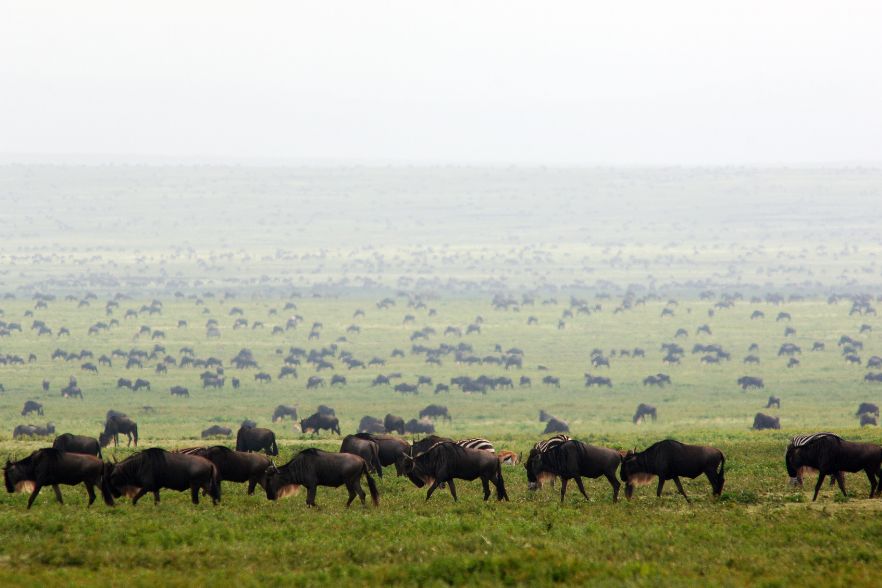
By Harriet James
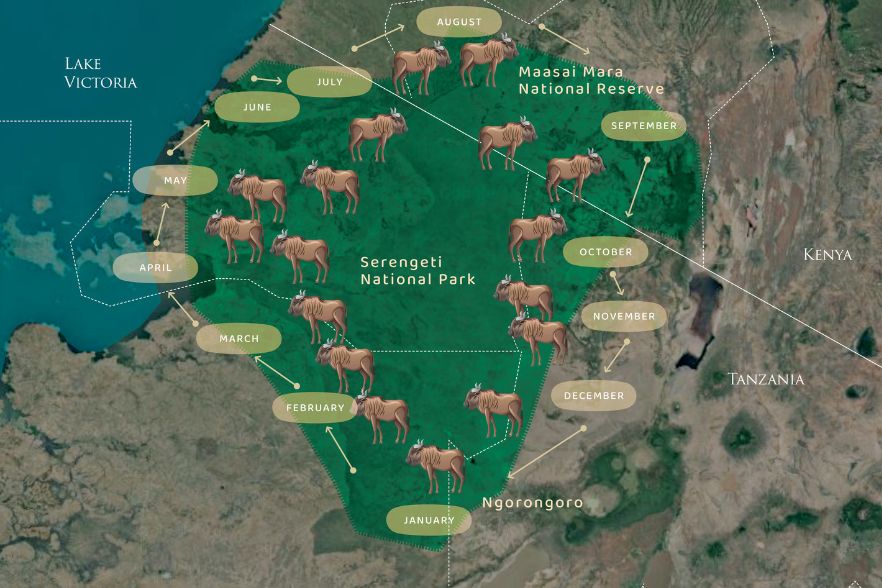
The Great Wildebeest Migration is one of the most spectacular wildlife events in the global tourism calendar. Driven by rainfall and the search for fresh grazing areas, over 1.5 million wildebeest move across the Serengeti–Mara ecosystem of Tanzania and Kenya through distinct seasonal phases. These include the calving season in the southern Serengeti and Ndutu plains between January and March, when thousands of calves are born each day; the long trek north through the central and western Serengeti from April to June; the dramatic Grumeti River crossings in western Tanzania around May and June; and the iconic Mara River crossings between July and October, as the herds enter Kenya’s Maasai Mara. As the short rains return in November and December, the herds begin their journey back south, completing a timeless cycle that shapes both the landscape and the predators that follow.
The most famous phase is the iconic Mara River crossing, which draws thousands of travellers to the Maasai Mara to witness one of nature’s most dramatic spectacles. Yet while these crossings will always hold their allure, the future of safari travel may lie in moments like the calving season – a quieter, more intimate period that’s grounded in a deep sense of respect for the rhythms of the wild.
Where life begins
Calving season is the period when the Great Migration reaches its most tender and dramatic phase, as hundreds of thousands of wildebeest give birth across the southern Serengeti plains. It is called calving season because this is when the majority of the herd delivers their young, often within a few short weeks, creating one of the highest concentrations of newborn animals anywhere in the world. The short grass plains provide rich nutrients for lactating mothers, while the open landscape allows them to spot predators from a distance. During this time, not only wildebeest but also zebras and gazelles give birth, filling the plains with fragile calves taking their first steps. This sudden explosion of life also draws predators like lions, cheetahs, hyenas, and leopards, making the season a powerful, emotional display of survival, instinct, and balance in nature.
The first time I witnessed this, I felt as if I had stepped into the very heartbeat of the Serengeti. We left before sunrise with my guide, Ayoub Hosea, from Asilia Dunia Camp, the sky still washed in pale blue as we drove towards a place Ayoub called Korongo la Kujificha, the Hidden Valley. The journey was long, quiet, and filled with anticipation. We were also battling tsetse flies, a sharp reminder that I had forgotten one golden rule of the bush: never wear dark clothes, which only makes you more visible to these relentless insects.
We arrived at around midday and witnessed mothers forming protective circles around their calves, creating living barricades. The newborns were a soft yellow-brown, some wobbling unsteadily, others resting under a spreading acacia tree. A few suckled quietly while their mothers scanned the horizon. Watching this fragile beginning felt like witnessing the Earth breathe.
“They love this area because it is open and safe for giving birth,” Ayoub explained. “There is plenty of grass and water. They need strength for their calves.”
We continued south toward Ndutu near the Ngorongoro Conservation Area. Tens of thousands of not just wildebeests, but also zebras, gnus, and gazelles were there grazing – some expectant, others guiding their newborns through the tall grass.
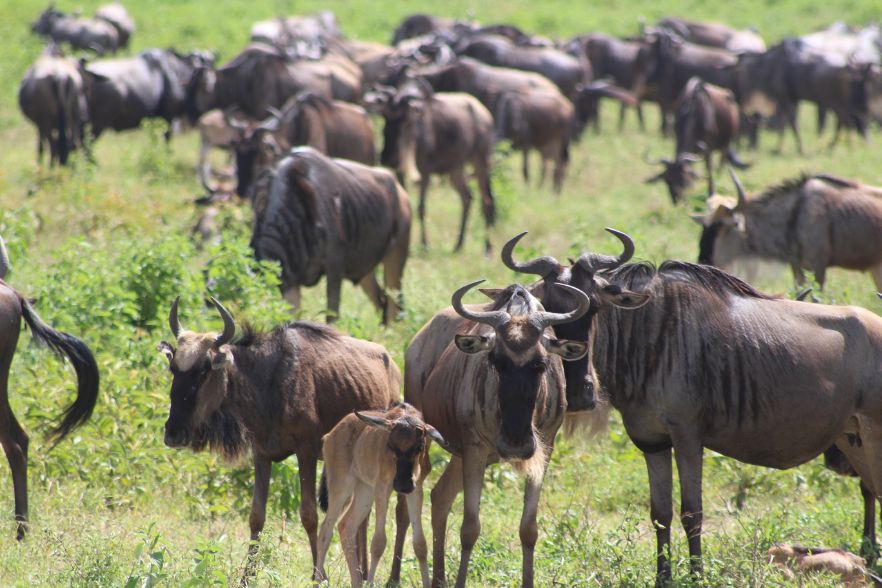
They congregate here to take advantage of abundant fresh grazing land and water, which supports both mothers and newborns. Synchronized births in large herds also reduce individual predation risk, increasing the survival chances of their young. The gnus, zebras, and gazelles all move together because they cannot easily camouflage. When danger comes, they stomp, charge, and listen for alarm calls from birds and baboons. As they graze, they fertilize the soil with their droppings, feeding new grass. They remain here for nearly three months because the volcanic soils are rich in nutrients, perfect for calves to build strength and for mothers to produce milk.
The Other Side of Life
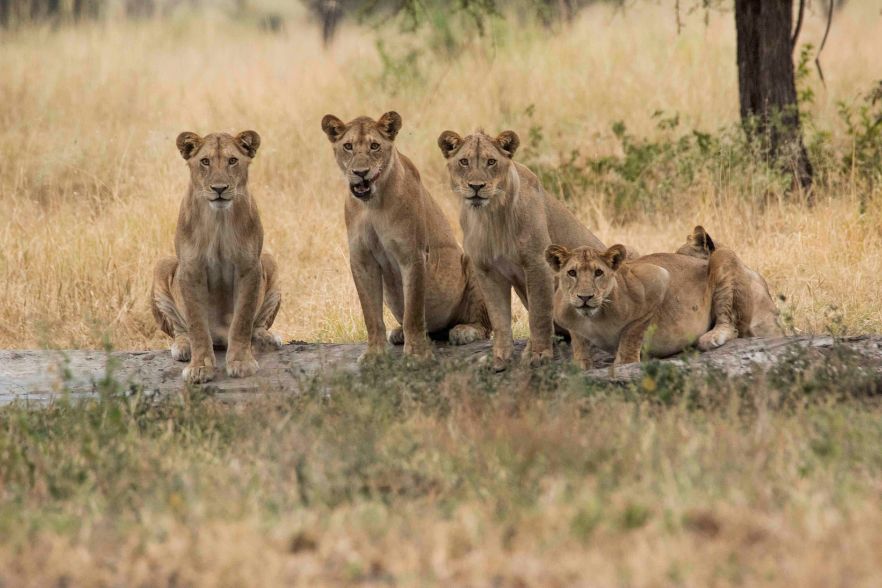
At one point, Ayoub spotted something dark in the grass—a dead gnu. Flies hovered thickly around it. He explained that placentas left behind during calving attract insects. Above us, Rüppell’s griffon vultures descended, jostling for position. “They are fighting because they can’t remove the tough skin,” he told me in Swahili. He explained that their beaks are not strong enough to tear skin, so they begin with softer parts like the eyes. Yet they play a vital role. “They clean the ecosystem. Disease cannot spread because vultures are immune,” he said.
The calving season is a reminder of how life renews itself, even in harsh conditions. It shows us that survival is fragile, and that every choice we make as visitors shapes what remains for future generations.
Wildebeest are not just travellers; they are architects of this ecosystem. By the end of March, the southern grasslands will be bare. The herds will rise again and march north through the central Serengeti, toward the dramatic river crossings of the dry season. This is the chapter most people know, the chaos of the Mara River between July and October.
The Cost of Popularity
The Serengeti, known in the Maasai language as the land that moves forever, feels like an endless twin of the Maasai Mara, only vaster. According to Tanzania tourism data, nearly 150,000 to 200,000 people visit the Serengeti each year, many drawn by this moment of renewal. National Geographic estimates that between 300,000 and 500,000 calves are born annually, with nearly 8,000 arriving each day. But that fame comes at a cost. During the famed Mara River crossing, dozens of safari vehicles cluster around the crossing points. Engines hum, cameras click, and the wildlife grows visibly stressed. Amid this popularity, the magic of the moment risks being overshadowed.
This is why the Serengeti calving season matters now more than ever. It offers an alternative that is quieter, deeper, and equally powerful. It spreads tourism across the migration calendar, easing pressure on the Mara while reminding us that the story of the wildebeest is not only about survival, but also about beginnings.
Yet even as we talk about calving, it’s sad to note that their numbers are declining. A decade ago, the herds numbered 1.5 million, but they are now closer to 1.2 million. Human population growth, shrinking habitats, and climate change – which is bringing unpredictable droughts and floods – threaten their future. These dangers were foreseen in the 1960 documentary Serengeti Shall Not Die, which urged the world to protect this living system.
The future of both the Mara and the Serengeti depend not just on park rangers and conservation policies, but on how we visitors choose to experience these places. Responsible safari travel begins with respect for wildlife and space. Animals need room to rest, feed, and protect their young without being surrounded by vehicles. Ethical operators understand this and limit how close they go and how long they stay. The best guides know that sometimes the most respectful thing to do is simply to watch from a distance. It also means choosing experiences that support conservation and local communities. Park fees, conservancy contributions, and community-run lodges fund anti-poaching efforts, ranger salaries, habitat protection, and education programmes. When travellers stay in places that give back, their presence becomes part of the solution, not the problem.
Simple actions matter too. Staying on designated tracks protects fragile grasslands. Reducing plastic waste, keeping noise low, and following park rules all help preserve the wilderness for the animals who depend on it. Learning the story of the migration before arriving deepens the experience, turning it from sightseeing into understanding.
The post Life Explodes in the Serengeti: Discovering Calving Season appeared first on Nomad Africa Travel & Magazine.









![[EXPRESS] CRÉATION DE MONNAIE UNIQUE : Le lancement de l’Eco en 2027 confirmé par la CEDEAO (RTS)](https://nations-sn.com/wp-content/uploads/2026/07/IMG-20260722-WA0004.jpg)