Red, blue and black: They’re playing old games with new maps
This op-ed challenges readers to look beyond the political theater surrounding redistricting and voting rights and ask a more uncomfortable question: What tangible gains have Black Americans received from decades of electoral representation? Using redistricting battles in the South as a backdrop, Leah Harmony argues that while protecting Black voting power remains essential, political parties too often mobilize around symbolism and seat preservation while failing to address the issues that continue to shape everyday Black life — housing, wealth building, education and economic stability. At its core, the piece is a call to distinguish between political rhetoric and measurable outcomes, and to build power that extends beyond election season. The post Red, blue and black: They’re playing old games with new maps appeared first on San Francisco Bay View.
 Black News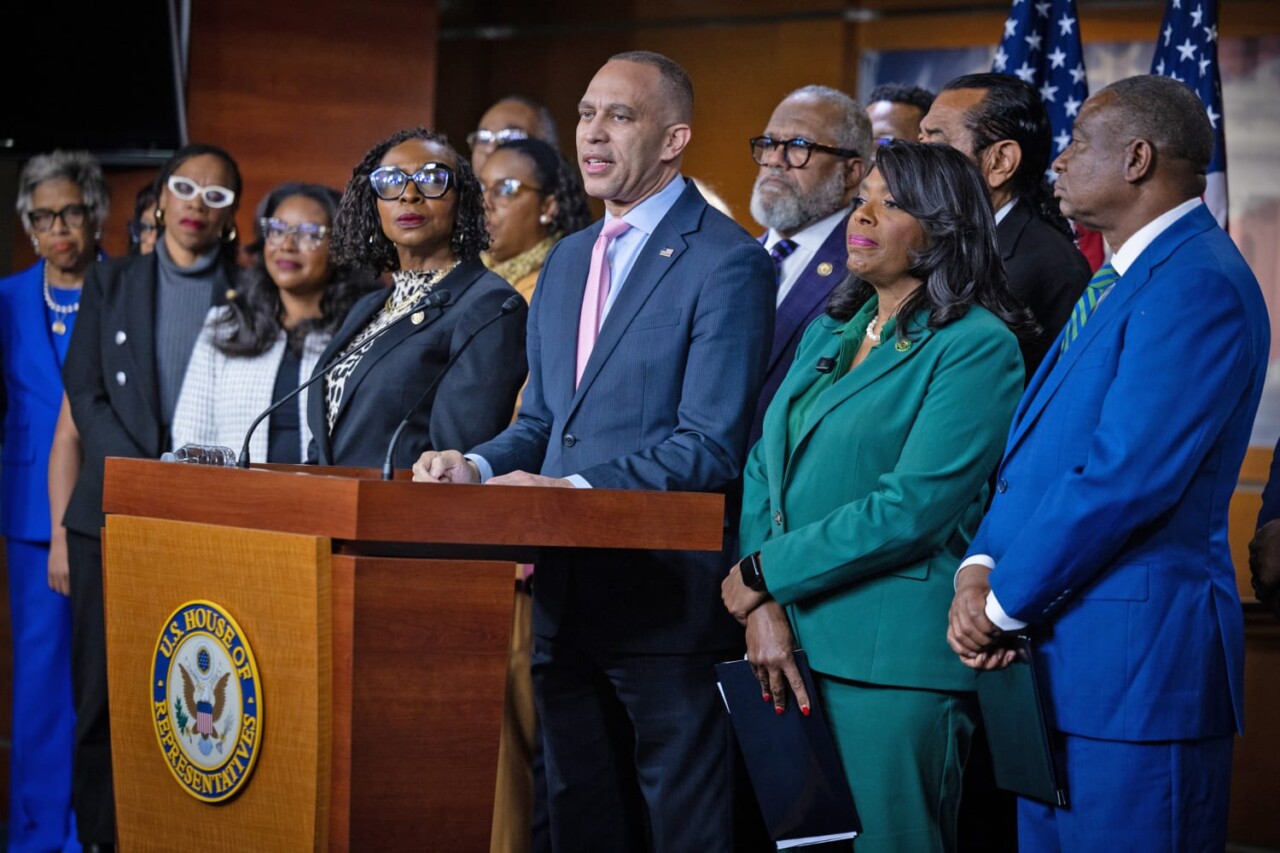
by Leah Harmony
Let me show you how the game is rigged. A few years ago, I discovered a popular brand of ginger ale was being sold without actually having ginger in it. That may not sound like much, but their promotion was entirely built on being made with real ginger. For me, it was one of those crack-in-the matrix moments. The ad featured a healthy young mother preparing a picnic in an abundant field of ginger. The words: made with real ginger were splashed on the screen and instantly the subconscious mind connects the sugar-filled, artificially flavored ginger ale with nature and care. Tricky. Later, after a lab discovery brought a class action suit, the brand quietly settled out of court. This is usually done to avoid media attention and having to admit wrongdoing. They simply reached into their allocated legal fund and paid $11 million in damages. The people rejoiced.
What they didn’t realize was that $11 million was built into the brand’s marketing budget and already charged to the game. The brand knew out of the gate that the lie would make them more money than the truth would cost them. The two attorneys from Harvard and Yale who brought the case to the judge took home $2.1 million. The people who were deceived cashed out at 50 cents each. Today, the brand does well enough to pay $848 million a year in dividends to its largest shareholder and they reported their latest annual revenue as $48 billion.
American politics is like that ginger lawsuit.
Ready players
It’s Primary season in politics, which means it’s time to wrangle the Black vote. Voter suppression and redistricting dominate the headlines. Suddenly, we’re inundated with headlines about Republicans scrambling to redistrict the Black coalition right off the map, starting with Louisiana and Tennessee and moving North from there. Though representatives put out a statement saying any seats gained could be filled with Black Republican lawmakers, the left isn’t buying it. Gov. Gavin Newsom says we’re living through “Jim Crow 2.0.”
Alexandria Ocasio-Cortez led a rally from behind a bulletproof stage pod, where from a bullhorn she told us we are under attack and we need to “pull up” on the Southern states. Over and over we hear the Voting Rights Act is being gutted by a Supreme Court intent on ushering in a new era of “American apartheid.” The redistricting in Tennessee is being called a “declaration of war.” The NAACP has even called for all Black college athletes to boycott college sports in response to the new maps.
It’s right on time, and it’s all very on-brand. Care and concern for Black folks is what they’re selling.
Same game
Beyond the headlines and rhetoric, many Black Americans are wondering: What has electoral representation changed in our daily lives? Republicans are doing exactly what they said they’d do. We’re witnessing the crescendo of a grand campaign. Of course the Republican Party in the South, under Donald Trump, is dangerous. Southern Republican lawmakers have always used redistricting to lessen Black voting power. Especially in states where Black district voting could threaten embedded, old money power like in Louisiana.
Season after season, the seats revolve, colors change, the public in-fighting persists, all funded by our tax dollars or donations that would rather be a great help to our communities. If we base the progress of our representation on our real-life statistics, we’d have to be honest and admit we, the Black people, are perpetually losing. Our representatives seem to want us content to just exist in a country most of us can’t afford to enjoy or even have a roof over our head in.
For the past 20 years Black Americans have experienced poverty at rates roughly double those of white Americans. Currently 18% of Black people are at or below the poverty line where white people are holding steady at 7%. The Black homeownership rate stands at roughly 43.6% to 44.7% nationally, leaving a significant gap between Black and white homeownership rate, which is holding steady at 72% to 74%. The Black homeownership rate in California sits at approximately 36.5%, representing the lowest rate among all major ethnic groups in the state.
I’m constantly wondering where all this equity is that everyone’s talking about. I cannot recall a single candidate or widely accessible policy in my voting timeline that tackled the reality of historical mortgage denials, neighborhood devaluations, gentrification or generational wealth barriers. This is with the exception of the Black Homeownership Initiative through CalHFA that provided educational materials and a referral to the Dream For All down payment assistance program. The successful program provided loan assistance in the following percentages: White 34%, Hispanic 34%, Asian 18%, Black 4%. When held against the stated goal, or against current voter awareness campaigns, those numbers don’t reflect initiative, by traditional or governmental definition. Yet, everyone I know has an ID and can vote but not a single friend in my circle owns their own home. That’s a mislabeled initiative if I ever saw one. Big Ginger ale would be proud.
Seeing the play
This is not an argument against voting rights protections. It is an argument that the public care and concern may actually just be electoral symbolism for your vote, and not tangible progress. The right to vote matters. It always has. But personally, I’m not comfortable pretending like it’s doing so is what frees us from our state of being. A ballot has yet to produce housing. A district map does not create generational wealth, stability or longevity. Representation has never stopped the gentrification of our stomping grounds.
The Civil Rights Act was fought so Black Americans could finally access the protections other citizens had enjoyed since the country’s inception. It’s sold as a set of laws aimed to repair historical harms. When we bought it, they didn’t explain that race-based legislation is unconstitutional, making targeted repair near impossible. Broken down further, that means harms caused by racism cannot be repaired if the remedy targets the race that was harmed. Or further: race-based harms cannot be remedied through race-based remedies. Tricky, tricky.
The act might as well be labeled: “made with real civil rights.”
Flipping the board
More and more, there seems to be an overlay of clarity on political antics. I’m not sure if it’s the young Black youth fearlessly yelling to Mayor Mamdani on crowded NYC streets about those tangibles we’ve been asking for, with their won’t back down chants of “I thought I told you that we won’t vote; I thought I told you that we won’t vote!” or if it’s that more people are speaking out from the trenches, that neither party seems to care at all where Black people rest their heads at night until someone starts drawing on the maps that threaten their seats.
These moments of understanding come in waves, then there’s a tidal wave, revealing chaos as king. Right behind the wars, aliens and pedophile politicians, there’s a gut punch of trauma pulling us into old battles already fought and won.
I’ve come to realize chaos isn’t a state of being, it’s a place called America. America, the beautiful, where the people are strong and what’s on the screen is not always what it appears to be.

I agree with the words of NOLA’s citizen activist, Marshan Camese, that the MAGA party is the last breath of the confederacy and the children they created are not on board with their racist politics. But none of that means we have to pretend that while Democrats held the seats they’ve lost, they even came close to solving that which continues to ail Black America.
So here we are, and how do we change our world from behind this muddy windshield? Voting is a gift inherited from ancestors who cherished it. That gift has transmuted and is now a larger lesson. To ignore it would be to our detriment.
The lesson is that voting alone can’t carry the entire weight of a thing so important as liberation. There are elected officials, organizers and legal advocates in Southern states, and the North, who are doing real work to stop racial vote dilution, often at personal and political cost. Their efforts deserve recognition. We should absolutely resist the erasure of Black political power from the map.
But it’s high time we stop seeing symbolism during election season as commitment to our communities when it has yet to be proven as such. Victories that benefit the parties instead of the people are not wins. They are confirmations. We know that politicians can mobilize overnight to save districts, redraw maps, fund legal battles and protect seats. We understand the same urgency could be applied to housing, wealth opportunities, failing schools, environmental hazards, poisonous food systems, and the criminal justice pipeline that keeps swallowing our future leaders.
The system has proven it can move. We must watch when and for whom it chooses to, and our energies should be distributed as such.
I say vote when it protects your interests. Challenge every power when that exploits our trauma and loyalty. Lift leaders that show up when it’s raining, not just when the sun shines on election season. Build within our own communities regardless of who wins. Draw our own maps. Redistrict within.
We must remember things are not always what they’re sold as. Not in America. Not in politics. And, not in soft drinks.
Leah Harmony is a producer and journalist. she manages production at the SF Bayview and can be reached at leah@sfbayview.com.
The post Red, blue and black: They’re playing old games with new maps appeared first on San Francisco Bay View.