The Continuing Impact Of The Assassination Of Dr. Martin Luther King Jr.
By Lawrence Hamm, Chairman\People’s Organization For Progress Photos: Lawrence Hamm On Saturday, April 4, 2026, the 58th anniversary of the assassination of Dr. Martin Luther King Jr, I visited the National Civil Rights Museum (NCRM) at the Lorraine Motel. The People’s Organization For Progress (POP) sent me to this year’s commemoration to demonstrate our ongoing commitment to the goals and ideals for which he stood. This visit is especially important at this time since everything that Dr. King fought for including racial equality, economic justice, civil rights, voting rights, human rights, and peace are under a relentless assault from President Trump and his racist, white supremacist, and fascist movement. Although I was representing POP, this is something I have been wanting to do personally for many decades. I flew out of Newark at 6:00am changed flights in Chicago and landed in Memphis about 11:00am. I checked into my hotel and wasted no time getting to the museum. By 1:30pm I had arrived at the museum. I was standing where Dr. King was shot and killed on April 4, 1968 while standing on the balcony of the Lorraine Motel, outside of Room 306 where he was staying in Memphis, Tennessee. He was shot at 6:01pm. He was pronounced dead at 7:05pm at St Joseph Hospital. When you approach the museum the first thing you encounter are the kiosks on the plaza. On one side each kiosk has a silhouette of a worker carrying a sign that says “I Am A Man.” These figures are taken from the iconic photo of Black workers marching and carrying the “I Am A Man” signs during the Memphis sanitation workers strike. On the other side of the kiosks are small television screens which tell the story of the sanitation workers and the role Dr. King played in that struggle. Inside the museum the layout, motif, and style is very similar to that of the African American History Museum in Washington, DC. And the content and exhibits are just as well done and compelling. The experience at the NCRM is just as rewarding. Inside there are many exhibits that take you on a journey of the African American struggle for civil rights. It begins at the ground level with the fight against slavery and winds its way to upper levels through the period of Jim Crow racial apartheid, the civil rights and Black Power Movements, into our contemporary era and struggles for racial justice. There is not enough space here to describe all of the great exhibits. However, a few of my favorites include a bus like those that were running during the Montgomery Bus Boycott, a replica of the jail cell that held Dr. King when he wrote his letter from a Birmingham Jail where people could sit inside, an exhibit dedicated to Fannie Lou Hamer, and a garbage truck like those used at the time of the sanitation workers strike. At the upper most level it ends at the balcony where Dr. King was assassinated and the room where he was staying when he was shot and killed. Words cannot describe the cascade of emotions that overwhelmed me when I saw this scene. I tried to hold back the tears. I could not. I looked at the balcony. I wanted to reach back in time and pull Dr. King off of that balcony and back inside. His death was so tragic. A man so committed to nonviolence in the end was himself the victim of an horrific act of violence. He died at a relatively young age. He was only 39. It seemed so painfully unfair, unjust, and abominable. Why would people want to kill a man who advocated nonviolence, preached love of one’s neighbor, who only wanted to do good and eliminate human suffering? They killed him because he was becoming a threat to the system and to the status quo. Although Dr. King did not advocate violence, he was increasingly and openly moving from a reformist perspective to a revolutionary perspective. He was moving from a civil rights perspective to a human rights perspective. And he was advocating for large scale mass nonviolent resistance to injustice. While continuing to advocate for reforms that might possibly be achieved within the framework of the capitalist system he started talking more and more about the need for institutional and systemic change. He became increasingly critical of the system of capitalism at home and imperialism abroad. As you can imagine there were those in power who were not happy with King’s radical perspective. They wanted to get rid of him for various reasons. First, because of his unwavering attack on racism and white supremacy. Despite the passage of the Civil Rights Act and Voting Rights Act racism and white supremacy had not disappeared. There were many who still wanted to preserve the racial status quo of white super ordination and Black subordination. Second, they wanted to remove him because of his opposition to the war in Vietnam. He wanted to end it and use the money that would be spent on the war for people’s needs. He gave his most memorable spe
 Black News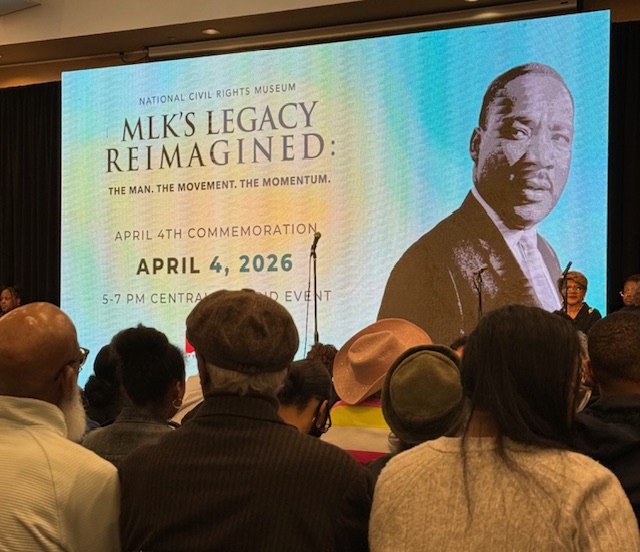


By Lawrence Hamm, Chairman\People’s Organization For Progress
Photos: Lawrence Hamm
On Saturday, April 4, 2026, the 58th anniversary of the assassination of Dr. Martin Luther King Jr, I visited the National Civil Rights Museum (NCRM) at the Lorraine Motel. The People’s Organization For Progress (POP) sent me to this year’s commemoration to demonstrate our ongoing commitment to the goals and ideals for which he stood.


This visit is especially important at this time since everything that Dr. King fought for including racial equality, economic justice, civil rights, voting rights, human rights, and peace are under a relentless assault from President Trump and his racist, white supremacist, and fascist movement.
Although I was representing POP, this is something I have been wanting to do personally for many decades. I flew out of Newark at 6:00am changed flights in Chicago and landed in Memphis about 11:00am. I checked into my hotel and wasted no time getting to the museum.
By 1:30pm I had arrived at the museum. I was standing where Dr. King was shot and killed on April 4, 1968 while standing on the balcony of the Lorraine Motel, outside of Room 306 where he was staying in Memphis, Tennessee. He was shot at 6:01pm. He was pronounced dead at 7:05pm at St Joseph Hospital.


When you approach the museum the first thing you encounter are the kiosks on the plaza. On one side each kiosk has a silhouette of a worker carrying a sign that says “I Am A Man.”
These figures are taken from the iconic photo of Black workers marching and carrying the “I Am A Man” signs during the Memphis sanitation workers strike. On the other side of the kiosks are small television screens which tell the story of the sanitation workers and the role Dr. King played in that struggle.
Inside the museum the layout, motif, and style is very similar to that of the African American History Museum in Washington, DC. And the content and exhibits are just as well done and compelling. The experience at the NCRM is just as rewarding.
Inside there are many exhibits that take you on a journey of the African American struggle for civil rights. It begins at the ground level with the fight against slavery and winds its way to upper levels through the period of Jim Crow racial apartheid, the civil rights and Black Power Movements, into our contemporary era and struggles for racial justice.
There is not enough space here to describe all of the great exhibits. However, a few of my favorites include a bus like those that were running during the Montgomery Bus Boycott, a replica of the jail cell that held Dr. King when he wrote his letter from a Birmingham Jail where people could sit inside, an exhibit dedicated to Fannie Lou Hamer, and a garbage truck like those used at the time of the sanitation workers strike.


At the upper most level it ends at the balcony where Dr. King was assassinated and the room where he was staying when he was shot and killed. Words cannot describe the cascade of emotions that overwhelmed me when I saw this scene. I tried to hold back the tears. I could not. I looked at the balcony. I wanted to reach back in time and pull Dr. King off of that balcony and back inside.
His death was so tragic. A man so committed to nonviolence in the end was himself the victim of an horrific act of violence. He died at a relatively young age. He was only 39. It seemed so painfully unfair, unjust, and abominable.
Why would people want to kill a man who advocated nonviolence, preached love of one’s neighbor, who only wanted to do good and eliminate human suffering? They killed him because he was becoming a threat to the system and to the status quo.
Although Dr. King did not advocate violence, he was increasingly and openly moving from a reformist perspective to a revolutionary perspective. He was moving from a civil rights perspective to a human rights perspective. And he was advocating for large scale mass nonviolent resistance to injustice.
While continuing to advocate for reforms that might possibly be achieved within the framework of the capitalist system he started talking more and more about the need for institutional and systemic change. He became increasingly critical of the system of capitalism at home and imperialism abroad.
As you can imagine there were those in power who were not happy with King’s radical perspective. They wanted to get rid of him for various reasons. First, because of his unwavering attack on racism and white supremacy. Despite the passage of the Civil Rights Act and Voting Rights Act racism and white supremacy had not disappeared. There were many who still wanted to preserve the racial status quo of white super ordination and Black subordination.
Second, they wanted to remove him because of his opposition to the war in Vietnam. He wanted to end it and use the money that would be spent on the war for people’s needs. He gave his most memorable speech in opposition to the war on April 4, 1967. He was assassinated on April 4, 1968.
Third, they wanted King eliminated because of his scathing critique of capitalism which he said created enormous wealth for the few and poverty and economic hardship for the many. He understood that the realization of his goal to eliminate poverty and economic inequality would require a radical change in the way the U.S. economy worked.
Fourth, they wanted King out of the way not just because of what he was saying but because there were people listening and agreeing with him. Even when his popularity was at its lowest point, due to the political attacks on him, because of his opposition to the war, he still had the support of millions.
Fifth, they decided to kill him because he was willing to organize positive direct mass action to achieve his goals. What was he doing at the time of his death? He was in Memphis helping the sanitation workers organizer a union and get a contract with fair hours, wages and working conditions.
His advisors didn’t want him to go to Memphis. He told them he had to go. The sanitation men were making slave wages and working under dangerous conditions. Several had been killed in the garbage compacting machines. King understood the necessity of supporting workers struggles for economic justice.
After King finished in Memphis he planned to go to Washington DC for his most ambitious project, the Poor People’s Campaign. He said he wanted to bring a million people to Washington to protest. He wanted to bring Black people from the ghettos, Latinos from the barrios, Native Americans from the reservations, and poor whites from Appalachia.


And they were going to engage in massive civil disobedience to shut Washington down until Congress passed an “Economic Bill of Rights.” It would include a national jobs program with jobs at a living wage to eliminate unemployment, universal free healthcare, guaranteed income, housing as a human right, and free quality education for all.
Dr King did not make it to Washington. He was felled by the assassins bullet. This was not the first attempt on his life. There had been others. This one succeeded.
Among those that wanted him dead was the FBI Director J. Edgar Hoover. King had long been a target of FBI surveillance and repression. They even tried to get him to commit suicide. He was a principal subject of FBI COINTELPRO Program whose stated objective was to prevent the rise of a Black messiah.
Coretta Scott-King, Dr. King’s wife, brought a lawsuit against the federal government to find out who was responsible for her husband’s death. She only sued for one dollar in damages because she wanted people to know that she was trying to get the truth not the money.
The court found that 11 government intelligence agencies and the Memphis police were all connected to the case in one way or another. Dr. King had been identified as an enemy of the state. He was a victim of state terror. Almost sixty years later there are still documents pertaining to his death that have not been declassified and released to the public.
King is gone but his struggle continues. If he had reasons to fight then we have even more reasons to do so today. Racism is as virulent today, perhaps even more so, than it was in 1968 when Dr King was assassinated. Black people are still the greatest victims of racial violence and police brutality. Racial equality is still as elusive today as it was then.
There are more Black people living in poverty, and more unemployed today. During this past year more than 300,000 Black people lost their jobs as a result of budget cuts and the elimination of DEI programs by DOGE. The wealth gap between white and Black families is greater than its ever been since slavery.
When Dr King came to Memphis in 1968 the mayor was white. Today, the mayor is Black. Since then many cities with majority or large Black populations have elected Black mayors including Memphis, Newark, Washington DC, Baltimore, Atlanta, Detroit, and Jackson.
While Black people have been successful in the struggle for political power, the struggle for economic justice has had mixed results. As a results of the gains of the Civil Rights and Black Power movements, and the post war expansion of the American economy, there was an expansion of the Black middle and working classes in the sixties and seventies.
However, since that time poverty has also increased at the national level. It has also increased in many of our major cities. This is true for most major cities not just those that are Black led.
The aforementioned cities and others have fallen prey to gentrification and many residents find it difficult to live there or can no longer afford to do so. In the aftermath of the sanitation workers strike, and the assassination of Dr. King, thousands of National guard troops were deployed to Memphis.
Almost sixty years later, troops are back on the streets of Memphis, Washington DC, and other cities. They are there not at the request of the residents but at the behest of President Trump—to intimidate and repress local populations.
While it is important for Black people to have Black political representation, that alone is not enough to eliminate or significantly impact the social ills that exist in those cities. That cannot happen without the far reaching economic reforms, redistribution of wealth, including Reparations for slavery, and restructuring of our economic system that Dr. King and others have called for.
Believe it or not the U.S. is more segregated today than it was six decades ago. Black people still face discrimination in housing, employment, health care, education, criminal justice and other areas of society.
Black infant and maternal morality rates are not only higher than those of whites but rival those of some poorer countries. Attempts are being made to ban the teaching of Black history. There are far greater numbers of Black people in our country’s federal and state prisons today than there were six decades ago.
To add insult to injury the hard won gains of the Civil Rights Movement are being eliminated before our very eyes. This didn’t start recently. It started sixty years ago. Towards the end of his life, King said the country had already turned its back on the fight to end poverty and the struggle for desegregation.


This has continued unabated for decades. Now, under the Trump administration, the Republican controlled Congress, and ultra-right super majority on the Supreme Court we are witnessing the elimination of the last vestiges of the Civil Rights Act, Voting Rights Act, Affirmative Action, and Diversity, Equity, and Inclusion.
In terms of economic justice and class inequality since 1968 we have seen the greatest upward redistribution of wealth in human history. The gap between the rich and the poor is wider than it has ever been.
Workers are working more hours but have less purchasing power. The federal minimum wage is $7.25 per hour and has not been increased in 16 years. You cannot rent a one bedroom apartment anywhere in America on a wage that low.
And despite the fact that the Memphis sanitation workers won their fight for a union there are fewer unionized workers in the U.S. today than there were when King was assassinated. Only about eleven percent of labor is organized in this country.
In his 1967 speech, about his opposition to the Vietnam War, Dr King said the “greatest purveyor of violence” was his own government. Since the end of the Vietnam conflict the U.S. has engaged in even more costly wars of imperialist aggression.
The millions spent on the Vietnam war was but a fraction of what has been spent on the wars in Iraq and Afghanistan, and support for Israel’s ongoing genocidal war against the Palestinians.
We are spending billions on support for war and genocide in the Congo, Sudan, and other African countries, a total blockade against Cuba in an attempt to economically strangle that country into regime change, imperialist aggression against Venezuela and the kidnapping of its president, and domination and repression in Haiti.
To top it off the Trump regime has requested a 1.5 trillion dollar military budget, the largest in history. We are also spending billions to maintain our nuclear weapons arsenal.
It is clear that the U.S. is even more imperialist, more war mongering, and more rapacious than it was during Dr. King’s era. We have trillions and billions for war but no money to help the majority of people in this country who are struggling just to make ends meet meet.


We must remember the contributions of Dr. King and all the martyrs of the Civil Rights Movement and the Black Liberation Movement. We should celebrate his birthday, memorialize his life, study his writings, and commemorate his death.
We do this not only for educational reasons but also in an effort to preserve the radical ideas of Dr. King. There are individuals, institutions, and forces in society that have gone to great lengths to suppress these ideas and promote an nonthreatening image of King that is palatable to the corporate America. We must struggle to dispel this false impression.
In this regard, I want to commend The Prison Lives Matter Coalition Interfaith and Prison Ministries Committee and the Safiya A. Bukhari- Albert Nuh Washington Foundation for sponsoring a program entitled “The Forgotten Revolutionary Legacy of MLK.” It was hosted by Sadiki ‘Bro Shep’ Ojore Olugbala. The speakers included Pastor Keith Collins, Sister Tuere Aisha, Jalil Muntaqim, Herb Boyd, Rosmari Mealy, and myself. It was held on the evening of April 4th.
Recently, I was asked by the Rev. Ronald Slaughter of St James AME Church in Newark, NJ to review Dr. King’s book “Where Do We Go From Here: Chaos Or Community,” with members of his congregation. We went through it in three sessions, one night a week for three weeks. I urge other churches, unions, student, and community groups to organize similar activities.
I have also, challenged activists and parents to make some if not all of Dr. King’s writings a part of the curriculum in our schools, colleges, and universities. And we should organize our own programs, forums, discussions, book clubs, courses and study groups at the grassroots level to examine revolutionary legacy. Let us do all that we can to preserve and propagate the true legacy of Dr. Martin Luther King.
However, while we do all we can to rescue his revolutionary legacy, the best way to honor him is to commit and re-commit ourselves to those things for which he was fighting. Most importantly let us honor him by building the types of organizations and movements that have the power to compel the building of a better nation and a better world where freedom, justice, equality, peace, and prosperity can be a reality for all.
For more information contact Lawrence Hamm at (973)801-0001. Photos courtesy of Lawrence Hamm.

Lawrence Hamm is the Chairman and one of the founders of the People’s Organization for Progress, a grassroots social justice organization active since 1982.