The high cost of illegal crossings at Mohokare
THE tragic disappearance of a young man in the waters of the Mohokare River is yet another painful reminder of a dangerous reality that has quietly normalised itself along the Lesotho–South Africa border. His story is part of a recurring pattern in which desperation, opportunity and illegality intersect — often... The post The high cost of illegal crossings at Mohokare appeared first on Lesotho Times.
 Black News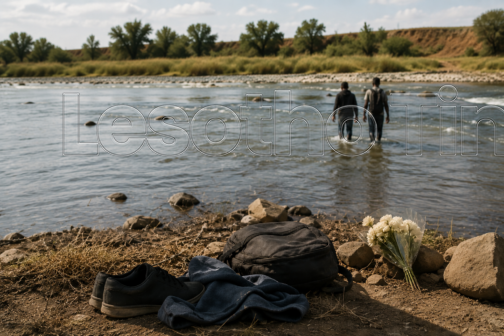
THE tragic disappearance of a young man in the waters of the Mohokare River is yet another painful reminder of a dangerous reality that has quietly normalised itself along the Lesotho–South Africa border. His story is part of a recurring pattern in which desperation, opportunity and illegality intersect — often with fatal consequences.
For years, the illegal crossing of the Mohokare has evolved into a thriving informal industry. Those who facilitate these crossings, commonly known as Lirurubele — “butterflies” — have built a livelihood out of transporting people and goods across the river. Using inflated mattresses or tyre tubes, they guide Basotho without proper documentation into South Africa and back home, particularly during peak seasons such as Christmas and Easter. What may appear to some as ingenuity or survivalism is, at its core, a risky and unlawful enterprise.
There is no denying that the economic pressures facing many Basotho are severe. Jobs are scarce, opportunities are limited, and for many families, cross-border movement is not a luxury but a necessity. In such an environment, it is easy to understand why the Lirurubele trade has flourished. It provides income for those who facilitate crossings and a lifeline for those seeking work or reconnecting with families across the border.
But understanding the motivations behind this practice should not be mistaken for endorsing it.
The hard truth is that illegality does not become acceptable simply because it is profitable or widespread. The crossing of the Mohokare without proper documentation is illegal, and the methods used are inherently dangerous. Every trip across that river is a gamble with human life — a gamble that is sometimes lost.
The recent disappearance of a young man believed to have been swept away by the current illustrates the brutal risks involved. This was someone described as strong, experienced, and familiar with the river. Yet even such experience offers no guarantee against the unpredictable forces of nature. The Mohokare is dangerous in that it is a flowing river, and based on the recent heavy rains, the water must be flowing in a large quantity, thus, making the current heavy for people attempting to cross it. A single misstep can mean death.
What is perhaps most disturbing is how routine these tragedies have become. Reports of drownings, missing persons, and unrecovered bodies surface with alarming regularity. Communities along the border have come to expect these incidents, treating them almost as an inevitable cost of doing business. Families mourn without closure, clinging to hope that the bodies of their loved ones will one day be found.
This normalisation of risk is deeply troubling. It raises uncomfortable questions about the role of both authorities and communities. Where is the sustained enforcement needed to curb illegal crossings? Where are the viable alternatives that would reduce dependence on such dangerous practices? And importantly, why has society become so accepting of a system that routinely places lives in jeopardy?
The responsibility does not lie with one party alone. The government authorities must strengthen border management while also addressing the root causes that drive people toward illegal crossings. This includes expanding legal and accessible migration channels, improving economic opportunities within Lesotho, and investing in community awareness campaigns about the dangers of river crossings.
At the same time, communities must confront the moral dimension of this issue. Making a living through illegality — no matter how understandable the circumstances — does not make it right. It creates a cycle where risk is commodified, and human life becomes secondary to financial gain.
There is also a need to challenge the perception that Lirurubele are simply providing a service. While they may assist people in reaching their destinations, they are also facilitating an illegal and dangerous act. Their role cannot be divorced from the consequences that follow — including injury, loss, and death.
None of this is to dismiss the harsh realities faced by those who rely on these crossings. Poverty and unemployment are powerful forces, and for many, the choice is not between legality and illegality, but between survival and destitution. However, this only underscores the urgency of systemic solutions rather than the continuation of hazardous shortcuts.
Ultimately, the Mohokare River has become more than just a geographical boundary; it is a symbol of inequality, desperation, and the limits of state capacity. Each life lost in its waters is a stark indictment of a system that has failed to provide safer, lawful alternatives.
The grief of families left behind should serve as a wake-up call. Behind every statistic is a story — of a son, a parent, a provider — whose life was cut short in pursuit of a better future. These are not abstract numbers; they are human tragedies that demand attention and action.
If there is any lesson to be drawn, it is this: normalising danger does not make it any less deadly. The continued reliance on illegal crossings is not a solution; it is a symptom of deeper structural problems that must be addressed with urgency and seriousness.
The post The high cost of illegal crossings at Mohokare appeared first on Lesotho Times.