‘What Is He Thinking???’: Trump Admits What He’s Really After in Iran — Then His Frustration Takes Over, He Goes Off About ‘Foolish People’ and Spirals Into Something Worse Slipping Out
President Donald Trump and his administration have spent weeks offering shifting explanations for a war with Iran that critics say began without clear justification. Often […] ‘What Is He Thinking???’: Trump Admits What He’s Really After in Iran — Then His Frustration Takes Over, He Goes Off About ‘Foolish People’ and Spirals Into Something Worse Slipping Out
 Black News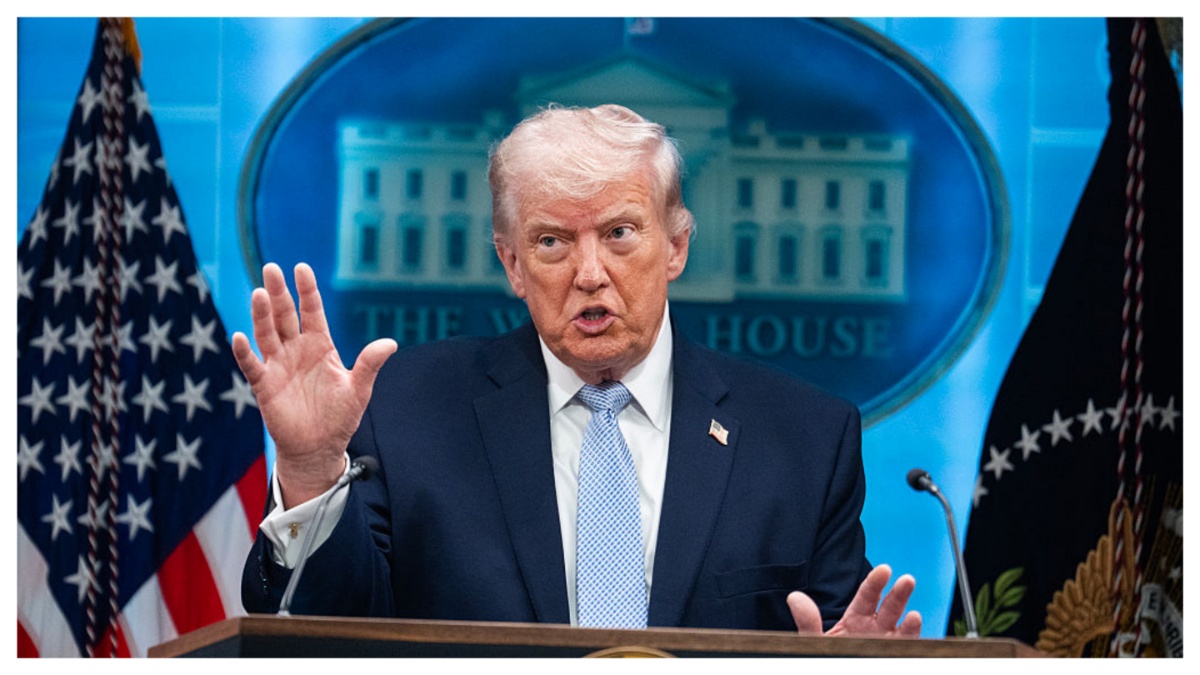


President Donald Trump and his administration have spent weeks offering shifting explanations for a war with Iran that critics say began without clear justification. Often framing it as a necessary move to protect Americans from an imminent threat, even as evidence for that claim remains thin.
But more than six weeks into the conflict, Trump is increasingly letting something else slip — a far more blunt explanation for what he wants out of it. And in a series of remarks Monday, that underlying motive came into sharper focus.
Pressed by a reporter on what he would say to Americans uneasy about the war, Trump didn’t soften his tone.
“They’re foolish, because the war is about one thing: Iran cannot have a nuclear weapon,” he said.
Moments later, as his frustration began to show, Trump drifted into a far more revealing line of thinking that went well beyond nuclear deterrence.
“If I had my choice, what would I like to do? Take the oil. Because it’s there for the taking and there’s nothing they could do about it.”
He continued, acknowledging the political constraint even as he pushed the idea further.
“Unfortunately, the American people would like to see us come home. If it were up to me, I’d take the oil, I’d keep the oil, I would make plenty of money.”
— Steven Latham (@StevenJLatham1) April 6, 2026
Trump calls Americans against the Iran war “FOOLISH.”
“If it were up to me, I’d take the oil and make plenty of money… UNFORTUNATELY, the American people want us to come home.”
He added that without U.S. action, “Israel would’ve been gone.”
Source: Trump comments at White… pic.twitter.com/ZxMjIpmFoJ
The moment underscored a broader point. Trump’s rhetoric isn’t just about what he wants to do, but about how far he can push the envelope before he pivots.
After admitting Americans likely wouldn’t support a risky move to take Iran’s oil, he redirected attention to Venezuela, even joking about running for president there.
Plans to seize Iranian oil would almost certainly require ground troops and a sustained presence, particularly around key export hubs like Kharg Island, which came under attack overnight Monday in strikes against military targets.
But a commitment to boots on the ground runs counter to the weariness of the American people, which Trump himself has often tapped into for political gain.
Even so, the instinct behind the idea wasn’t new.
“I’m a businessman first,” Trump said, invoking a worldview where victory comes with tangible rewards. He expressed nostalgia for a time when “to the winner belong the spoils,” a phrase that he’s repeated for years now and captured how he has framed U.S. leverage abroad — not just as strategy, but as opportunity.
Online, the reaction was immediate and pointed.
“What is he thinking??? That 90 million Iranians will just bow down and say — ok, please take the oil!!” one user wrote.
Another focused on Trump’s wording, “Notice he said ‘I’d take the oil, I’d keep the oil and would make plenty of money.’ Not the U.S. — he would.”
A third mocked, “No way! The plan the whole time was to forcefully take their oil for himself and make money?!?! Who could’ve possibly seen that coming?!?”
Within moments of stepping back from Iran, Trump’s focus shifted thousands of miles away, to Venezuela. He spoke glowingly about U.S. involvement there following the capture of President Nicolás Maduro and his wife earlier this year.
Trump described the conflict as brief and decisive.
“The conflict with Venezuela was ‘over in 45 minutes’,” he said, adding that the United States had already benefited from the outcome.
“We have great people running Venezuela. The relationship is good, and we are a partner with Venezuela, and we’ve taken hundreds of millions of barrels (of oil), already, (it) is in Houston, refined and out, and paid for that war many, many times over.”
Then came the line that quickly spread online.
“The people of Venezuela, they say, if I ran for president of Venezuela, I’m polling higher than anybody has ever polled in Venezuela, so after I’m finished with this, I can go to Venezuela,” Trump said. “I will quickly learn Spanish. It won’t take too long. I’m good at language, and I will go to Venezuela. I’m going to run for president. But we’re very happy with the president-elect that we have right now.”
The comment was delivered in a light tone, but its timing — coming immediately after he ruled out one aggressive move in Iran — gave it a different weight.
Online, reactions poured in, many reading the moment less as humor and more as a sign of a broader pattern.
“Hey Congress. Stop pretending there’s nothing wrong with this,” a viewer said. “Clearly he’s spiraling and has been for quite some time. We deserve so much better.”
View on Threads
Others went further, interpreting the shift as part of a larger trajectory.
“Oh my god, this is an expansion mission for Trump. Once he moves on from Iran, he’ll do it to Cuba too and he’ll take that country too..somebody do something.”
The intensity of the reactions reflects the broader uncertainty surrounding Trump’s foreign policy approach.
For weeks, markets and analysts had been watching his Iran rhetoric closely, trying to gauge whether it would translate into concrete action. Monday’s comments appeared to ease some of that concern, at least temporarily, by signaling hesitation about a full-scale operation targeting Iran’s oil.
But if the pressure on one front eased, the rhetoric didn’t exactly cool, it just changed directions.
That has been a consistent feature of Trump’s political style. When one path narrows, he shifts lanes, often in ways that keep attention fixed on him while avoiding an outright retreat. The Venezuela remarks, delivered in the same breath as a concession on Iran, fit neatly into that pattern.
Whether he was joking, trying to get a reaction, or something in between, it sent a familiar message that to him, things like borders and foreign soveriegnty are open to his whim, just like any deal.