Africa’s Longest-Ruling President Appoints His Son Franck Biya as Vice President
The constitutional amendment took 48 hours to pass. The presidential decree naming its first beneficiary followed the same day. By the evening of April 4, Franck Emmanuel Biya — son of Africa’s longest-serving non-royal head of state — was Vice President of Cameroon and commander of its armed forces, elevated to the top of the [...]
 Black News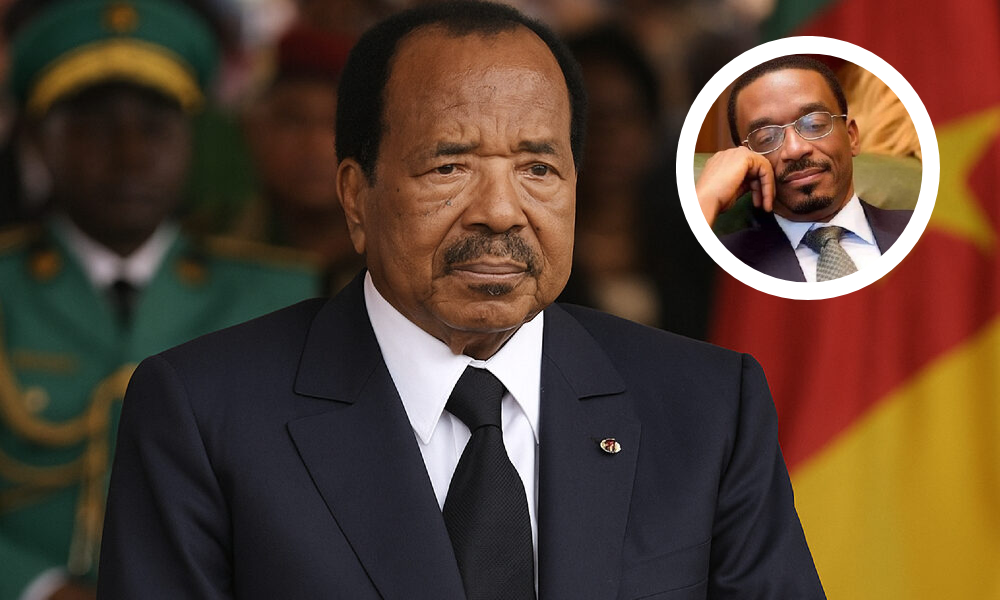

The constitutional amendment took 48 hours to pass. The presidential decree naming its first beneficiary followed the same day. By the evening of April 4, Franck Emmanuel Biya — son of Africa’s longest-serving non-royal head of state — was Vice President of Cameroon and commander of its armed forces, elevated to the top of the country’s line of succession by a document his father had signed.
The post he now occupies did not exist a week ago.
Parliament ratified the constitutional amendment creating the vice presidency in a joint congressional session on April 4, with 205 votes in favor, 16 against and 3 spoiled ballots. The change fundamentally restructures the country’s chain of succession: where power would previously have passed to the President of the Senate in the event of a presidential vacancy, it will now transfer automatically to the vice president, with no requirement to hold fresh elections. The vice president is appointed and dismissed at the president’s sole discretion.
ALSO READ: 9 Things You Would Have to Believe In Order to Trust Cameroon 2025 Election Official Results
The mandate being reorganized around this new office is itself contested. President Paul Biya claimed 53.66 percent of the vote in the October 2025 presidential election, defeating ten challengers. Multiple opposition parties alleged irregularities and unsuccessfully contested the results — a pattern that has accompanied each of his previous seven electoral victories dating back to 1984. Public discussion of Mr. Biya’s health is prohibited by law. He is 93 years old.
The constitutional maneuver carries echoes across the continent. In Zimbabwe, Robert Mugabe moved in 2017 to position his wife Grace as his successor, dismissing his vice president to clear the path. The army intervened, placed Mr. Mugabe under house arrest and parliament launched impeachment proceedings. He resigned after 37 years in power. In Togo, the dynastic transfer held — but only by altering the constitution in advance: two years before Gnassingbé Eyadéma’s death in 2005, the eligibility age for the presidency was quietly lowered to match his son Faure’s age. Faure Gnassingbé has governed Togo ever since. In Angola, José Eduardo dos Santos handpicked his successor and expected that choice to protect his family’s interests. Within months, his daughter Isabel had been removed from her position as head of the state oil company.
Succession by design, the record suggests, rarely unfolds as designed.
The appointment lands with particular force in the country’s English-speaking northwest and southwest regions, where a separatist conflict that began in 2017 has never been resolved. The armed conflict has cost thousands of lives and displaced hundreds of thousands more, making the question of regional representation in the line of succession politically charged.
That charge is not incidental to Cameroonian history — it is at its center. Cameroon has long operated according to an unwritten but practiced power-sharing convention, under which the prime ministerial office has been reserved for political figures from the Anglophone northwest and southwest regions, in recognition of the country’s origins as a union of British and French-administered territories. The current prime minister, Joseph Dion Ngute, is from the English-speaking southwest. His two immediate predecessors also came from Anglophone regions. The vice presidency, a new office created and filled in a single week, carries no such expectation.
Joshua Osih, chairman of the opposition Social Democratic Front, said the amendment “weakens legitimacy, reinforces centralisation, and ignores a major historical grievance,” calling instead for a jointly elected presidential ticket designed to reflect Cameroon’s linguistic and regional composition. The silence of many parliamentarians, particularly those from English-speaking regions, drew additional concern from observers.
According to the World Bank, poverty reduction in Cameroon has stagnated over the past two decades, with approximately four in ten Cameroonians living below the national poverty line. More than 70 percent of the country’s nearly 30 million citizens are under 35. The majority have known no head of state other than Paul Biya, who first took office in 1982.
ALSO READ: In a Rare Public Rebuke, Daughter of Cameroon’s 92-Year-Old President Opposes His Bid to Extend Rule
Whether Franck Biya, 54, would govern differently from his father is a question that cannot be answered in advance. What is not in question is the method by which he has arrived at the threshold of power: a constitution amended in two days, a parliamentary vote in a chamber dominated by the ruling party, and a decree bearing his father’s signature.
Research on authoritarian transitions in Africa finds little evidence that the death or departure of a long-serving leader produces democratic change. In most cases, political space narrows further. For the young Cameroonians who make up the majority of the country’s population — and who had no vote in the October election that opposition groups say was decided before it was held — the question of who governs them, and how, remains unresolved by any process they have been permitted to participate in.