Borderland Frontiers: Bridges or Barriers?
Governance vacuums, cross-border insurgency, insecurity, human trafficking, arms supply, contraband trade alarm government Despite their deeply interconnected cultures and peoples, the countries of the Horn of Africa, like the rest of the continent, still bear the borders carved out for them by European colonists. Even though Ethiopia was never colonized, its boundaries were not immune […]
 Black News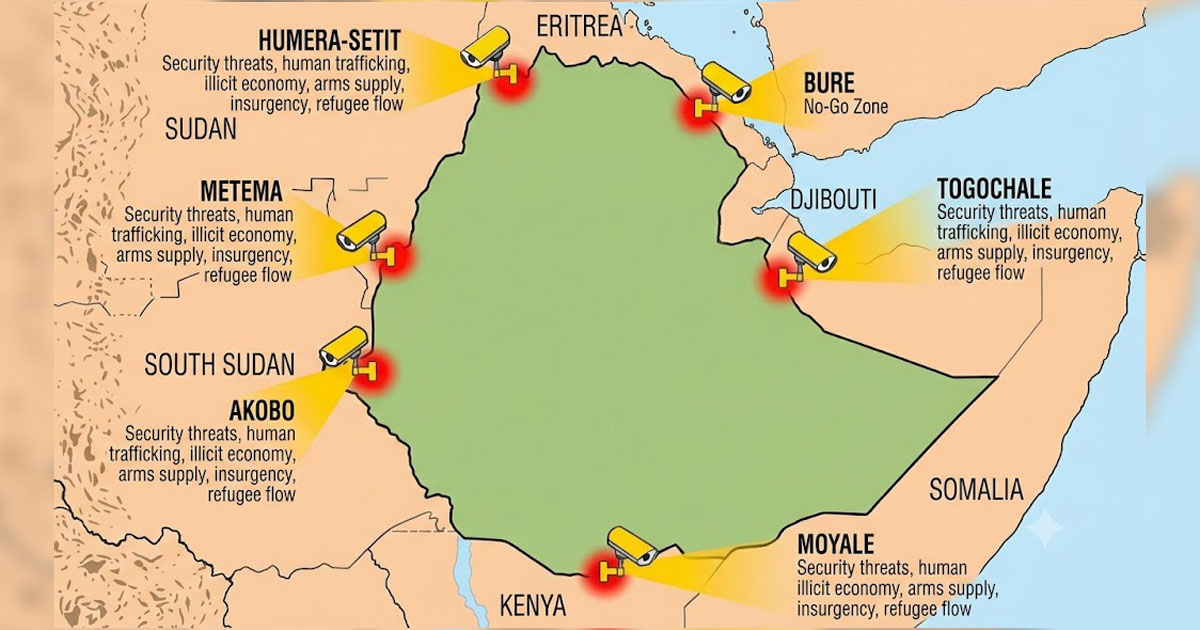

Governance vacuums, cross-border insurgency, insecurity, human trafficking, arms supply, contraband trade alarm government

Despite their deeply interconnected cultures and peoples, the countries of the Horn of Africa, like the rest of the continent, still bear the borders carved out for them by European colonists. Even though Ethiopia was never colonized, its boundaries were not immune to the designs of the colonial powers who once ruled over its neighbors, namely Britain, Italy, and France.
As the fortunes of the countries that make up the Horn today are intertwined, so too are the mutual and complicated challenges arising from the boundaries that separate them. Porous borders have become an increasingly pressing problem in the region, with lax security, weak governance, and financial constraints allowing the proliferation of mineral smuggling, human trafficking, and arms dealing across national boundaries.
The growing border problem has captured the attention of the Ethiopian government, whose officials appear intent on finding a feasible solution.
On June 12, 2026, experts and officials from Ethiopian Institute of Foreign Affairs (IFA), Immigration and Citizenship Service (ICS), Refugees and Returnees Service (RRS), other institutions, in collaboration with GIZ and the AU Border Program (AUBP), convened at Addis Ababa’s Skylight Hotel to discuss new initiatives they hope will ensure broader governance and security in border areas.
Cherugeta Genene, the state minister in charge of federalism and conflict management at the Ministry of Peace, was among the attendees when the IFA, in partnership with AUBP and GIZ, unveiled a border governance roadmap based on a study conducted over the past couple of months.
The ‘Roadmap for the Implementation of Improved Border Governance in the Federal Democratic Republic of Ethiopia’ was compiled by a team of a dozen experts who traveled earlier this year to a number of key border areas and towns, including Jijiga, Togochale, Bulho, Galafi, Gambella, Kurmuk, Asossa, Moyale, and Metemma.
“The Horn region is characterized by its deep historical connections, cross-border social and economic integration, and growing ambitions for regional integration. Meanwhile, it continues to face challenges in insecurity, illicit networks, irregular migration and the border effects of geopolitical elements. Ethiopia is located at the heart of the Horn, and faces both the opportunities and challenges,” said Kenea Yadeta (PhD), security advisor to the Prime Minister, during his opening remarks at the conference.
“Borders have become areas where some governments proliferate insurgent forces against their neighbor countries. Borders should be seen as opportunities for development and social progress. Naturally, borders are peripheral and weakly administered by central governments. We need to work on the root causes to address the challenges,” he added.
Key Findings
The assessment, whose findings have been incorporated into a federal strategy, revealed the depth and complexity of the problems arising from the porous borders of the Horn.
Along the Ethiopia-Somalia border—a major migration corridor—the study found significant gaps relating to trade and smuggling, human mobility, and security.
“Although the state’s presence is visible in the border area, particularly at formal entry points, there is vulnerability regarding the infiltration of extremist groups,” reads the report. “There are no fences or CCTV cameras to monitor the secret roads in the countryside. Although the difficulties of monitoring the border urge the government to equip itself with modern technologies like drones, there are no such facilities in border areas.”
The document identifies contraband as the primary source of income for the communities residing alongside the Ethiopia-Somalia border, where agencies like the Ethiopian Customs Commission struggle to keep a lid on the “significant volume” of commodities flowing through illegally.
Experts note the lack of a common agreement on the legal status of immigration services, the absence of effective communication between the security agencies of Ethiopia and Somalia, and the lack of transportation and communication equipment also have an outsized effect on weak border governance in the area.
The report describes conditions along the Ethiopia-Somalia border as “separation, control, and protection” rather than AUBP’s strategic vision for borders serving as “contact, junction, and bridge.”
Its authors argue that solving the issues along this border requires addressing the development needs of borderland communities, building alternative livelihoods, ensuring interagency cooperation, and formalizing agreements between both sides.
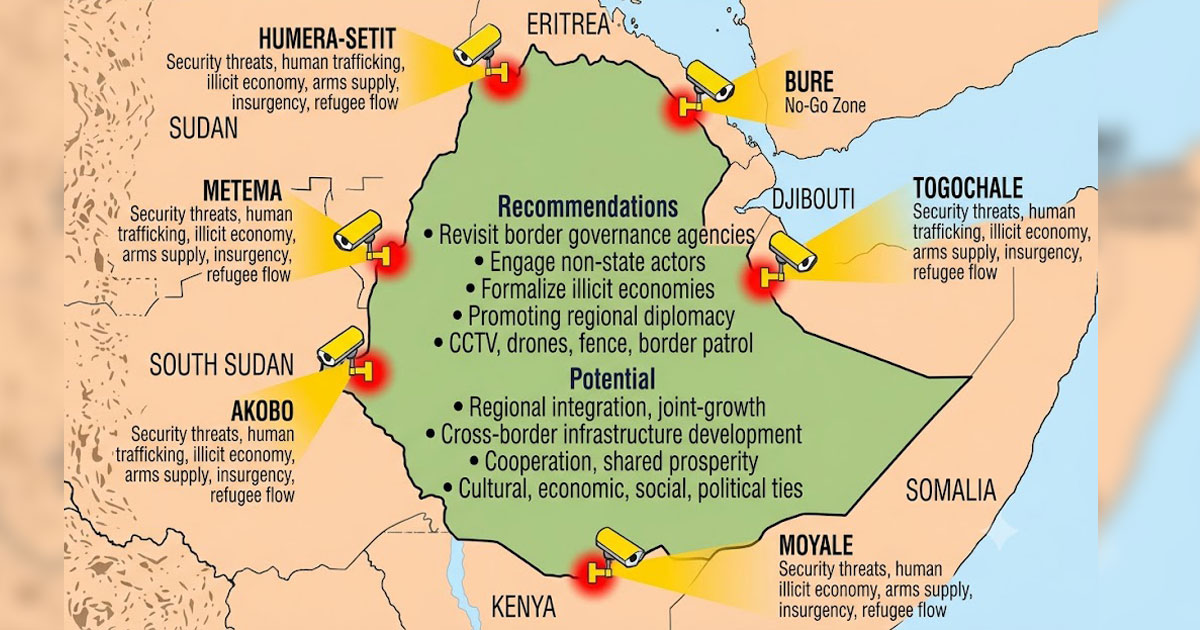
They also recommend the establishment of one-stop border posts like Moyale, formalization of informal economies, strengthening of border agencies, and forming a better understanding of the links between border control and regional security dynamics.
Further north, the report characterizes border governance along the relatively short boundary between Ethiopia and Djibouti as a peaceful economic lifeline plagued by severe infrastructural deficits.
This stagnation, fueled by prolonged disputes, has resulted in profound economic paralysis and widespread anxiety among local populations.
The study findings highlight a “formally centralized but informally diffuse” governance model in which state presence is primarily limited to tax collection and transit monitoring at major hubs like Galafi and Balho. This has created a “governance vacuum” in remote areas, leaving human security and basic services like water, education, and health nearly nonexistent.
Meanwhile, in the absence of robust state intervention, traditional Afar institutions including sultanates, clan leaders, and Fiema youth groups have become primary providers of social order, conflict resolution, and security intelligence.
The report’s authors warn the region has become a high-risk transit point for irregular migration and humanitarian crisis.
They urge the governments of Ethiopia and Djibouti to focus on economic formalization, modernizing socio-economic infrastructure, joint development schemes, governance reforms, diplomatic de-escalation, and modernizing the border control mechanisms.
In the south, the study paints the Ethiopia-Kenya border as home to an extensive network of unmonitored informal routes. Along this border, up to 70 percent of communities lack access to basic infrastructure, nearly half lack access to safe water, and youth unemployment hovers at 35 percent.
The border town of Moyale is highlighted for political uncertainty stemming from administrative friction tied to internal regional disputes between the Oromia and Somali regions. The area also suffers from insecurity due to resource-related conflict, particularly over grazing land and water, and the report notes it remains vulnerable to illegal flows of arms, human trafficking, organized crime, and unauthorized migration.
The study highlights illegal trade in Small Arms and Light Weapons (SALW), and continued activity of illicit armed groups as serious security risks on Ethiopia’s southern border.
On the other hand, while Moyale one-stop border post remains a crucial point of trade and movement, the wider southern border is prone to illegal trade that often evades taxes through alternative routes that bypass bureaucratic hurdles.
Experts note that while there are a lot of local and international NGOs, CSOs and community organizations present along this route, their participation in border related issues is insignificant.
Here too, inadequate transportation and communication equipment, coupled with a lack of specialized skills among border officers and local community volunteers, poses a challenge for governance and security.
The study recommended economic empowerment, institutional modernization, balanced attention, strengthening collaboration and legal procedures, and engaging non-state actors as the most effective methods to improve these gaps.
To the west, the Ethiopia-Sudan border is also characterized by security threats, among other challenges, particularly along the Metemma-Setit Humera corridor in the Amhara region, and the Kurmuk frontier in Benishangul-Gumuz.
“Ethiopia-Sudan boundary remains contested historically. The Metemma-Humera (Al-Fashaga) section is the most disputed area, where fertile agricultural lands, overlapping territorial claims, and competing historical narratives continue to fuel tensions between Ethiopia and Sudan,” reads the report.
In contrast, the Benishangul-Gumuz frontier is relatively less contested and historically characterized by shared tribal identities, customary governance systems, and livelihood-based cross-border interactions.
“Border security challenges have significantly intensified due to armed conflicts in Sudan and the presence of non-state actors in the border areas. The borderlands are experiencing rising levels of insecurity, including kidnapping for ransom, small arms proliferation, contraband trade, human trafficking, and movement of non-state armed groups across porous borders,” warn experts.
The Kurmuk and Blue Nile frontiers areas in Benishangul Gumuz are facing growing instability due to the ongoing war between the Sudanese Armed Forces (SAF) and the Rapid Support Forces (RSF), who have been fighting for more than three years.
The closure of official border crossing points such as Kurmuk, Almahal, Bamza, and Gizen has disrupted cross- border trade, mobility, and long-standing kinship relations. Armed confrontations near the Ethiopian border have increased fear, insecurity, and economic vulnerability among local populations. Despite their enormous agricultural, mineral, and trade potential, the borderlands remain economically marginalized and infrastructurally underdeveloped.
Experts urge the government to focus on strengthening security and civilian protection along the Sudanese border, establish a specialized institution to oversee governance, and promote community-based governance and peacebuilding.
They also see diplomatic rapprochement and initiatives for economic cooperation as key to transforming the borderlands from conflict zones into productive and safe places to live.
Like the others, the Ethiopia-South Sudan border is politically fragile and remains highly porous, fluid, and vulnerable to transnational security threats and governance challenges.
“The Ethiopia-South Sudan frontier is not merely a territorial line separating two sovereign states, but a socially negotiated and politically contested space characterized by overlapping authorities, hybrid governance systems, and extensive cross-border interactions,” reads the report.
Historically, border governance on the Gambella frontier has largely relied on customary institutions, local community leaders, and militia structures rather than strong formal state intervention.
Prolonged conflict in South Sudan has significantly shaped the governance and security dynamics of this border, which remains confronted with transnational threats, including refugee influx, cattle raiding, intercommunal violence, child abduction, illegal migration, contraband trade, and the proliferation of small arms and light weapons.
Large sections of the frontier lack immigration posts, customs offices, police stations, transportation infrastructure, and communication networks, rendering border governance highly difficult. Border districts like Akobo, Lare, Jikawo, Gog, Dimma, and Itang remain particularly vulnerable to armed incursions and cross-border violence.
Here, the study’s authors recommend strengthening community-based border governance and conflict resolution, improving border control and regulation of cross-border mobility, promoting regional diplomacy and peacebuilding in South Sudan, and expanding borderland infrastructure and socio-economic development.
The study did not cover the Ethiopia-Eritrea border, which remains a “no-go” zone amid tensions between the two countries.
The Deliberations
The presentation was followed by discussions involving government officials, experts, and development partners.
Officials from the Ethiopian Immigration and Citizenship Services (ICS) said they provide a number of services along the country’s borders, but pointed out the challenges they continue to face.
“We control incoming and outgoing transportation systems. With the Ministry of Transport, we provide special IDs for Ethiopian truck drivers going to and coming from Djibouti. We facilitate in providing border communities with local IDs so they can participate in the market systems of neighboring countries instead of coming to central markets or using passports,” stated an ICS official.
Yet, officials concede illicit trade, human trafficking, arms dealing, and other illegal activity remain widespread along borders.
“There are three big human trafficking routes. The southern Ethiopia route is used by human trafficking operators bound to South Africa. The Eastern Ethiopia route is used by human traffickers whose destination is the Middle East and Gulf. The Metemma route is used for destinations in Europe and others. Foreigners also enter and leave through our porous border areas. We often collaborate with Interpol to identify people who should not enter or exit the Ethiopian border,” stated the ICS official.
ICS is mandated by federal law to implement an integrated border management system, which it is in the process of doing in tandem with nearly a dozen other government institutions. Its officials say a detailed study has been conducted on Ethiopian borders, including airspace, and a national steering committee has been established.
The committee is led by Redwan Hussein, director of INSA, and Demelash Gebremichael, deputy head of the Federal Police Commission.
Other officials from Ethiopia’s Refugees and Returnees Service (RRS) also stressed they are discharging their mandates.
“Regarding refugees coming to Ethiopia from neighboring countries, we are working with Ethiopian institutions, especially security offices and regional governments. In addition, we also work with international organizations like IOM and UNHCR. We jointly undertake assessments before allowing refugees to cross Ethiopia’s borders, addressing what root causes are uprooting them from the other side,” said an RRS official.
The most proactive insights and recommendations came from David Gudish, who is deputy permanent observer to the AU from the embassy of Germany, and who was at the meeting. He drew on the experiences of the European Union in prioritizing regional integration.
“Secure and stable borders are key for enriching regional integration. The EU community has good experience on this. This experience could be replicated in the Horn of Africa,” he stated.
“Germany’s collaboration on this with Ethiopia is not new, but longstanding. Germany believes effective border governance needs concrete operational capacity on the ground. Germany also has been enhancing Ethiopia’s capacity on this through several supports including providing patrols, field assessment, mobility along borders’ difficult terrains and to increase proactive governance presence in border zones,” said Gudish.
However, material support is only one side of the coin, asserts Gudish.
“Sustainable border governance requires robust institutional capacity and highly skilled manpower. Germany is investing in these. Ethiopia is boldly rewriting the narrative by choosing to view its frontiers not as barriers that divide, but as vital bridges of human security, economic cooperation, and shared regional prosperity,” he said.
Gudish called on AU member states to move from a fragmented approach to coordinated strategies.
“The AU, IGAD and other initiatives are also crucial,” he said.