From Reconstruction to Recruiting: The SCORE Act and the Fight for Black Athletic Freedom
*In American history, Black mobility has always triggered institutional response. From Reconstruction’s collapse to Jim Crow labor controls, from redlining to college athletic exploitation, systems have often adjusted the rules the moment Black Americans gain leverage. The SCORE Act may be the newest chapter in that story. As Congress moves toward a critical vote on […] The post From Reconstruction to Recruiting: The SCORE Act and the Fight for Black Athletic Freedom appeared first on EURweb | Black News, Culture, Entertainment & More.
 Black News
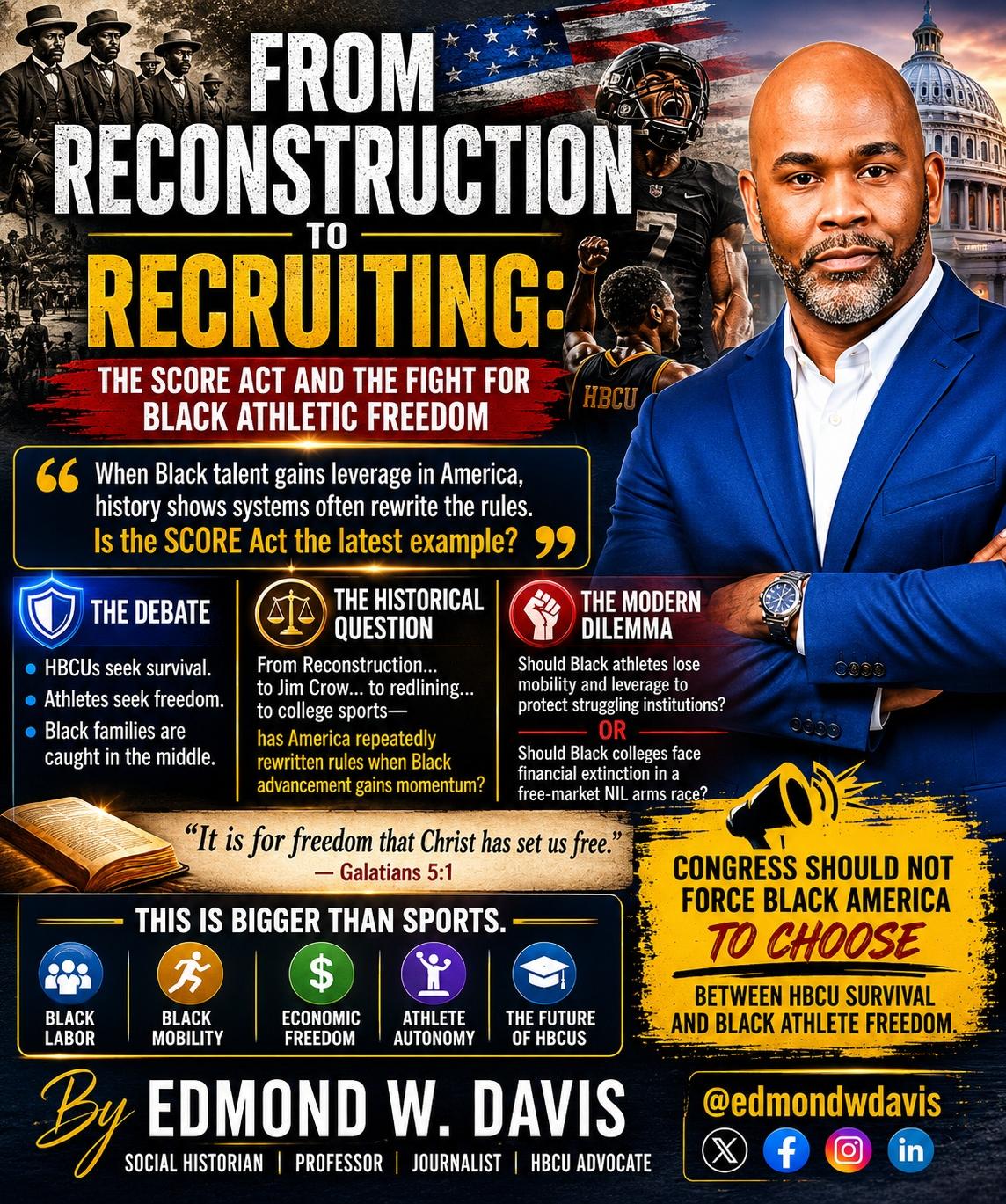
*In American history, Black mobility has always triggered institutional response. From Reconstruction’s collapse to Jim Crow labor controls, from redlining to college athletic exploitation, systems have often adjusted the rules the moment Black Americans gain leverage. The SCORE Act may be the newest chapter in that story.
As Congress moves toward a critical vote on federal NIL legislation, Black America is not speaking with one voice. This is not a simple partisan fight. It is a deeply emotional, economic, historical, and moral divide unfolding within Black America itself. HBCU commissioners, athlete-rights advocates, Black journalists, civil liberties observers, and families of student-athletes are asking fundamentally different questions about freedom, survival, and fairness.
Some Black leaders see protection. Others see containment.
According to a Centre Daily Times article, the commissioners of the SWAC, MEAC, CIAA, and SIAC—representing many of the nation’s Historically Black Colleges and Universities—have publicly supported aspects of federal NIL reform, arguing that a national framework is preferable to a fragmented patchwork of conflicting state laws. Their concern is not ideological theater. It is institutional survival. Smaller athletic departments cannot financially compete with the unrestricted spending power of the SEC, Big Ten, and other major Power conferences. Many HBCU leaders fear that if college athletes are classified as employees or NIL systems descend further into chaos, already resource-strained Black colleges could face crushing legal exposure, unsustainable payroll realities, and even existential threats.
That concern deserves respect.
But so does the opposing side.
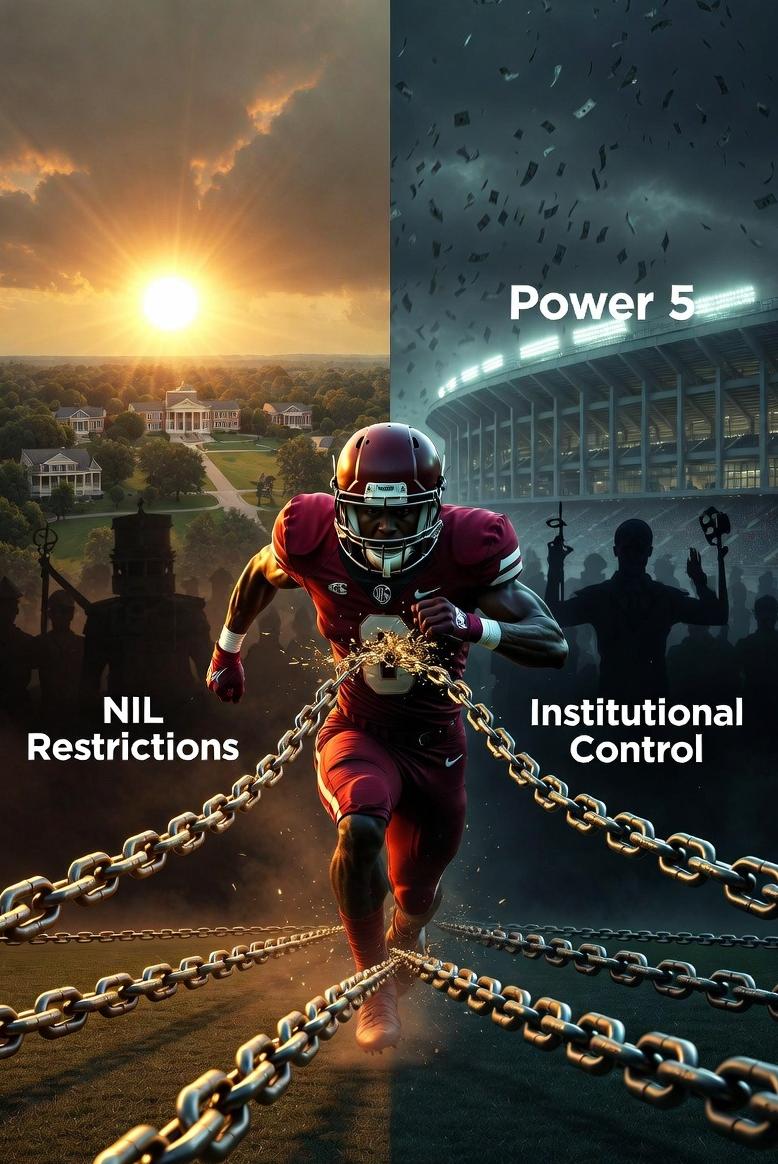
Athlete-rights advocates, civil liberties observers, and many Black commentators view the SCORE Act as a dangerous restructuring of power that could ultimately benefit institutions far more than the athletes whose labor fuels college sports. According to the National Urban League, critics argue that the legislation could shield NCAA governance structures, weaken athlete bargaining leverage, restrict future employment rights, and preserve the economic dominance of institutions that have profited from Black athletic excellence for generations.
And history explains the suspicion.
For decades, Black athletes helped build multi-billion dollar cathedrals they did not own.
College football and men’s basketball became billion-dollar American industries in large part because of Black athletic labor. Television contracts generate extraordinary revenue. Coaching salaries in major conferences routinely exceed eight, ten, and even twelve million dollars annually. Universities construct elite facilities, strengthen donor ecosystems, and elevate institutional brands through the extraordinary performance of athletes who, until recently, were denied even the right to monetize their own names, images, and likenesses.
To many Black Americans, this history sounds painfully familiar.
As Ecclesiastes 4:1 reminds us: “I saw the tears of the oppressed—and they had no comforter; power was on the side of their oppressors.”
This is why the debate is emotionally charged.
Because while some see reform, others see a polished modernization of an old American formula: controlled freedom.
The HBCU paradox makes this especially painful.
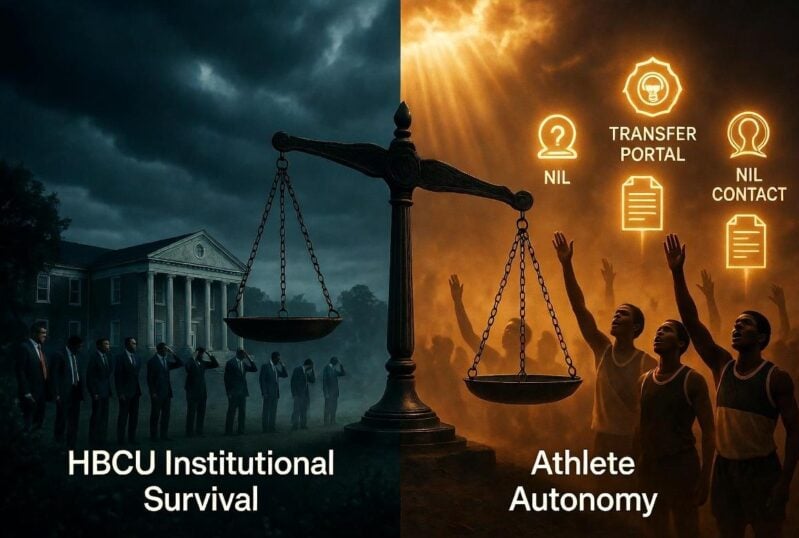
Many HBCU leaders may support federal guardrails not because the system is ideal, but because the alternative may be institutional irrelevance. In a marketplace where wealthy predominantly white institutions can outspend nearly everyone, “bad structure may be better than no structure” becomes a pragmatic survival strategy.
But that creates a profound moral dilemma:
Does protecting Black institutions require limiting Black athletes’ freedom?
That question becomes even more urgent when race enters the conversation directly.
The issue of racism in college athletics is not theoretical. Black athletes have long described racial isolation, hostile campus climates, tokenization, culturally disconnected coaching environments, Confederate symbolism, and subtle or overt exclusion at some predominantly white institutions. Not every campus is the same, but enough stories have emerged over decades to make this concern impossible to dismiss.
Now consider the practical implications.
If a Black athlete at LSU, Alabama, Ole Miss, Arkansas, Auburn, or another major institution experiences a racially hostile environment and wants to transfer to an HBCU, should Congress help create financial barriers that make that move harder?
Should federal law make mobility more difficult precisely when autonomy is needed most?
Galatians 5:1 offers a powerful reminder: “It is for freedom that Christ has set us free. Stand firm, then, and do not let yourselves be burdened again by a yoke of slavery.”
This is why the transfer question matters so deeply.
If NIL valuation rules become more restrictive, if institutional approval mechanisms tighten, or if athlete leverage weakens under federal standardization, then transferring to an HBCU may become less financially viable for athletes leaving powerful programs. That does not merely affect economics. It affects dignity, agency, and personal safety.
Isaiah 10:1–2 warns us clearly: “Woe to those who make unjust laws, to those who issue oppressive decrees, to deprive the poor of their rights…”
That scripture does not require opposition to every law. But it does require moral scrutiny whenever laws consolidate power upward while limiting freedom below.
To be fair, supporters of the SCORE Act are not villains. Many are trying to protect institutions that have historically done more with less. HBCUs have long served as sanctuaries of Black excellence, leadership, scholarship, and cultural affirmation while operating without the massive financial infrastructure enjoyed by elite athletic powers.
But protecting Black colleges should not require recreating systems where Black labor remains structurally subordinate.
That is the core concern.
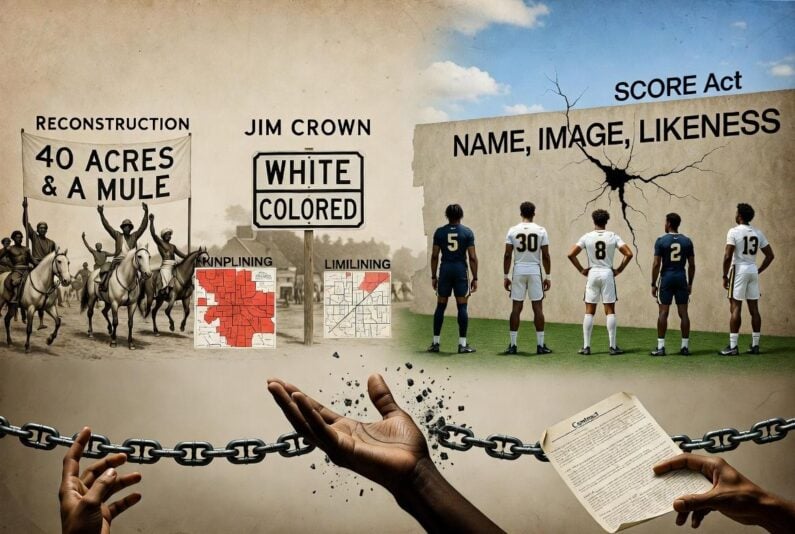
This debate is not merely about NIL compensation.
It is about whether Black athletes can fully own their mobility, labor, and opportunity in an America that has historically responded to Black advancement by rewriting the rules.
From Reconstruction to recruiting, the pattern feels painfully familiar.
This moment also feels hauntingly reminiscent of another painful American chapter. During the height of the so-called War on Drugs from the 1970s through the 1990s, federal policies disproportionately devastated Black urban communities. The long-term consequences included mass incarceration, fractured families, economic instability, over-policing, premature death, and cycles of internalized violence in neighborhoods already stripped of opportunity.
That is why this moment feels so unsettling.
Because once again, Black America appears to be positioned in a struggle not entirely of its own making.
This time not in the streets. Not in public housing corridors. Not in the shadows of the crack era. But inside boardrooms, athletic departments, and congressional chambers.
The battlefield has changed. The underlying tension feels familiar.
Black institutions may be forced into opposition with Black athlete autonomy. HBCUs seeking institutional survival may find themselves standing opposite the very freedoms Black student-athletes have only recently begun to access. If so, this would represent not progress, but another effective American pattern of internal fracture—where systemic pressure creates conflict among Black stakeholders competing for limited power, resources, and protection.
The SCORE Act is not merely about NIL. It is about who controls Black mobility, Black labor, and Black opportunity in 21st-century America. HBCUs deserve not just to survive but also to thrive. Black athletes deserve freedom and economic mobility. Congress should not force America to choose between the two.
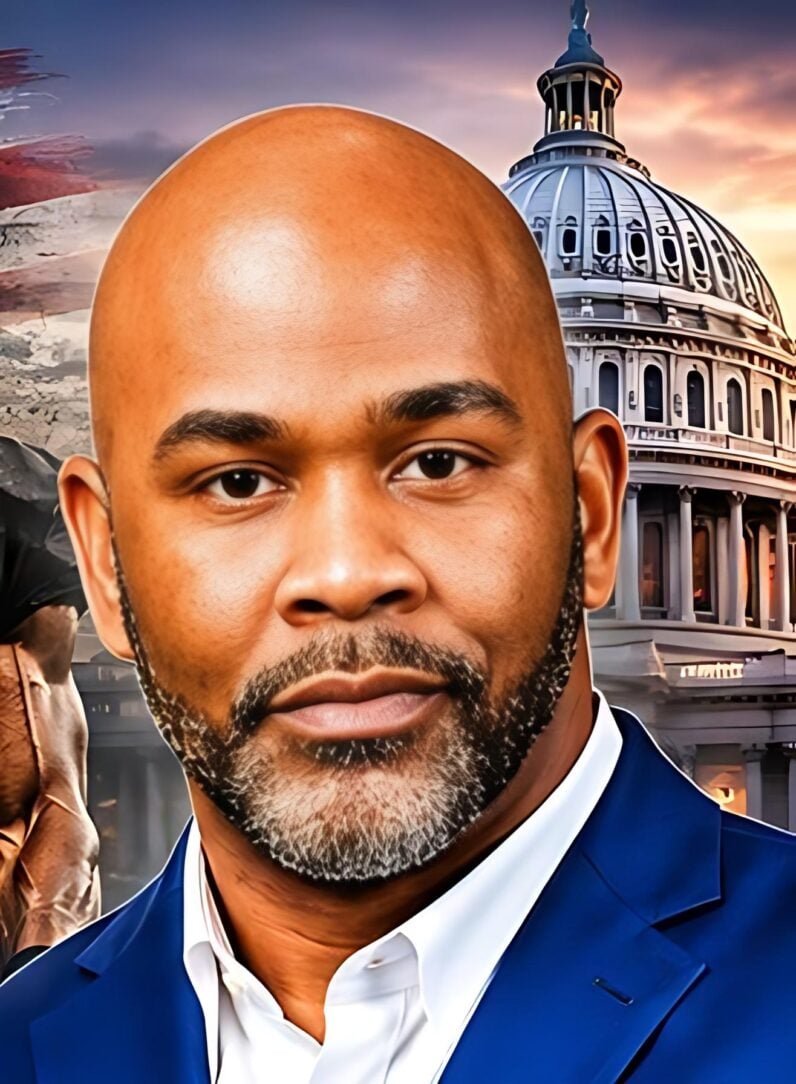
ABOUT THE AUTHOR:
Edmond W. Davis is an American social historian, international speaker, and Amazon #1 bestselling author. He is a global authority on the Tuskegee Airmen and serves as the founder and executive director of the National HBCU Black Wall Street Career Fest. A native of Philadelphia, PA, and current resident of Little Rock, AR, Davis is committed to cultural empowerment and educational equity through storytelling and civic engagement. Davis is a grand marshal at the 38th Annual African American History Month Celebration Parade.
(If You Like/Appreciate This EURweb Story, Please SHARE it!)
MORE NEWS ON EURWEB.COM: School Admits A’Shari Hobbs Did Nothing Wrong — Then Punished Her Anyway
We Publish Breaking News 24/7. Don’t Miss Out! Sign up for our Free daily newsletter HERE.
The post From Reconstruction to Recruiting: The SCORE Act and the Fight for Black Athletic Freedom appeared first on EURweb | Black News, Culture, Entertainment & More.