Inquiry-based chemistry training for west coast natural sciences teacher
Advancing Knowledge Non-Profit Company (AK NPC) has continued its professional development programme for Natural Sciences educators in the West Coast Education District of the Western Cape. This initiative is supported through a partnership between AK NPC, the Garden Cities Archway Foundation (GCAF), and the Western Cape Education Department (WCED). The second-term CAPS curriculum for Natural […]
 Black News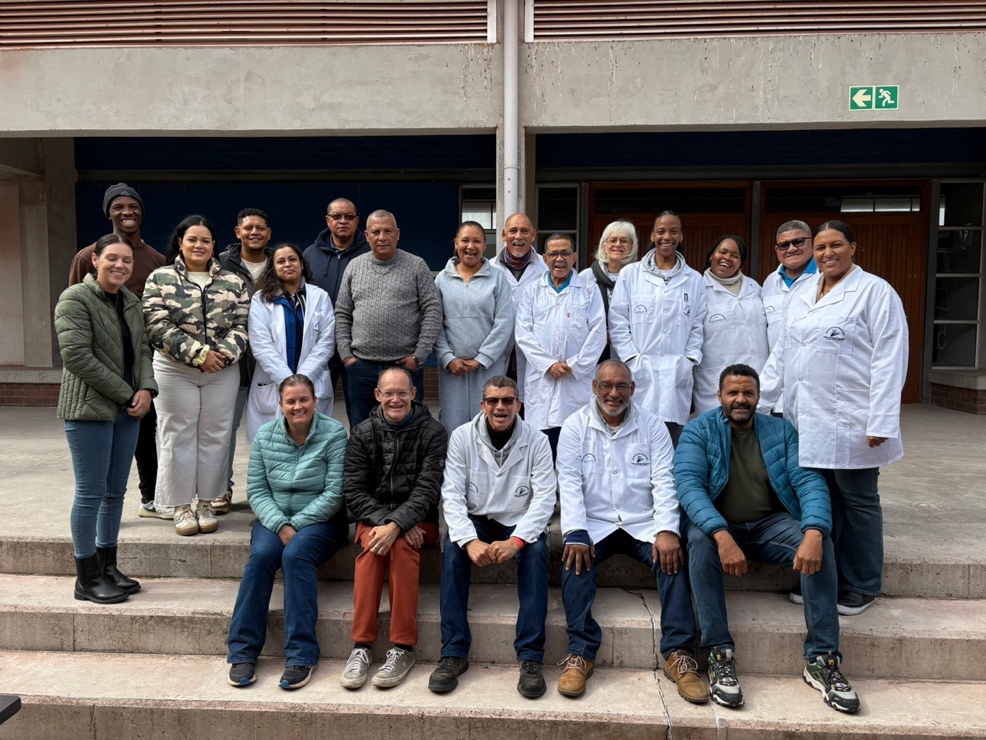
Advancing Knowledge Non-Profit Company (AK NPC) has continued its professional development programme for Natural Sciences educators in the West Coast Education District of the Western Cape. This initiative is supported through a partnership between AK NPC, the Garden Cities Archway Foundation (GCAF), and the Western Cape Education Department (WCED).
The second-term CAPS curriculum for Natural Sciences, covering both the Intermediate Phase (Grades 4–6) and Senior Phase (Grades 7–9), focuses on the “Matter and Materials” knowledge area, commonly referred to as chemistry. This training formed the second of four professional development sessions planned for West Coast Natural Sciences teachers in 2026. The first session addressed Life Sciences content for Term 1.
The workshop took place in the science laboratory at Louwville High School in Vredenburg—a facility established through the successful partnership between AK NPC, GCAF, and WCED. Training for Intermediate and Senior Phase (Grades 4–7) teachers was held on Friday, 17 April 2026, while Senior Phase (Grades 8–9) teachers attended on Saturday, 18 April 2026.
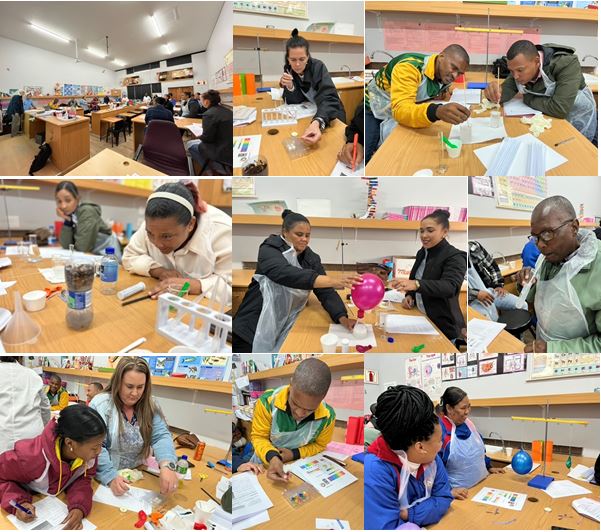
The inquiry-based training sessions adopted a hands-on approach to the practical and experimental chemistry content that teachers are required to cover during the upcoming term. The programme aims to equip educators with the skills to conduct engaging, inquiry-based lessons using readily available, everyday materials. AK NPC’s philosophy emphasises illuminating theory through practical application.
The course is endorsed by the South African Council for Educators (SACE), enabling participating teachers to earn professional development (PD) points that contribute to their professional growth and support applications for promotion posts.
Teacher participation was coordinated in collaboration with the West Coast Education District’s subject advisors, represented by Mr Ferdie Greeff. The chemistry sessions were facilitated by Prof Shaheed Hartley, Robert Solomon, Zaiboen Ahmed, Mark Ogilvie, Gert Marero, Annestacia Marthinus, and Danie Burger. They were supported by AK NPC staff members Somila Dlakavu and Siphiwuthando Qeqe (science interns), as well as project coordinator Melissa Petersen.
CHEMISTRY FOR INTERSEN (GRADES 4–7) TEACHERS
Teachers braved heavy rains to attend the training session at Louwville High School on Friday, 17 April 2026. The course provided an introduction to foundational chemistry concepts for the Intermediate Phase and highlighted key principles of the inquiry-based approach. These included understanding dependent, independent, and controlled variables, the scientific method, and hands-on investigative activities.
Practical sessions covered topics such as solubility, compressibility, basic chemical reactions, chromatography, acid-base reactions and indicators, forces and their balance, strength of materials, and an introduction to the periodic table. Teachers actively participated in activities aligned with the “Matter and Materials” curriculum, many of which can be directly implemented in their classrooms. The inquiry-based approach encouraged educators to ask probing questions, formulate hypotheses, and engage in problem-solving through experimentation. Reflections from participating teachers included:
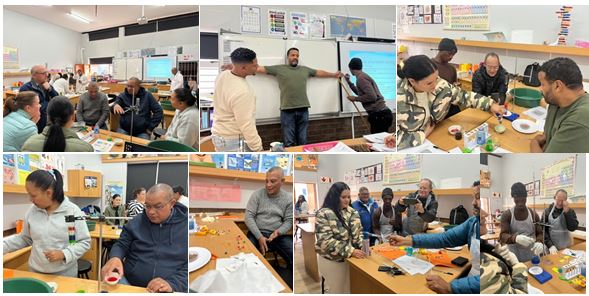
- “This session comes at the right time as we prepare our chemistry lessons. It will help us keep learners actively involved in our teaching.”
- “As a new Natural Sciences teacher, especially in this section of the curriculum, the videos I recorded will help me revisit the content. I feel much more confident now.”
- “I am glad I attended—many of my questions were answered. Recording the activities will help me see how to integrate practical work into my lessons.”
- “I can now use simple materials that learners can bring to class to set up experiments they can do themselves. This will make lessons more engaging.”
- “The experiments were simple and used everyday materials. It makes teaching easier when learners can see and do the work themselves.”
CHEMISTRY FOR SENIOR PHASE (GRADES 8–9) TEACHERS
Many participants also teach Physical Sciences at FET level, which contributed to a smooth facilitation process. The session introduced inquiry-based science education by exploring participants’ understanding of science, the nature of scientific knowledge, and the application of the scientific method through problem-solving.
Core chemistry concepts were presented through the study of matter, including phases of matter, mixtures, elements, the periodic table, compound formation, chemical reactions, and balancing equations. Each concept was paired with a practical, thought-provoking activity that encouraged hands-on engagement and critical reflection.
Teachers participated in experiments involving the separation of mixtures (mechanical methods, density-based techniques, and chromatography), acid-base reactions through titrations, preparation of gases such as oxygen, hydrogen, and carbon dioxide, and combustion reactions involving metals and non-metals.
Participants shared the following reflections:
- “This was a workshop well worth attending—time well spent. I enjoyed every experiment and was reminded of how exciting chemistry can be.”
- “Although I only teach Grades 8 and 9, I learned a great deal. Even experienced Physical Sciences teachers found this approach engaging.”
- “This was an excellent, challenging, and thought-provoking workshop. It presented familiar concepts in a new way through inquiry-based learning.”
- “Our teachers greatly appreciated the interactive sessions. I encourage more educators to attend future workshops, including the upcoming Energy and Change (Physics) session in August 2026.”
This project was made possible through the partnership between AK NPC, GCAF, and WCED. Organisations and corporate partners interested in supporting this initiative to empower science teachers and build a strong pipeline of STEM learners are encouraged to contact the Director of AK NPC, Prof Shaheed Hartley, at shartley@skatt.co.za or visit www.skatt.co.za.