‘IS GOD IS’ Reimagines The Revenge Genre Through Black Women’s Eyes
Aleshea Harris breaks from the cinematic tradition that has spent decades requiring Black women to forgive our way back to grace.
 Black News
“You ever want to scrape your scars off and see what’s underneath?”
It’s a natural question for anyone who has carried trauma in their body and wants to know: What is left underneath all the harm that has been done to me? Who would I be without these scars?
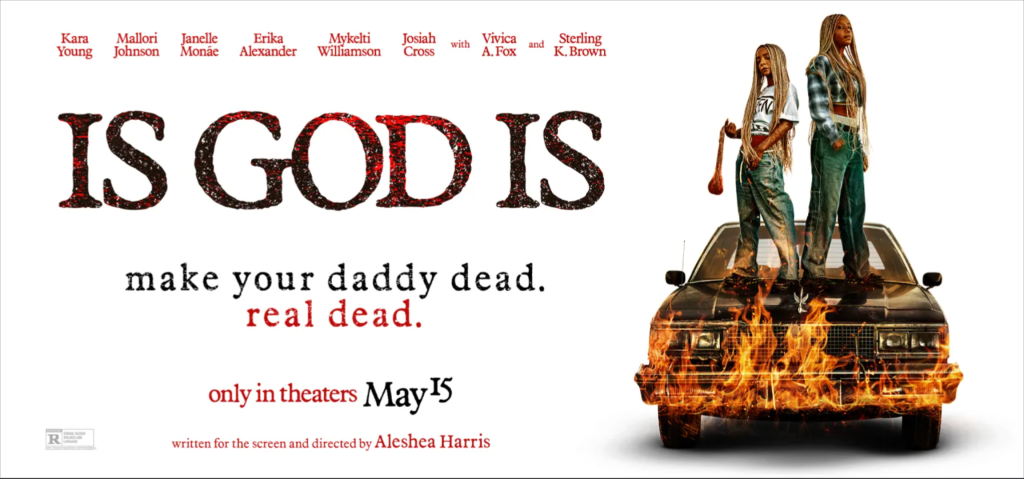
In Is God Is, the first feature film from writer-director Aleshea Harris, this question hangs in the air between twin sisters, Racine and Anaia, who bear emotional and physical scars from a fire their father set during their early years while attempting to incinerate their mother.
The twins are now grown, and the movie brings us along with them to a home in the South, where their mother Ruby, who they believed had died in the fire their father set, is alive and near death.
As the two young women prepare to come face to face with her on her deathbed, Racine asks her twin, “You ready to go see God?”
“God?” answers Anaia, quizzically.
To which Racine replies, “She made us, didn’t she?”
As they make their way to her bedside, a curtain parts to reveal their mother propped up in a hospital bed. Most of her body is covered in bandages, and she is flanked by Black women on either side of her, carefully braiding her hair.
Harris has physically arranged Ruby for us the way any god would be in her last days, on display, tended to, and watched over dutifully by her faithful.
She is God, just like Racine said.
As God begins to recount to the twins the night their father set her on fire, she intentionally layers in a maternal warning, “He does have a tender side,” she divulges. “Men like your Daddy always have a tender side.” God is folding this lesson into her testimony as a cautionary tale for her twins to carry forward as something likely to be true about every abusive man her daughters might encounter throughout the course of their lives.
God reveals she did not call her girls home for a reunion. She wants them to exact revenge on her behalf. The target? Their sometimes tender, and often charismatic father, Man. “Make your Daddy dead. Dead. Dead,” she instructs. “And everything around him, you can destroy it, too.”
What would ordinarily play as an extreme deathbed wish arrives differently when the request comes from God. Ruby can no longer be cast aside as another Black woman the world has discarded. The change in name makes the violence done to her two decades ago cosmic in scale. To burn a god is sacrilege, and the retaliation has to match, leaving violent revenge the only proportional answer.
For Harris, leading with revenge is not a screenwriter’s flourish. Rather, it is a decision by an exceptional filmmaker who wants Black women in the audience to see their anger reflected back at them.
“There might be something for someone who has suffered in these ways or has seen someone suffer in these ways, watching these women fully embrace their anger, be given space and a narrative for that rage,” Harris explained. “I’m not wagging my finger at Black women for their anger. The posture of the movie is that the anger is justified. That it is righteous rage.”
Harris pushes back against the expectation that Black women should bury our anger. “The dictates of respectability hold that for Black people, and certainly for Black women, there is no space for that Black rage,” she explained. “We earn our stripes as mothers by our ability, in part, to endure. I think that’s despicable and dehumanizing.”
Is God Is asks what happens when Black women stop waiting on systems that were never built to save them. The daughters of God have been tasked with delivering the justice the institutions, the community, and the church failed to.
Their father, the man they call the Monster, has built a new life in the years since the fire. The twins’ first stop on their mission to find him is a woman named Divine, the Healer, a pastor played by Erika Alexander. Divine leads her own small storefront church and is one of the women the Monster fathered a child with, a son named Ezekiel.
When the twins find her at the church, she is cloaked head to toe in white, waiting for the Monster’s return. Divine is not running an ordinary church. The pulpit she has built has given her unchecked authority over the people who sit in her pews. “You go in there, and she is literally throwing those people around with the power of the Holy Ghost,” Alexander told me. “She is actually casting the devil out of a child. [Saying] It is your turn again. It is ridiculous.”
True to her name, dressed head-to-toe in all white, Divine has positioned herself as a conduit for the holy, the channel through which God reaches her congregation. To the world in general, and to her parishioners in particular, she belongs to God.
Divine has also constructed an altar dedicated to the Monster, replete with his clothes and personal effects. The altar reveals her fuller truth. Divine belongs to God. In her case, God is the Monster.
For Alexander, playing Divine required digging into a character who was so blinded by her devotion to the Monster that she is not quite human. “She is still lusting for him. So to me, she’s not a real person anymore. She’s in purgatory. She’s not on earth, and she’s not in heaven nor hell. This woman doesn’t represent reality.”
In a brief encounter inside Divine’s church, the twin daughters represent a changing of the guard, a new generation of Black women refusing to honor the cycle of violence and silence that Black women traditionally have been asked to sustain.
Divine reveals to the twins that the Monster left her when she was pregnant with their son, Ezekiel. Racine snaps. “Oh, uh uh. You’ve been sittin’ up waiting on a man who left you pregnant? A man who ain’t tell you where he was going? That’s the man you waiting on?”
Without skipping a beat, Ezekiel, now grown, comes to his mother’s defense the only way he knows how. “The Bible says…”
Divine cuts him off mid-sentence. Her voice drops as something shifts in her body. With the full weight of her pulpit behind her, she turns on Racine the way she might turn on a parishioner she is about to cast a demon out of, “I can see that you’re septic with anger, and the spirit of devilment.”
By attacking Racine, Divine is doing precisely what her faith has trained her to do. Black women watching the film will recognize a Divine in their own lives: the auntie who told her mother to stay, the first lady who blamed the single young lady for the pastor’s wandering hands, the woman who organized casserole deliveries for the abuser’s mother while her own daughter is hiding away in a domestic violence shelter, chastised for escaping the abuse.
I asked Alexander where Divine finds her power. “I think she built a wall. That church is a wall away from what really hurts her. That she’s not loved. That she was left pregnant. That she was left lusting, and that’s all she can remember,” Alexander shared. “There are so many women who are broken down like that. They cannot get over the man who has done them wrong because they feel that lusting, and what they really want is to be loved. Behind that lust is love. It’s what happens to a dream deferred. It turns in on you.”
Harris also wants people to see the parts of Divine that have been broken down. She shared her hope that “there’s some empathy for Divine. She’s not just a clown, especially as Erika portrays her. She is in a kind of limbo, this waiting in the white dress, and it’s sad that this stasis is caused by her complete and myopic devotion to the Monster.”
Harris was deliberate about what Sterling K. Brown’s acting credentials would bring up for the audience in his role as the Monster. “For Sterling, I have it in the script that when we finally see his face, he is like Obama,” she told me. “He is meant to be this guy who is very charming, very attractive, very unassuming. And so that is subverted, of course, when he makes the turn.”
Alexander goes a step further, pointing out how often people have given men a pass because of their charm, “Didn’t we do that for Cosby? And Diddy? We want to love these people. They are charismatic, by the way. There’s something to them.”
There is something to them.
The twins find the Monster’s most recent wife, Angie, played by Janelle Monáe, on the road. She is leaving him and has left their twin sons back at the house. All three women share a connection and have been harmed by the same dangerous man. None of that stops Angie from looking down on the twins from the moment they meet.
Angie is bougie, and her class performance is the only protection she has built for herself against the Monster. She has spent her marriage believing that the right house, the right clothes, the right surface life would eventually absorb the terror underneath.
By the end of the film, all three of the Monster’s sons have shown the same violent tendencies as their father. We are reminded that no one is safe from the Monster, and that protecting an abuser helps produce abusive successors and future generations of victims.
The twin daughters have become agents of a heretical matrilineal religion doing the work the orthodox religion refuses. Harris makes a strong case that Black women’s salvation will not come from the Father. It will come as a final directive from the Mother whose daughters named her God and committed to fulfilling her dying wish.
“There’s an opportunity for folks to challenge patterns in a family,” Harris explained. “And that’s why it’s just very instinctive that we lay some of this at the young women’s feet and offer them the opportunity to choose a path, and at least I do that as a storyteller, and we see them sort of make their choices.”
The path the twins choose is one that generations of Black women have been counseled away from. Anger. Refusal. Revenge.
What does Harris want Black women to walk out of movie theaters believing they deserve?
“Everything,” she answered with equal parts enthusiasm and resolve. “That any desire for revenge is justified. That the way that we feel is to be honored because it’s so often dismissed. But I also hope that Black women and girls will sit with the cost of holding anger and remember that we get to be okay no matter what. That there’s something about bearing the wound and having the scar but continuing on.”
Harris and Is God Is leave us with what many of us as Black women know intuitively and from lived experience. When we are abused, we have a right to be angry – to want revenge. Harris doesn’t stop there. Neither can we. We have to be our own protectors. Our own gods. Because no one is coming to save us. No one ever was.
SEE ALSO:
Howard Student Turns Eating Disorder Into Film Black Women Can’t Ignore
‘A New Day Begun’ Traces The Origins Of The Black National Anthem