Migration: why this policy field is emerging as a priority in Liberia
All across West Africa, migration policy-making has become a top priority. Not least related to the externalisation pressures of the European Union (EU) and its members’, regulating migration is a policy field that governments are pushed to pursue. But it also ties back to a culture of migration, long-standing mobility across the region, and displacement related to conflict and climate-related challenges. What about in Liberia, a country with its own complex history? In this piece, we show how migration is emerging as a top priority for the government, shown by institutional overhauls and joining international frameworks. We argue, on the […] The post Migration: why this policy field is emerging as a priority in Liberia appeared first on African Arguments.
 Black News
All across West Africa, migration policy-making has become a top priority. Not least related to the externalisation pressures of the European Union (EU) and its members’, regulating migration is a policy field that governments are pushed to pursue. But it also ties back to a culture of migration, long-standing mobility across the region, and displacement related to conflict and climate-related challenges. What about in Liberia, a country with its own complex history? In this piece, we show how migration is emerging as a top priority for the government, shown by institutional overhauls and joining international frameworks. We argue, on the basis of recent research in Liberia, previous work on migration priorities in West Africa as well as on Liberia, that this is related to new pressures, including from Burkinabé migrants but also the current US government.
Growing priority
There are numerous signs of the rising importance of the migration agenda. First, involving the diaspora has always been significant for the Liberian post-war governments. The Boakai government pushed this further, committing a concrete budget of 300,000 USD to the Office of Diaspora Affairs (liaising with the Foreign Office but based at the Presidency), launching diaspora conferences in the US in 2025 as well as “Annual Return” celebrations around Christmas, since 2024. In a move reminiscent of similar activities in Ghana, the government is now also welcoming African American investors to come to Liberia, offering them citizenship for a return to their ancestral homelands.
But beyond this, the government has taken on the migration agenda with a sense of urgency. In the run-up to the International Migration Review Forum that took place in New York in early May, IOM and the Liberian government expressed the urgency of making migration a policy priority. Indeed, President Boakai signed a new Executive Order in early March 2026, detailing his plans for migration. Liberia’s key agency, thus-far in charge of refugees, the Liberian Refugee, Resettlement, and Reintegration Commission (LRRRC), will be transformed into a new agency, the Refugee and Migration Commission of Liberia (RAMCOL). RAMCOL, set to be implemented by next year, will extend the mandate of the commission to labour migrants, refugees, stateless persons, and notably, deportees. This signifies on the one hand, in the words of Deputy Minister of Legal Affairs Jeddi Armah that migration governance is a “national priority.” On the other hand, it showcases that Liberia is interested in migrants beyond their powerful diaspora and refugees: namely labour migrants and deportees. Why both the political prioritisation and the type of migrants is now on the agenda will be outlined next.
Historical importance of migration in Liberia
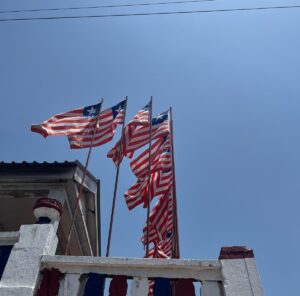
Liberian flags in Monrovia. The country’s history is deeply entangled with the United States.
Liberia is one of only two countries in Africa that was never formally colonised, yet like so many other states on the continent, it shares its very birth as a nation with a history of immigration. The country was founded by freeborn and recently emancipated enslaved people from the US under the auspices of the American Colonization Society in 1822, and declared independent in 1847. Indigenous groups within Liberia also build on migration histories, including people belonging to the Mandingo community, who have roots across the entire region, or the Kissi people who straddle well into Guinea and Sierra Leone, one of the causes of recentborder skirmishes in Liberia’s Lofa county. More recently, migration proved as an inevitable survival strategy of many Liberians during the country’s brutal 14-year civil war from 1989 until 2003. During this time, the diaspora had a mixed record of influencing the conflict on the ground. Since, Liberia has also regularly hosted refugees from neighbouring Sierra Leone and Cote d’Ivoire. In 2025, a last batch of Liberian refugees returned from Buduburam Camp in Ghana, after the cessation agreement from 2012, although some chose to stay in Ghana. Given the extensive history of migration in the region, why is the Liberian government deciding to prioritise migration policy making now?
Why now?
Making migration more of a priority takes place in a political climate where aid funds are increasingly tied to migration policy developments. Additionally, the European Union and United States have recently adopted stricter deportation and migration policies, and Liberia is experiencing increased migratory movement.
Since 2025, Liberia has experienced an increase in Burkinabé migrants and refugees entering in the Southeast of the country. In July 2025, the Liberian Immigration Service (LIS) registered 40,000 Burkinabé residing in Liberia, a number that rose to 55,000 in August 2025. The majority of them are assumed to have migrated for cocoa farming, which gave rise to tensions around land usage between local populations, migrants, authorities, and land conservation organisations. The government launched an initiative to improve the documentation of Burkinabé migrants, an effort that fits into the mandate extension of the LRRRC, which will be responsible for labour migrants and refugees alike.
Furthermore, stakeholders in Liberia organised several workshops to review the current state of GCM implementation in the West African country. Coordinated by the IOM through the UN Network on Migration’s Building Migration Partnerships Programme and financed through the European Union, Liberia is committed to implement the GCM into national policies. Thus, even as international cooperation is in decline given the current global climate, Liberia’s participation in the GCM process is timely to stay in line with international affairs where it still is possible.
Liberia has also been implicated in US plans to deport third-country nationals like other African countries. An agreement was signed in September 2025 and made public in March 2026. Liberia agreed to take on Kilmar Abrego Garcia, a man accused of human smuggling crimes who was erroneously deported to El Salvador and then returned, noting in a statement on the matter the “longstanding friendship” between the two countries. The commitment to send Abrego Garcia to Liberia was confirmed in April 2026 despite Costa Rica also agreeing to take him and his preference to go there. A US Government official explained the preference for Liberia that the US government had spent “resources and political capital” negotiating with Liberia in the first place. Indeed, the statement to take on Abrego Garcia followed a series of high-level meetings, resulting in tourism and business visas being extended to three years instead of only 12 months (though immigrant visas are still halted for Liberians). Additionally, investment agreements of $124 million were signed to the health sector and a concession agreement of $1.8 billion was signed for access to Liberia’s rail corridor by the US-backed company Ivanhoe Atlantic. Though Abrego Garcia is still in the US and a deportation to Liberia is not likely any time soon, at the end of April 2026, nine Liberian nationals with criminal convictions were returned to the country on a charter flight.
What next?
As other West African countries like Ghana or Sierra Leone have shown, engaging the diaspora is a vital step to secure investments and connecting Liberians across the world. Twenty-three years after the end of the war, Erasmus Williams, Head of the diaspora office, recently described Diaspora Liberians as “key partners in the rebuilding process,” noting that they contribute an estimated US$350–400 million annually in remittances one of Liberia’s largest economic lifelines. But diaspora members are not the only migrants that matter.
Looking at the bigger picture, the reform of the LRRRC to streamline migration policy across sectors and ministries, recognizing the role of the diaspora, working on inclusive migration policies through the GCM implementation might hint to progressive migration policy developments in Liberia. At the same time, as the Liberian scholar-activist Robtel Neajai Pailey has pointed out, Liberia should take note of its unique history of providing sanctuary for Black migrants when it comes to negotiating deportations with the US.
This article was co-authored with Franzisca Zanker, the Deputy Director of the Arnold Bergstraesser Institute (ABI) in Freiburg, Germany, where she also heads the research cluster on “Patterns of (Forced) Migration.” Her research interests include migration and refugee governance, migrant agency, peacebuilding and civil society and she has carried out research in Liberia, Kenya, Uganda, South Africa and The Gambia.
The post Migration: why this policy field is emerging as a priority in Liberia appeared first on African Arguments.