Ports are not just infrastructure: what Tema reveals about development in Africa
Across Africa, large-scale infrastructure projects are transforming economies at an unprecedented pace. Between 2010 and 2022, African ports captured an outsized share of global port investment – $13 billion, concentrated heavily in the Democratic Republic of Congo, Nigeria, Senegal, and Ghana. Ports, railways and energy systems are widely framed as the backbone of this growth: essential for trade, investment, and global integration. But that framing rests on a narrow assumption that infrastructure is primarily a technical solution to economic problems. My research on Ghana’s Port of Tema, conducted with colleagues Casper Andersen and Annette Skovsted Hansen, suggests the more useful […] The post Ports are not just infrastructure: what Tema reveals about development in Africa appeared first on African Arguments.
 Black News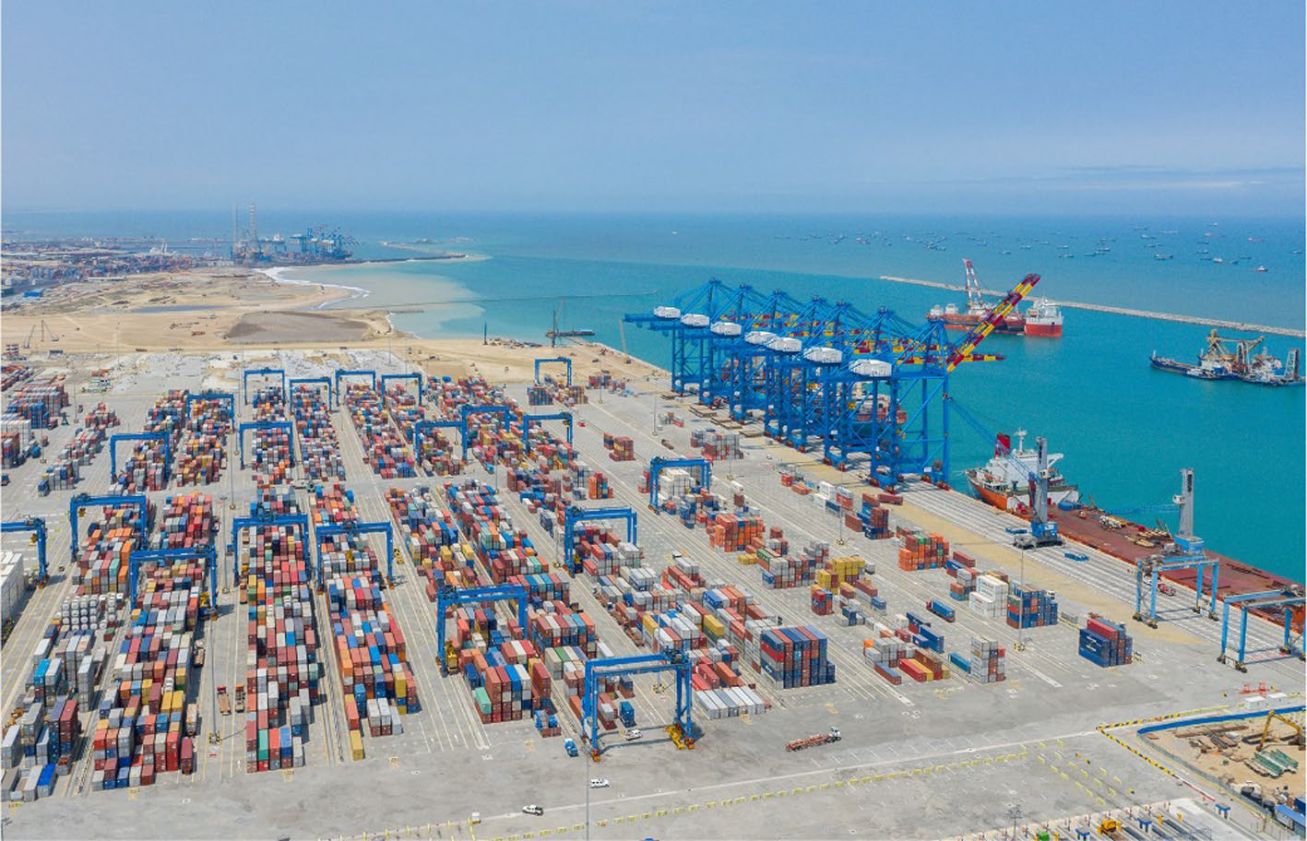
Across Africa, large-scale infrastructure projects are transforming economies at an unprecedented pace. Between 2010 and 2022, African ports captured an outsized share of global port investment – $13 billion, concentrated heavily in the Democratic Republic of Congo, Nigeria, Senegal, and Ghana. Ports, railways and energy systems are widely framed as the backbone of this growth: essential for trade, investment, and global integration.
But that framing rests on a narrow assumption that infrastructure is primarily a technical solution to economic problems. My research on Ghana’s Port of Tema, conducted with colleagues Casper Andersen and Annette Skovsted Hansen, suggests the more useful question is not whether infrastructure “works,” but whose vision of development it realises, and at what cost.
Beyond technical success
By conventional metrics, Tema’s recent expansion is an unambiguous success. The port’s new Terminal 3, run by Meridian Port Services (MPS) – a joint venture between Ghana’s Port and Harbours Authority (GPHA), APM Terminals and Africa Global Logistics – tripled the port’s overall capacity to 3.5 million containers a year, more than triple Terminal 2’s 800,000. Its 16-metre draft lets it berth mega-ships of 15,000 containers or more, putting Tema in direct competition with regional rivals like Abidjan, Lomé and Dakar. Hapag-Lloyd, the world’s fifth-largest shipping line, has since named Tema its transshipment hub for West Africa, routing cargo flows between Europe and southern Africa through the port. Transshipment traffic, negligible a decade ago, surged past 4.4 million tonnes in 2024.
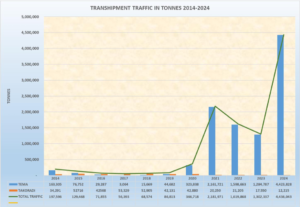
Transshipment traffic in tonnes, 2014 to 2024, showing Tema’s surge to 4.4 million tonnes in 2024.
These are real gains. Yet focusing on throughput and connectivity tells only part of the story, because infrastructure is never just about performance, it is also about power.
A meeting point of competing visions
Tema’s expansion has drawn together state institutions, multinational investors, and Ghanaian workers and officials, each carrying a different idea of what the port is for. For MPS and its shareholders, the priority is efficiency and integration into global shipping networks. For Ghanaian governments, the port has always been tied to a much older national project. For dockworkers and GPHA itself, it is increasingly about who does the work, and who gets paid for it.
These visions collide inside the infrastructure itself, and the terms of that collision have shifted markedly between Tema’s two major concessions.
When GPHA concessioned Terminal 2 in 2004 – Ghana’s first container terminal deal of its kind – it built the terminal first, then negotiated from a position of strength: a 30 percent equity stake alongside APM Terminals and Africa Global Logistics, with real oversight retained by the state. It was a deliberate alternative to the “landlord port” model the World Bank had recommended, under which the state simply owns and leases.
Terminal 3 was negotiated differently. Rather than running a competitive bidding process, government accepted an unsolicited proposal from MPS. GPHA’s stake was diluted from 30 to 15 percent, and exclusive container-handling rights – Tema’s most profitable activity – were granted to MPS alone, shutting out GPHA’s other terminals and local stevedores. Around 1,200 jobs were put at risk. After sustained protest from the Maritime and Dockworkers Union, GPHA’s stake was restored to 30 percent under what became known as the “Dubai Agreement” – but a further commitment to allocate 20 percent of container business back to GPHA’s own terminals has not, six years on, materialised. The dispute remains unresolved.
Layering, not replacement
This is not simply a story of an older, state-led vision being swept aside by a newer, corporate one. What our research found instead is a process of layering: each new phase of Tema’s development builds on, rather than erases, what came before.
The port’s founding vision dates to Kwame Nkrumah’s 1963 Seven-Year Development Plan, which imagined Tema not as a trade conduit but as the anchor of national industrialisation, fused with the Volta River hydroelectric project to power Ghanaian manufacturing for export. That vision never disappeared. It was retranslated in the 1990s through Ghana’s “Vision 2020” and the Ghana Trade and Investment Gateway Project, and resurfaces in the 2017 “Ghana Beyond Aid” agenda. GPHA’s own leadership invoked it explicitly when Terminal 3 broke ground, describing the expansion as taking “the dream of our founding father, Dr Kwame Nkrumah, to the next level.”
Who shapes the deal and its limits
What Tema demonstrates is that large infrastructure projects redistribute authority. They determine who controls assets, who makes decisions, and who captures the gains, and in doing so, they reshape institutions as much as they move cargo.
Ghana’s own port sector offers a striking example of a counter-attempt. At Takoradi, in Ghana’s west, the country’s first locally owned container and bulk terminal has been developed by Ghanaian firm Ibistek – what former GPHA director general Paul Ansah called the breaking of a “century-long jinx” that had convinced Africans they lacked the capacity to build such infrastructure themselves. The $475 million project was de-risked through a 35% equity stake from the Africa Finance Corporation, a development finance institution, which exited to Turkish operator Yilport Holding in 2023 once construction was complete. Yilport now holds a controlling 51% stake, with GPHA at 30% and Ibistek at 19% under a 25-year concession. The sequence matters – Takoradi was conceived and structured by Ghanaian actors before global capital arrived, unlike Tema’s Terminal 3, where a foreign-led consortium entered through an unsolicited bid before terms had been set domestically. But it is also worth being honest about the limits of that distinction. Takoradi handles a fraction of Tema’s container throughput, and even there, a global terminal operator has ended up with the controlling stake. The structural pull of multinational capital in port development is difficult to escape entirely, whatever the sequencing. GPHA’s proposed Port Development Fund, designed to grow Ghanaian firms’ capacity to finance port infrastructure directly and reduce dependency on external capital, was precisely an attempt to address that structural problem at its root. That it never fully materialised is itself part of the story.
None of this is a rejection of global integration. The question is not whether foreign capital participates in African ports, it will, but whether African institutions shape the terms of that participation, or merely receive them.
A broader lesson for Africa
Tema is not unique. Across the continent, similar negotiations are playing out wherever global capital meets national development strategy, and the temptation is always to measure success by what gets built rather than by who controls what was built.
Tema’s experience suggests something more complicated. The difference between Terminal 2 and Terminal 3 was not a difference in technology or ambition, it was a difference in negotiating position, and in how much institutional space the state retained to define the terms. Policymakers elsewhere on the continent, as they sign concession agreements and welcome international terminal operators, would do well to ask not just what infrastructure can deliver, but what governance architecture sits behind it, and whether that architecture serves national development or quietly displaces it.
The post Ports are not just infrastructure: what Tema reveals about development in Africa appeared first on African Arguments.