Red flags to look for in dating, domestic violence abuse
Black women in Houston face a deadly domestic violence surge.
 Black News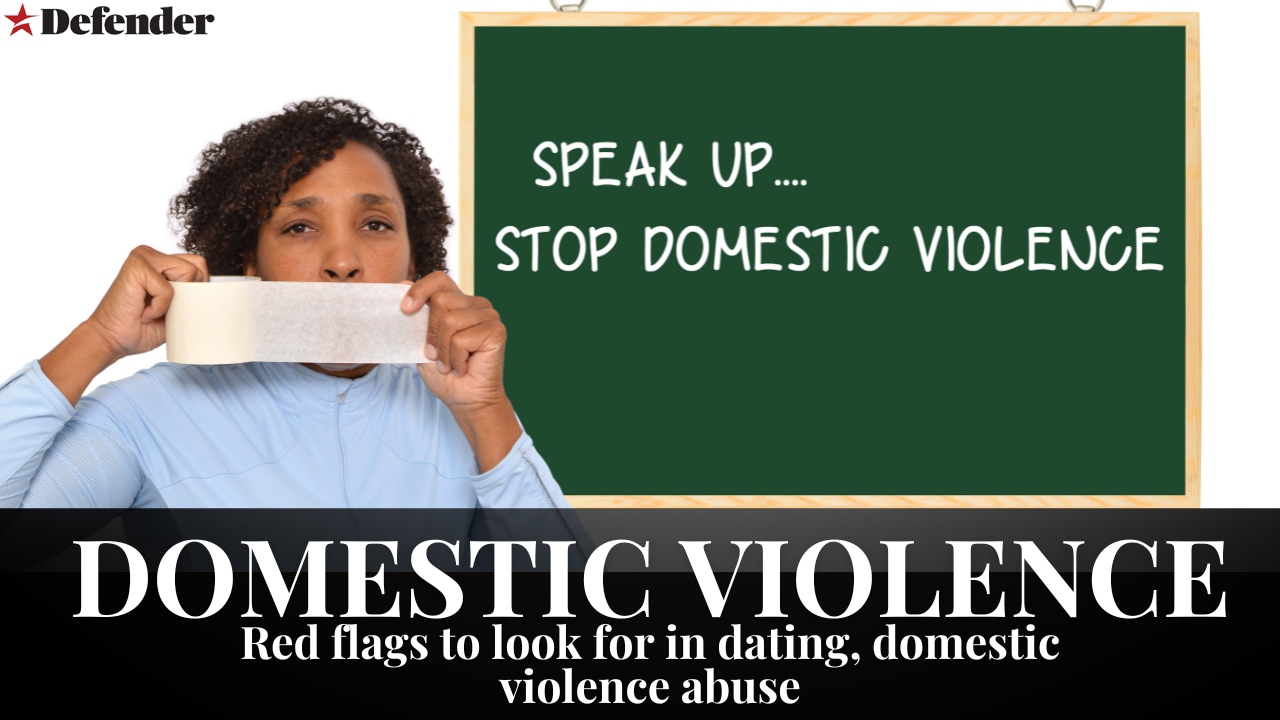




New Year’s Day is supposed to be a fresh start.
Triva Starks experienced a traumatic incident when her husband assaulted her while she was ill with the flu.
She had not gone out. She had not started an argument. Starks asked one question. “Where have you been?” and that question put her life in danger. He beat her.
She recently posted the surveillance footage of the assault on Instagram, unedited and unfiltered. The internet watched in shock.
The Houston-area hairstylist, entrepreneur, and mother who goes by Nikki had been with viral sketch comedian Uncle Stanley Joe since she was 12. They had been married for 20 years. She knew his anger. She had learned to read his moods, to time her questions, to shrink herself to keep the peace. None of it was enough that night.
“I always knew that I was going to eventually post the video to expose him,” Nikki said in an interview with the Defender Network. “And it was just not to expose him, it was also to help others who are dealing with domestic violence, and also to hold my feet to the fire to never go back.”
The video Nikki posted was not even the worst of it. It was one of the “mildest” experiences of abuse that she shared with the public.

Her story landed in the middle of a month that has stunned the country.
In April 2026 alone, Dr. Cerina Wanzer Fairfax, a Virginia dentist and mother of two, was killed by her estranged partner days after being awarded full custody of their children. In Shreveport, La., a man shot and killed eight children, seven of them his own, in what police called an entirely domestic incident. Coral Springs Vice Mayor Nancy Metayer was tragically found shot to death by her partner in her home. And the body counts continue to increase.
Black women across this country and right here in Houston are being killed by the men who share their beds, their children, and their last names. And in most of those cases, the signs were there long before the trigger was pulled.
According to the Institute for Women’s Policy Research (IWPR), over 40% of Black women experience intimate partner violence (IPV) in their lifetime, a rate significantly higher than the roughly 31.5% for women overall. This includes physical violence, sexual violence, and stalking by an intimate partner.
“Intimate partner violence, for many years, has typically disproportionately impacted Black women more than any other demographic,” said Chanica Brown, chief client services officer at the Houston Area Women’s Center (HAWC). “This is just historically what we see here at our residential campus.”
In 2024, HAWC answered more than 35,000 calls and more than 3,000 live chats. The center housed more than 900 survivors, including more than 400 children.
The warning signs most women miss

Experts say most fatal relationships have identifiable warning signs. Most survivors were never taught to recognize them or were conditioned to excuse them.
“The red flags that we most commonly see, the ones that are missed, really are surrounding power and control,” Brown said. “Isolation is a big one. Isolation from family and friends, and that really tends to be a gradual progression.”
Brown described other hallmark behaviors, including constant criticism, financial control, technology surveillance, and threats, whether directed at immigration status, children, or a survivor’s employment.
“And a lot of times we’ve seen too where the survivor has an income of their own, and they’re required to turn over their income to the abuser,” Brown said. “So, just really exercising power and control over the survivor. Some of these are overlooked.”
Safe Horizon Vice President of Community and Digital Services Michele Richard said physical escalation indicators are among the most dangerous and most overlooked. She identified stalking as a lethality escalator, including tracking devices hidden in vehicles or bags, shared passwords, and monitored phone activity.
“If two or more of these things are happening at the same time, we urge survivors to reach out to a service provider to talk through safety planning, especially if someone is considering leaving the relationship with kids.”
Why do survivors stay? And why leaving is deadly

The question survivors say they dread most is: “Why didn’t you just leave?”
The answer is neither simple nor safe.
“When you take the steps to leave, that is when you will end up murdered,” Nikki said plainly. She knows this firsthand. A cousin of hers was killed by her husband in Spring, Texas, after she sought a divorce. “So I’ve seen domestic violence in my family, right in front of me.”
Her daughters were the reason she stayed, and ultimately the reason she found the courage to leave.
“I want my daughters to be proud of me because I haven’t been a great example,” she said. “They kind of see me as a woman who’s not very strong when it comes to walking away from their dad in a very abusive situation and constantly putting them back in a cycle over and over and over again. I just want them, first of all, to trust me.”
Triva “Nikki” Starks
“I want my daughters to be proud of me because I haven’t been a great example,” she said. “They kind of see me as a woman who’s not very strong when it comes to walking away from their dad in a very abusive situation and constantly putting them back in a cycle over and over and over again. I just want them, first of all, to trust me.”
Experts say the most dangerous time is when the survivor is leaving or has left. Survivors leave and return to abusive relationships an average of seven times before leaving for good, with each departure carrying escalating risk. This is the time when the person causing harm is losing power over the survivor. If there is any time that a person is thinking about following through with femicide, the murder of a woman, it is that time.
Financial dependency is one of the most powerful barriers keeping women trapped.
“When I had no money, I knew for a fact that I could never leave him,” Nikki said. “What am I going to do? I don’t have the finances to provide for our children or myself.”
Nikki spent years quietly building financial independence as an entrepreneur, carefully assembling an exit plan while still in the marriage.
“I knew that I couldn’t leave without an exit plan. So I took years to build myself up as an entrepreneur and get my own money,” she said. “And once I got my own money, I was still there. But I didn’t know that my husband was not going to let me leave.”
Her advice to women facing financial dependency is to develop a plan for financial independence, such as saving money from an allowance or strategically managing bill payments. It is essential to develop an exit strategy, as financial dependence can lead to prolonged constraints.
Isolation, too, compounds the danger. Nikki described projecting strength publicly while hiding abuse privately.
“Outside of the home, I’ve always tried to be this strong, courageous woman,” she said. “People would say she was smiling through all of this, and we had no clue.”
The “strong Black woman” image is itself a barrier to survival. There is this stigma of being the strong, matriarchal person who holds the family together. Sometimes Black women feel the need to defend the family at all costs, which can mean protecting their partner.
Religion plays a significant and often silencing role. There might be some religious norms that may make it difficult culturally for Black women to feel like they can’t leave the domestic violence situation.
When the system falls short
Nikki described her disappointment with the legal system after an assault in Harris County, where police could only provide limited assistance due to the domestic violence unit being closed. She expressed broader concerns about the system’s failure to protect all women, noting that a previous case involving her had gone unresolved. Her experiences have led her to feel that the justice system is not designed to help victims like her.
The comparison to her experience in Montgomery County highlighted the inconsistency, as police there issued a protective order automatically after a different incident.
“Montgomery County is one of the best counties that deal with domestic violence,” she said. “They actually did what needed to be done.”
Harris County Commissioner Rodney Ellis, in a statement to the Defender Network, acknowledged the systemic failure directly and named federal defunding as a driving force behind it.
“The Trump Administration’s deadly cuts to domestic violence service providers and critical programs families rely on have exacerbated this crisis,” Ellis said. “The system is falling short when survivors, especially Black women, face violence and still have to fight to be housed, protected, supported, or even believed.”
Ellis noted that the Victims of Crime Act fund has decreased 72% since 2018, and that the proposed fiscal 2026 federal budget would reduce funding for the Office on Violence Against Women by 30% from $713 million to $505 million. Local service providers laid off staff in response to federal cuts in 2025.
In response, Ellis led the creation of the Harris County Domestic Violence Assistance Fund in 2022, which provides flexible funding to 19 community-based organizations, including Fresh Spirit, a Black women-led organization serving women of color, for housing, transportation, childcare, and other survivor needs. Harris County’s fiscal 2025 budget also included $1 million for domestic violence coordination, led by HAWC.
“Every woman deserves to live free from fear,” Ellis said. “And every survivor deserves to know they are not alone, and help is available.”
A message to survivors
Nikki is in the season of healing. She reassures survivors that they are not foolish or weak and that they have the capacity to overcome challenges.
She also directly addressed women held in place by religious obligation, a pressure her own husband’s family used against her for years.
“I would always hear that God hates divorce,” Nikki said. “I want to tell you today that he does not. In Psalms 11:5, the Lord says for his soul hates the wicked and the one who loves violence. He hates the wicked. And any man that is putting his hands on you, he’s wicked. You can get out of that situation because God will carry you through. He loves us. He loves his daughters. He will never leave us or forsake us.”
If You Need Help
| Resource | Contact |
| Houston Area Women’s Center (24/7) | (713) 528-2121 or 1-800-256-0551 |
| National Domestic Violence Hotline | 1-800-799-SAFE (7233) or text START to 88788 |
| AVDA Houston | (713) 224-9911 |
| HPD Family Violence Unit | (713) 308-1100 |
| Texas Advocacy Project | 1-800-374-HOPE |
| Free Danger Assessment Tool | dangerassessment.org |