Senator Lindsey Graham Knew Donald Trump Was A Racist And The Southern Gentleman Helped Him Rule
As soon as word of Graham’s death hit the political streets, Washington started the familiar work of embalming his reputation.
 Black News
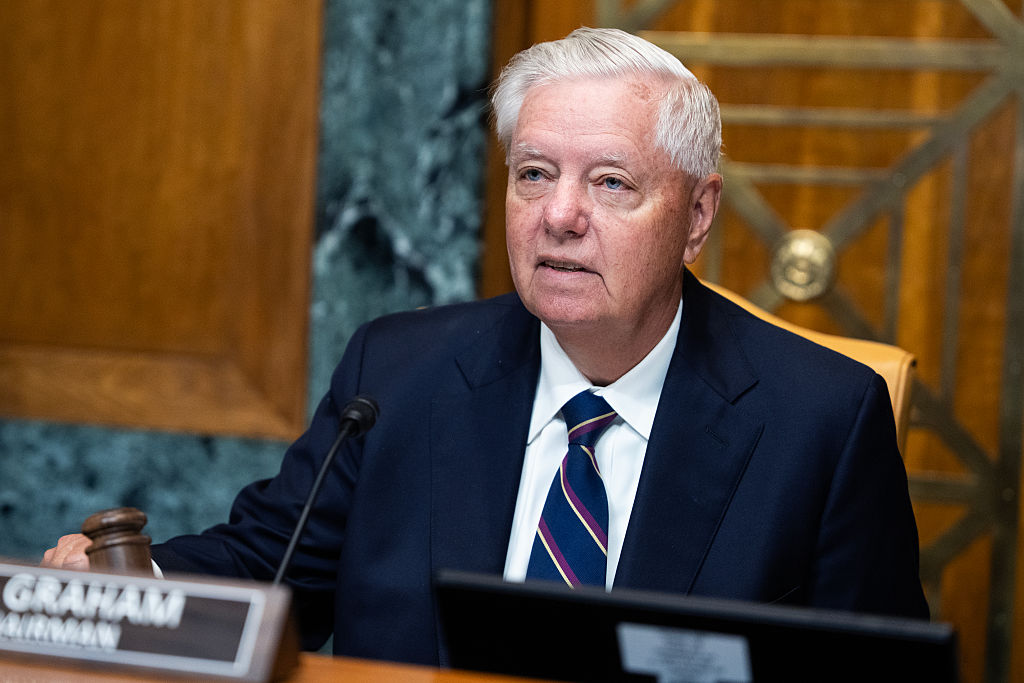
The longtime Republican Senator Lindsey Graham is dead at age 71. The DC Medical Examiner’s Office has reported that his death was caused by an aortic tear due to cardiovascular disease.
Predictably, as soon as word of Graham’s death hit the political streets, Washington started the familiar work of embalming his reputation. Politicians and major news outlets eulogized him as a charming, patriotic senator, a foreign-policy statesman fiercely devoted to American power, and a witty bipartisan dealmaker.
Donald Trump posted: “Senator Lindsey Graham, one of the greatest people and senators I have ever known is dead! He was always working, and was a true American Patriot. Lindsey will be greatly missed. So sad.”
Meanwhile, right-wing conspiracy merchants like Laura Loomer, Indiana state senator Mike Delph, and other pro-MAGA accounts were peddling conspiracy theories suggesting that the Russians had poisoned Graham following his trip to Ukraine and called for an investigation.
Rev. Al Sharpton logged onto Facebook and gave the Black clergy version of reputation laundering by offering condolences, recalling Graham as “quick-witted and funny,” and noting that they had shared laughs about James Brown. Sharpton also reduced Graham’s record to “stark political differences,” which is a mighty polite way to describe a career spent helping empower a racist right-wing movement.
On the other end of the political spectrum, pundits described how Graham went from being one of Donald Trump’s loudest critics and then spent the final and most consequential chapter of his career as one of the president’s most loyal lieutenants. He called Trump dangerous and dishonest, a “kook,” “bigot,” “xenophobic,” and said he was “unfit” for office and then made himself useful to the same dangerous man he had warned the country against voting for. Some are treating this aspect of his political evolution as an embarrassing act of hypocritical subordination. In that telling, Graham is a kind of cautionary tale about authoritarianism, democratic decay, ambition, political cowardice, and the Republican Party’s wholesale surrender to Trump.
But Graham’s surrender to Trump is not just a story about Graham, about one white man’s ambition, humiliation, cowardice, and lost dignity, or how he made himself useful to a dangerous man. This is also a political story about what Trump and Graham together made dangerous for Black people once that usefulness was converted into power.
Almost nobody is asking some critical questions: What did Graham’s surrender do to Black people? What about the times he defended Trump against allegations of racism? Where is the sustained accounting of the voter suppression he enabled, the racist president he repeatedly sanitized, the judges he helped install, the civil-rights protections he helped weaken, and the racial grievance he converted into respectable Senate politics?
Lindsey Graham’s story is not about one of those good Republicans who lost his way. This is a story about a white politician who knew exactly what racism looked like, understood the danger it posed, and gave Trump’s racial demagoguery a Southern gentleman’s accent, a law degree, and Senate respectability. No, he was the kind of theatrical, slur-spewing, hood-wearing segregationist. But Graham’s great sin was not just that he debased himself for Donald Trump. It was that he used his proximity to power to help turn Trump’s racial project into policy, law and a legacy that harmed Black folks.
Two things can be true. Graham knew Trump was dangerous and sacrificed his own principles for power, and he knew Trump was racist and sacrificed Black people for power.
When Trump told four congresswomen of color to “go back” to other countries, even though three of these women were born in the United States, Graham went on Fox & Friends and called them “a bunch of communists” who “hate our country.” He performed the same service when Black political power came under attack.
After the Supreme Court gutted the Voting Rights Act’s preclearance system in 2013, Graham applauded the result, declaring that the protection was “no longer necessary” in South Carolina because the state had made “tremendous progress.” Preclearance existed because jurisdictions with documented histories of racial discrimination could not be trusted to rewrite voting rules without federal review. Graham treated that protection as South Carolina being unfairly “singled out and treated differently.”
Then came 2020.
Trump’s campaign to overturn the presidential election did not place every ballot under equal suspicion. It’s fraud mythology centered on Atlanta, Detroit, Philadelphia, and Milwaukee, cities where Black voters helped remove him from office. A white ballot was treated as democratic, but a Black ballot was treated as evidence of fraud.
During Georgia’s recount, the state’s Republican secretary of state, Brad Raffensperger, said Graham raised the possibility of rejecting absentee ballots in counties with high rates of signature problems. Graham denied asking anyone to discard lawful votes. That dispute should be reported accurately. So should the larger truth: Graham helped legitimize a campaign that placed Black voting power on trial because Trump lost.
His words during his 2020 campaign against Jaime Harrison were just as revealing. Graham said young African Americans and immigrants could go anywhere in South Carolina, but they needed to be conservative rather than liberal. That’s a whole lot of presumption packed into one sentence, ain’t it? Graham was basically saying that Black folks were free and welcome so long as they shared his conservative values and remained politically obedient.
Graham’s most enduring racial legacy can be found in his time on the federal bench and as chairman of the Senate Judiciary Committee, where he helped accelerate Trump’s judicial transformation of the country. Those lifetime Trump-appointed judges will decide voting-rights cases, employment discrimination claims, police-accountability lawsuits and challenges to racial inequality long after Graham’s funeral. His most consequential statements about race were not spoken. Many were confirmed.
An honest accounting should include the moments when Graham did the right thing. He supported removing the Confederate battle flag from South Carolina’s State House grounds after the massacre at Mother Emanuel, and he also participated in some bipartisan immigration negotiations. But isolated acts of decency don’t erase enduring structural harm. Graham may have helped lower the state’s Confederate flag after a racial massacre, but he continued to support the white supremacist machinery that weakened Black voting power. He condemned racism when it became too vulgar for polite company, and then turned right around and protected the race-baiter-in-chief when Republican power required it.
Graham succeeded Strom Thurmond in the Senate, but he did not need to imitate Thurmond’s open segregationism. American racism had learned new manners. It spoke of election integrity, states’ rights, colorblindness, judicial restraint, and conservative values. Thurmond represented the barricade. Graham represented the explanation for why the barricade supposedly had nothing to do with race.
Before Washington finishes embalming Lindsey Graham’s reputation, Black America should make certain that choice is written into his obituary.
Lindsey Graham’s death deserves basic human acknowledgment. It does not require historical amnesia. Death ends a life; it does not acquit a record. And no amount of senatorial nostalgia should obscure the central fact of Graham’s final political chapter: he saw the race-baiter coming, warned America about him, and then held the door open.
Lindsey Graham once warned that if Republicans nominated Trump, they would be destroyed and would deserve it. He was only half right. The party was not destroyed. It was revealed. And Graham spent the rest of his life helping it become exactly what he had warned us it was.
SEE ALSO:
Black Pastors Refuse to Canonize Charlie Kirk
Preston Damsky, ‘Viewpoint Neutrality,’ And White Supremacy [Op-Ed]