This Play Doesn’t Just Portray Church. It Becomes Church.
What happens when theater stops asking audiences to observe and instead invites them to worship? Baltimore Center Stage's Pray transforms theatergoers into a congregation, blending Black church traditions, African spirituality and audience participation into an experience that feels as much like Sunday morning as opening night. The post This Play Doesn’t Just Portray Church. It Becomes Church. appeared first on Word In Black.
 Black News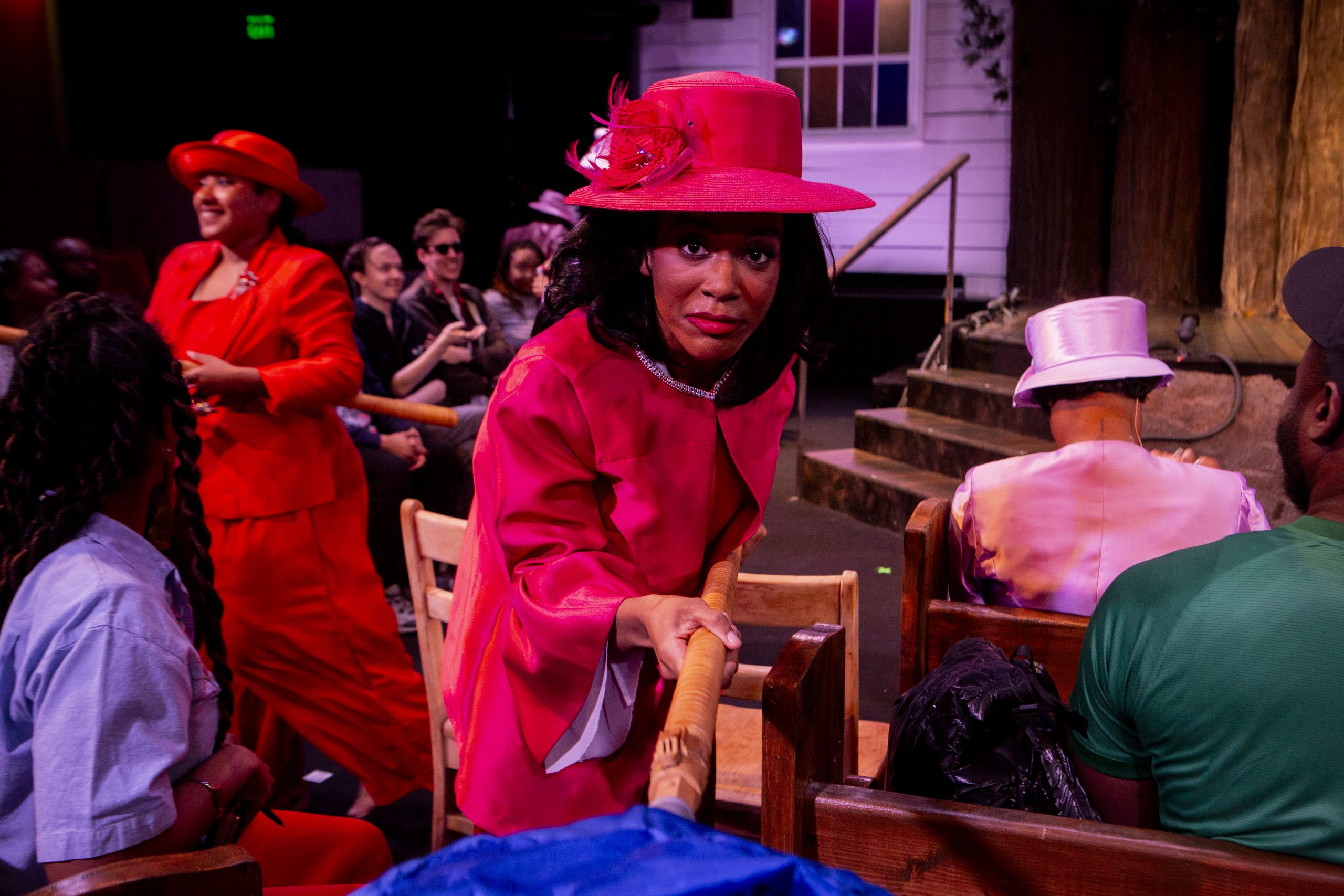

Before the lights dim, before a single line is spoken, audiences entering Baltimore Center Stage discover something unexpected.
There is already a church waiting for them.
LEARN MORE: She Didn’t Want the Pulpit. Instead, She Built a Stage
A towering tree from the Republic of Congo rises from the sanctuary-like stage. A piano sits ready. Musicians prepare to play. Church pews fill the room—not just for actors, but for the audience itself.
There is no comfortable distance between performer and spectator because, from the moment people enter, they have become part of the congregation.
That is the premise behind “Pray,” an immersive choreopoem now playing at Baltimore Center Stage through July 5. Rather than asking audiences to watch a Black church service unfold, the production invites them to participate in one.
“It’s never the same,” performer Ziiomi Law says. “Depending on how the audience responds, informs what we offer that night.”
The audience sits among us. I may be sitting on a pew right next to you. You’re not separated from the performers; you’re part of the experience.
Ziiomi Law, CAST MEMBER, “PRAY”
For Baltimore audiences, that concept feels remarkably familiar.
Anyone who has spent time in a Black church knows that worship is never entirely scripted. Testimonies run long. Announcements become conversations. Greeting your neighbor may take far longer than planned.
The Spirit often determines when service ends—not the clock.
Law says “Pray” embraces that same freedom.
Faith Traditions
While the production follows the familiar order of worship—prayer, praise, offering, greeting, benediction—it is not confined by time or theology. The story moves fluidly from the 1800s to the present and into imagined futures while exploring Black spirituality beyond denominational boundaries.
The work honors Southern Baptist traditions while making room for African traditional religions, hoodoo, and other spiritual practices carried across the African diaspora.
The result is neither conventional theater nor conventional church.
Audiences encounter a deeply Black meditation on faith, memory, joy, survival, and the permission to wrestle honestly with belief. Law says Pray is intentionally gender expansive to honor the range of queerness and human experience: “It is also a love letter specifically to Black women and femmes and throughout the service that can be felt.”
‘Baltimore Understood’
To Law, who began her career as a dancer, Baltimore — a Black-majority city where it’s often said there is a church on every corner and in the middle of every block — has embraced the production differently than audiences in New York.
“This is the demographic we’re making this work for,” Law said in a question-and-answer session with Word In Black. “Baltimore has really understood the assignment,” and theatergoers behaved as if they were in an actual church.
For residents of Charm City, “Pray” may feel less like attending a play than coming home to a sanctuary that asks as many questions as it answers.
The interview with Law has been edited for length and clarity.
Word In Black: When audiences walk into Pray, what’s the very first thing they experience?
Ziiomi Law: The first thing most folks notice is that we have a tree inside the church—a Wengue tree from the Republic of Congo. You immediately walk into a church service. We have a piano, a live band, and church pews, but it’s immersive. The audience sits among us. I may be sitting on a pew right next to you. You’re not separated from the performers; you’re part of the experience.
WIB: What exactly does “immersive” mean in this production?
Law: We’re all co-creating the experience together. The audience’s energy changes what happens every night. How people respond informs what we offer. Every performance is different. The play is an offering and an invitation, so audience members get as much as they allow themselves to receive.
WIB: The structure follows a church service, but the story isn’t linear. How does that work?
Law: We move across different periods of time—the 1800s, the present, the future, even times we can’t really name. But the framework is a church service. There’s prayer, praise and worship, offering, greeting your neighbor, benediction. That’s the structure audiences follow.
WIB: Does audience participation ever change the length of the performance?
Law: Absolutely. The show is about 70 minutes, but there’s room for improvisation, just like church. If greeting your neighbor needs to last longer, it does. If someone would naturally jump in, we make room for that.
WIB: Why call the production “Pray” instead of, say, “Church”?
Law: Because we’re talking about spirituality that’s much broader than one denomination. Prayer happens in churches, but it also happens in people, places and everyday life. We wanted something expansive. Also several members of the creative team are preachers’ kids so this work is deeply personal and meaningful to us.
WIB: What emotional journey do audiences take?
Law: There’s joy. There’s laughter. There’s dancing and twerking in church hats and church suits, which can surprise people. But we’re also talking about historical trauma Black people—especially Black women and Black femmes—have survived. The work gives people permission to hold deep faith while still asking questions.
WIB: How do you know when a performance has truly connected?
Law: We feel the audience with us. When people are emotionally engaged and willing to go on the journey, we know it’s working.
WIB: Baltimore audiences are experiencing Pray after its New York premiere. What’s different here?
Law:In New York, people appreciated it as theater, but they didn’t always have the cultural context. Here, people immediately recognize the world we’re building because it’s familiar.
WIB: How long has this project been in development?
Law: Since around 2018 or 2019. We premiered in New York in 2023, and this is the first time the production has been mounted outside the city where it was created.
WIB: Is the cast mostly local?
Law: About half the cast is from Baltimore, and our band is predominantly local. It was important to honor the incredible talent already here while bringing back a few of us who’ve been with the production since the beginning.
WIB: Tell me a little about the play’s history.
Law: I was dance captain for the 2023 premiere in New York City and we won two Lucille Lortel awards in 2024 for Outstanding Ensemble and Outstanding Musical. Our director, nicHi douglas, won for Outstanding Director and was nominated for Outstanding Choreographer. Our show was nominated in 6 categories, and we swept the awards with our wins.
WIB: Your background is primarily dance. How did acting become part of your career?
Law: I’ve been dancing since I was three. Acting really came through dance because I kept getting cast in roles that required both. I’ve been acting professionally for about five years.
WIB: What’s next after Pray closes?
Law: I’m heading to a Katherine Dunham Technique conference to continue helping preserve that legacy. After that, I’m resting, spending time with my mom, my dog and my family. We’ve been working nonstop since May, and it’s time to restore myself.
The post This Play Doesn’t Just Portray Church. It Becomes Church. appeared first on Word In Black.