UK slams sanctions on 35 targets over Africa-linked recruitment into Russia’s drone war
The United Kingdom has imposed a new wave of sanctions targeting 35 individuals and entities accused of supporting Russia’s drone manufacturing industry and operating transnational networks that exploit vulnerable migrants from Africa and other regions.
 Black News

The United Kingdom has imposed a new wave of sanctions targeting 35 individuals and entities accused of supporting Russia’s drone manufacturing industry and operating transnational networks that exploit vulnerable migrants from Africa and other regions.
- The UK has imposed sanctions on 35 individuals and entities supporting Russia's drone industry and recruitment of migrants for frontline roles.
- These measures aim to disrupt supply chains linked to Russian drone production and dismantle networks exploiting vulnerable migrants.
- Targets include Russia’s Alabuga Start programme and suppliers in third countries.
- Sanctions specifically address the recruitment of migrants from several countries who are sent to either drone factories or conflict zones.
The measures, announced by the UK government, focus on disrupting supply chains linked to Russian drone production and dismantling recruitment systems that authorities say are funneling foreign nationals into dangerous frontline roles under deceptive promises of work and opportunity.
Officials said the networks have been recruiting migrants seeking better economic prospects and sending them either to weapons manufacturing facilities or directly into combat zones with minimal training.
A key focus of the sanctions is Russia’s Alabuga Start programme, which is tied to drone production at a state-linked industrial facility already under UK restrictions.
The programme has been identified as part of a broader system supporting Russia’s expanding use of low-cost attack drones in Ukraine.
Sanctions also target individuals and entities in third countries, including Thailand and China, accused of supplying drone components and other military goods to Russia.
Among them is Pavel Nikitin, whose company produces the VT-40, a low-cost drone widely used in attacks on Ukraine. Three individuals linked to the Russian state were also sanctioned for recruiting foreign nationals to fight in Ukraine.
African countries named in recruitment routes
One of the individuals sanctioned, Polina Alexandrovna Azarnykh, is accused of facilitating the movement of recruits from several countries including Nigeria, Ivory Coast, Egypt, Morocco, Iraq, Syria, and Yemen through Russia, where they are later deployed in Ukraine under harsh and poorly resourced conditions.
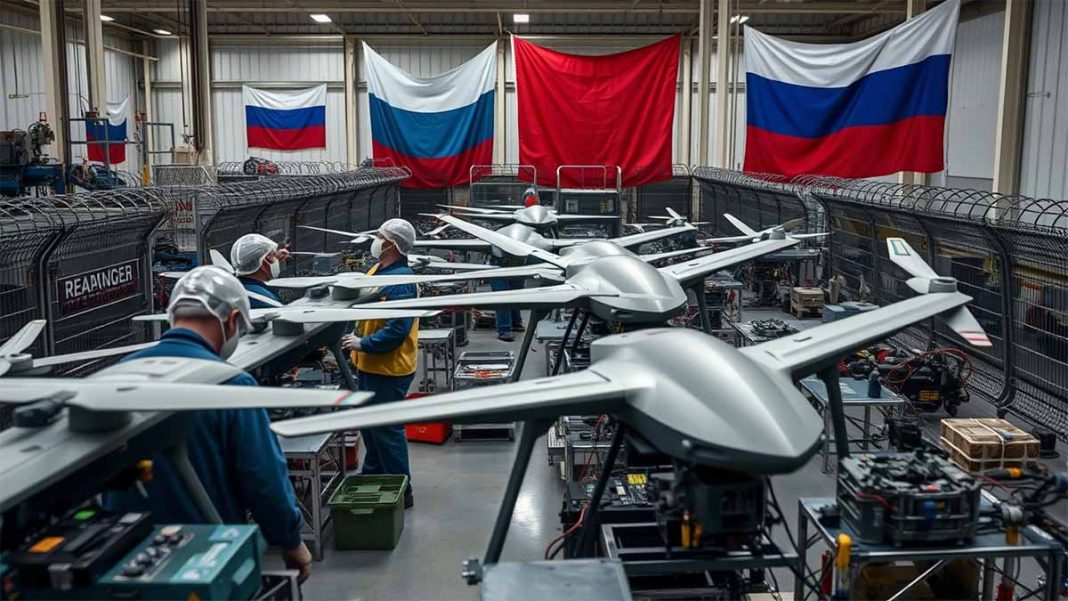
UK officials say many of those recruited were misled about the nature of the work, only to end up either in drone production facilities or on the frontlines of the conflict.
London also highlighted Russia’s growing reliance on unmanned aerial systems, noting that Moscow fired the equivalent of more than 200 drones per day into Ukraine in March 2026, marking the highest monthly total on record.
According to UK officials, these operations depend heavily on international supply chains, including components and technical expertise sourced from third countries, some of which have now been targeted under the sanctions.
Expanding scope of UK sanctions
The new measures fall under the UK’s Global Irregular Migration and Trafficking in Persons Sanctions Regime, the first of its kind globally, designed to target human trafficking networks and those who facilitate irregular migration for political or military purposes.
UK officials say the regime allows London to pursue actors “anywhere in the world” involved in people smuggling, forced labour, and exploitation linked to conflict zones.
Sanctions Minister Stephen Doughty said: "The practice of exploiting vulnerable people to prop up Russia’s failing and illegal war in Ukraine is barbaric.”
He added that the measures “expose and disrupt the operations of those trafficking migrants as cannon fodder and feeding Putin’s drone factories with illicit components to target innocent civilians and vital infrastructure.”
The government described the sanctions as part of efforts to “disrupt Russia’s war machine” while protecting vulnerable migrants from exploitation, including those from African and Middle Eastern countries caught in the recruitment networks.
The move signals a widening geopolitical dimension to the Ukraine conflict, where migration flows, labour exploitation, and military supply chains are increasingly intersecting across multiple continents.