22 Electric Vehicles handed over to public sector – What comes next
Twenty-two Electric vehicles (EVs) have been handed over to key public sector departments, marking the operational start of a demonstration pilot under the Nationally Determined Contributions Technology (NDC-TEC) Project. The project aims to demonstrate the benefits and feasibility of EV adoption in government operations while advancing Saint Lucia’s low-carbon development goals. Distribution began in March […] The article 22 Electric Vehicles handed over to public sector – What comes next is from St. Lucia Times.
 Black News
Twenty-two Electric vehicles (EVs) have been handed over to key public sector departments, marking the operational start of a demonstration pilot under the Nationally Determined Contributions Technology (NDC-TEC) Project.
The project aims to demonstrate the benefits and feasibility of EV adoption in government operations while advancing Saint Lucia’s low-carbon development goals.
Distribution began in March and continued last week, with the remaining vehicles allocated to essential services, including Postal Services, Customs and Excise, Police, Fire Service, Education, Health, Infrastructure, the Air and Sea Ports Authority and the Sir Arthur Lewis Community College.

“These electric vehicles will not only support our operational needs but will also serve as living learning tools,” said Dr Madgerie Jameson-Charles, principal of the Arthur Lewis Community College, after receiving the EV.
“We commend the Government of Saint Lucia and its partners for moving decisively from policy to practice.”
Jameson-Charles said the inclusion of the college highlights the importance of educational institutions in Saint Lucia’s transition to a low-carbon future.
On March 4, four EVs were handed over to the Ministry of Infrastructure, WASCO and the Police Force.
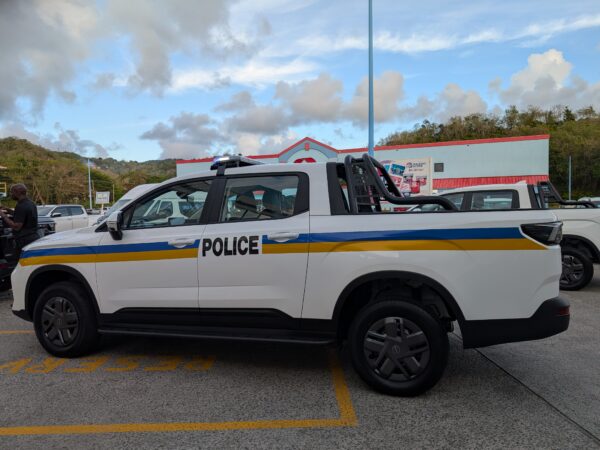
The initiative is funded by the International Climate Initiative (IKI) and implemented by the Deutsche Gesellschaft für Internationale Zusammenarbeit (GIZ) in collaboration with the Department for Sustainable Development.
“We are grateful for the close cooperation and openness of the government services, who shared a lot of information so that we could provide the most suitable vehicles for their needs,” said Ina de Visser, Head of the NDC-TEC Programme for GIZ in Saint Lucia.
According to the NDC-TEC Project team, the initiative goes beyond replacing internal combustion engines and is part of a broader effort to increase sustainability in the transport and energy sectors. Supported by CARICOM, the NDC-TEC programme is also an avenue for advancing regional climate goals.
“We are eager to see the cars on the road and the services gaining experience and confidence with vehicles. This way, the government’s objective of achieving 30% EVs in the government fleet by 2030 can become reality,” de Visser added.
The official commissioning of the EVs is expected to take place at a ceremony later this year.

Inside the NDC-TEC Project
According to GIZ, the pilot’s rollout could signal to the global community that, despite Saint Lucia’s mountainous terrain, the country is prepared to demonstrate that electric vehicles can meet the demands of high-mileage government operations without compromise.
Additional details on the intentions behind the project provided in a release from GIZ include:
Projected fiscal savings
On average, the EVs in this pilot are expected to reduce fuel and maintenance costs by at least 30% when compared to traditional internal combustion engine (ICE) vehicles. This presents a scalable model for national cost savings, with final figures to be determined through collected data.
Data-driven future planning
Each of the 22 vehicles is equipped with telematics systems to monitor energy consumption, battery health and mileage in real time. This data will be analysed by GIZ and the Government of Saint Lucia to generate evidence-based insights. These findings will help estimate greenhouse gas emission reductions, assess future national grid requirements and refine the government’s fleet transition strategy.
Building technical capacity and green jobs
The NDC-TEC project includes a strong training component. In addition to the vehicle handovers, specialised training has been provided for local mechanics and automotive technicians, emergency first responders (Fire and Police), and fleet managers. This is intended to build the technical expertise needed to maintain an electric fleet locally while also supporting job creation in the green economy.
Battery lifecycle and sustainability
In alignment with Saint Lucia’s commitment to a circular economy, the project has proposed a framework to support the second-life use of EV batteries. Once these batteries reach the end of their automotive lifespan, they are expected to be repurposed before being exported for professional recycling, ensuring that no hazardous waste remains on the island.
Implementing partners
The NDC-TEC project is supported by a network of regional and international partners, including: Deutsche Gesellschaft für Internationale Zusammenarbeit (GIZ), a German development agency providing technical cooperation; Caribbean Centre for Renewable Energy and Energy Efficiency (CCREEE), a CARICOM institution focused on sustainable energy; the
Caribbean Development Bank (CDB), a regional financial institution supporting social and economic development; University of the West Indies (UWI), providing research and data support; and Climate Analytics (CA), a global science and policy institute.
The article 22 Electric Vehicles handed over to public sector – What comes next is from St. Lucia Times.