Barrow: No community will be left behind as he launches 385km of road in URR
Phase 1 will deliver 781 kilometres of paved, all-weather roads, with 385 kilometres in the Upper River Region (URR) and 395 kilometres in the Central River Region (CRR), a landmark initiative aimed at transforming rural connectivity and boosting economic activity across The Gambia. Significantly, the project is being financed through domestic resources, a move Barrow described as “a powerful demonstration of our growing capacity to drive our own development, without dependence on external borrowing.” Barrow added: “Infrastructure is not just an aspect of development, but the foundation upon which we build and sustain visible and impactful progress.” The president emphasised that reliable roads will reduce isolation, improve access to essential services, and create opportunities for farmers, traders, and entrepreneurs. “For agricultural communities, particularly groundnut and sesame producers, the roads are expected to cut transport costs, reduce post-harvest losses, and open up markets.” “For the farmers in both regions, these roads will reduce transport costs, limit post-harvest losses, improve access to markets, and help them secure better prices for their produce,” Barrow stated. Beyond agriculture, he added the roads are expected to strengthen cross-border trade with Senegal and position Gambian communities to benefit from the African Continental Free Trade Area. Barrow also stressed accountability, urging the National Roads Authority to supervise contractors diligently and called on local communities to take ownership of the project. “The funds we are investing here belong to the Gambian people and must be used responsibly,” he warned. “The project will succeed best when government and communities work together.” The president framed the initiative as part of the YIRIWAA National Development Plan, which envisions a more connected, inclusive, and prosperous Gambia, adding: “Under the YIRIWAA Plan, development is not a privilege for a few. It is a right for all Gambians,” Barrow declared. Sulayman Sumareh Janneh, Managing Director of the National Roads Authority (NRA), commended Gambian engineers for their sacrifices. He revealed that they had mapped over 1,000 km of survey work, saving the government approximately 1.5 billion dalasis. “The work they do costs the government zero bututs,” he said, adding that the projects would open up farming access and boost national development. He called on local authorities to partner with the NRA for successful completion. The NRA boss described road infrastructure as a fundamental pillar of national development, stating that improved road networks create opportunities and drive socio-economic growth. “For communities whose livelihoods depend on farming, trade, education and health services, access determines opportunity,” Mr Janneh said. He noted that roads go beyond physical construction, describing them as catalysts for productivity, social inclusion and economic resilience. Speaking on the technical scope of the projects, the NRA head explained that all roads under the programme would be built to all-weather standards. “The works commenced with accurate surveying and setting-out to ensure proper alignment, level and gradient. Thereafter, earthworks will shape a stable road formation with the appropriate camber to safely drain surface water away from the carriageway,” he explained. Village alkalo Mawdo Drammeh underscored the importance of quality roads, noting that the construction work currently underway in Tumana had never been attempted under previous regimes. He emphasised that the new road network would ease decades of hardship, while also highlighting that the district is, for the first time, benefitting from a hospital. “Our grandparents have been calling for these roads since the First Republic, but to no avail. Within ten years of Barrow’s government, construction has finally begun,” he said. Mawdo Susso echoed these sentiments, pointing to the expansion of electricity and other infrastructure. He argued that the number of projects delivered under Barrow’s leadership far exceeded those of the past two governments. Basse Area Council councillor Ejatou Jallow praised the president’s initiatives, particularly in supporting women. She explained that road construction had eased access to gardens, reducing the difficulties women previously faced. Jallow pledged her “unflinching support” for the administration. Regional chairman Alhagie Bubu Drammeh claimed that 86% of the vote in the forthcoming presidential election would go to Barrow, citing the “unprecedented development” in infrastructure. He urged residents to acquire voter cards to ensure Barrow’s continuation in office, declaring: “President Barrow is going back to State House on December 6th.” Hon. NFally Kora of Tumana District described the road foundation laid by the president as a “nightmare turned into reality,” benefiting over 26 communities. He highlighted progress in clean drinking water, ga
 Black News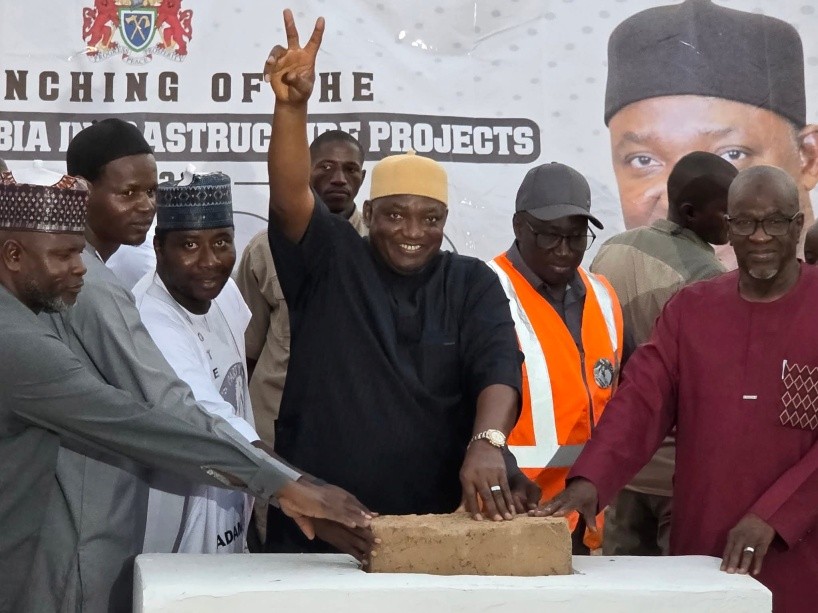
Phase 1 will deliver 781 kilometres of paved, all-weather roads, with 385 kilometres in the Upper River Region (URR) and 395 kilometres in the Central River Region (CRR), a landmark initiative aimed at transforming rural connectivity and boosting economic activity across The Gambia.
Significantly, the project is being financed through domestic resources, a move Barrow described as “a powerful demonstration of our growing capacity to drive our own development, without dependence on external borrowing.”
Barrow added: “Infrastructure is not just an aspect of development, but the foundation upon which we build and sustain visible and impactful progress.”
The president emphasised that reliable roads will reduce isolation, improve access to essential services, and create opportunities for farmers, traders, and entrepreneurs. “For agricultural communities, particularly groundnut and sesame producers, the roads are expected to cut transport costs, reduce post-harvest losses, and open up markets.”
“For the farmers in both regions, these roads will reduce transport costs, limit post-harvest losses, improve access to markets, and help them secure better prices for their produce,” Barrow stated.
Beyond agriculture, he added the roads are expected to strengthen cross-border trade with Senegal and position Gambian communities to benefit from the African Continental Free Trade Area.
Barrow also stressed accountability, urging the National Roads Authority to supervise contractors diligently and called on local communities to take ownership of the project.
“The funds we are investing here belong to the Gambian people and must be used responsibly,” he warned. “The project will succeed best when government and communities work together.”
The president framed the initiative as part of the YIRIWAA National Development Plan, which envisions a more connected, inclusive, and prosperous Gambia, adding: “Under the YIRIWAA Plan, development is not a privilege for a few. It is a right for all Gambians,” Barrow declared.
Sulayman Sumareh Janneh, Managing Director of the National Roads Authority (NRA), commended Gambian engineers for their sacrifices. He revealed that they had mapped over 1,000 km of survey work, saving the government approximately 1.5 billion dalasis. “The work they do costs the government zero bututs,” he said, adding that the projects would open up farming access and boost national development. He called on local authorities to partner with the NRA for successful completion.
The NRA boss described road infrastructure as a fundamental pillar of national development, stating that improved road networks create opportunities and drive socio-economic growth.
“For communities whose livelihoods depend on farming, trade, education and health services, access determines opportunity,” Mr Janneh said.
He noted that roads go beyond physical construction, describing them as catalysts for productivity, social inclusion and economic resilience.
Speaking on the technical scope of the projects, the NRA head explained that all roads under the programme would be built to all-weather standards.
“The works commenced with accurate surveying and setting-out to ensure proper alignment, level and gradient. Thereafter, earthworks will shape a stable road formation with the appropriate camber to safely drain surface water away from the carriageway,” he explained.
Village alkalo Mawdo Drammeh underscored the importance of quality roads, noting that the construction work currently underway in Tumana had never been attempted under previous regimes. He emphasised that the new road network would ease decades of hardship, while also highlighting that the district is, for the first time, benefitting from a hospital. “Our grandparents have been calling for these roads since the First Republic, but to no avail. Within ten years of Barrow’s government, construction has finally begun,” he said.
Mawdo Susso echoed these sentiments, pointing to the expansion of electricity and other infrastructure. He argued that the number of projects delivered under Barrow’s leadership far exceeded those of the past two governments.
Basse Area Council councillor Ejatou Jallow praised the president’s initiatives, particularly in supporting women. She explained that road construction had eased access to gardens, reducing the difficulties women previously faced. Jallow pledged her “unflinching support” for the administration.
Regional chairman Alhagie Bubu Drammeh claimed that 86% of the vote in the forthcoming presidential election would go to Barrow, citing the “unprecedented development” in infrastructure. He urged residents to acquire voter cards to ensure Barrow’s continuation in office, declaring: “President Barrow is going back to State House on December 6th.”
Hon. NFally Kora of Tumana District described the road foundation laid by the president as a “nightmare turned into reality,” benefiting over 26 communities. He highlighted progress in clean drinking water, gardens, roads, and electrification, urging residents to “replicate such development by voting for Barrow.”
Majority Leader and NAM for Kantora, BillayTunkara, stressed that no nation could develop without good roads. He assured that Barrow’s government was committed to transforming national infrastructure, urging voters to support the president for the sake of Gambia’s future.