Gambia hosts 15th extraordinary session of OMVG Council of Ministers
Opening the session on Friday, 22 May 2026, Guinea’s Minister of Energy and newly appointed Chairman of OMVG, Mr Laye Sekou Camara, delivered a stark warning: persistent financial constraints and contractual tensions are threatening the completion of flagship energy projects, including the Sambangalou Dam and the OMVG Interconnection. “We must act with speed, responsibility and solidarity,” Camara urged, stressing that without sustainable financial stability, the organisation’s ambitions for energy integration and community development could falter. Camara emphasised that the organisation faces mounting cash flow tensions, weakening both the High Commission’s operations and the implementation of community projects. He called for member states to clear outstanding contributions, secure operating budgets for the High Commissioner and SOGESART (the strategic community society), and mobilise counterpart funds for the 2026 financial year. He underlined the need for structural reforms, including: updating OMVG’s legal and administrative instruments, strengthening transparency and accountability, rationalising institutional charges, enhancing supervisory bodies, and aligning governance with international standards and modern financing mechanisms Camara also highlighted the importance of innovative funding, citing initiatives such as Blue Peace Financing and integrated resilience programmes supported by strategic partners. Beyond financial concerns, Camara warned of institutional tensions between member states, particularly around functional balance and organisational coherence. He urged ministers to approach these issues with discernment, responsibility, and respect, stressing that equity and institutional stability are essential for the organisation’s unity. “The consolidation of SOGESART must be based on balanced, consensual, transparent governance mechanisms, in line with best practices observed in comparable community organisations,” he said. The host nation’s representative, Rohey John Manjang, Minister of Environment, Climate Change and Natural Resources of The Gambia, praised OMVG as a “shining example” of African cooperation and integration. She reminded delegates that OMVG has consistently advanced regional initiatives to improve energy access, strengthen economic integration, and promote sustainable management of shared river basin resources. “We must continue to build upon these achievements and ensure that the objectives of OMVG are translated into tangible benefits for our populations,” she said, expressing hope that deliberations would remain guided by consensus and cooperation. Established by The Gambia, Guinea, Guinea-Bissau and Senegal, OMVG’s founding mission is the integrated development and shared management of the Gambia, Kayanga/Geba and Koliba/Corubal river basins. At its core, the organisation embodies the conviction that the region’s most pressing challenges—water security, food security, energy access, and climate resilience—can only be addressed through joint action, shared governance, and pooled resources. The extraordinary session in Banjul underscored both the achievements and the fragility of OMVG’s vision. With flagship projects delayed and financial pressures mounting, ministers face a decisive moment: either mobilise resources and strengthen governance, or risk undermining decades of regional cooperation.
 Black News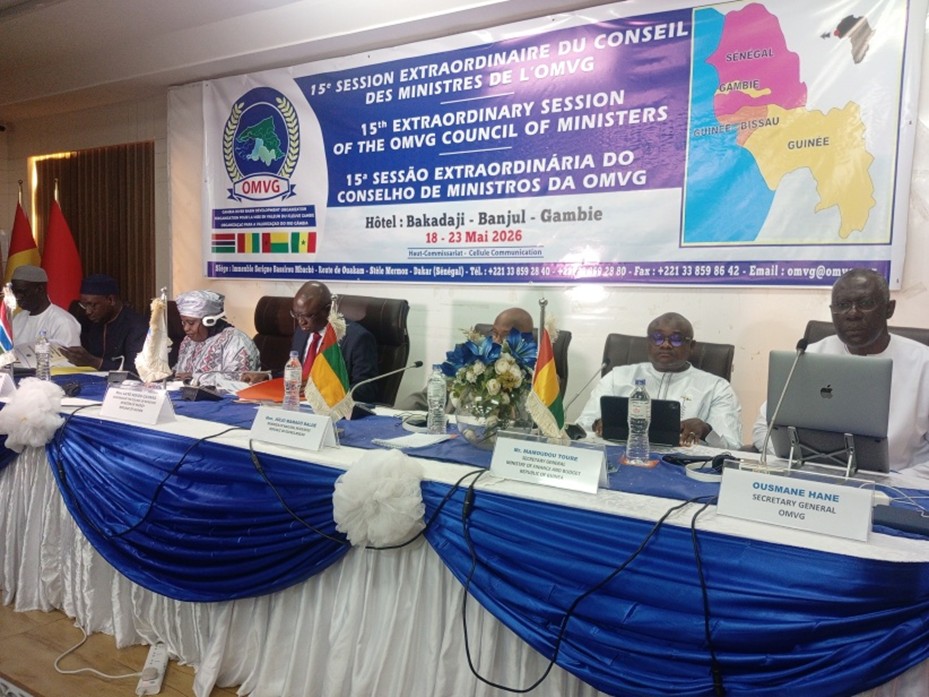
Opening the session on Friday, 22 May 2026, Guinea’s Minister of Energy and newly appointed Chairman of OMVG, Mr Laye Sekou Camara, delivered a stark warning: persistent financial constraints and contractual tensions are threatening the completion of flagship energy projects, including the Sambangalou Dam and the OMVG Interconnection.
“We must act with speed, responsibility and solidarity,” Camara urged, stressing that without sustainable financial stability, the organisation’s ambitions for energy integration and community development could falter.
Camara emphasised that the organisation faces mounting cash flow tensions, weakening both the High Commission’s operations and the implementation of community projects. He called for member states to clear outstanding contributions, secure operating budgets for the High Commissioner and SOGESART (the strategic community society), and mobilise counterpart funds for the 2026 financial year.
He underlined the need for structural reforms, including: updating OMVG’s legal and administrative instruments, strengthening transparency and accountability, rationalising institutional charges, enhancing supervisory bodies, and aligning governance with international standards and modern financing mechanisms
Camara also highlighted the importance of innovative funding, citing initiatives such as Blue Peace Financing and integrated resilience programmes supported by strategic partners.
Beyond financial concerns, Camara warned of institutional tensions between member states, particularly around functional balance and organisational coherence. He urged ministers to approach these issues with discernment, responsibility, and respect, stressing that equity and institutional stability are essential for the organisation’s unity.
“The consolidation of SOGESART must be based on balanced, consensual, transparent governance mechanisms, in line with best practices observed in comparable community organisations,” he said.
The host nation’s representative, Rohey John Manjang, Minister of Environment, Climate Change and Natural Resources of The Gambia, praised OMVG as a “shining example” of African cooperation and integration.
She reminded delegates that OMVG has consistently advanced regional initiatives to improve energy access, strengthen economic integration, and promote sustainable management of shared river basin resources.
“We must continue to build upon these achievements and ensure that the objectives of OMVG are translated into tangible benefits for our populations,” she said, expressing hope that deliberations would remain guided by consensus and cooperation.
Established by The Gambia, Guinea, Guinea-Bissau and Senegal, OMVG’s founding mission is the integrated development and shared management of the Gambia, Kayanga/Geba and Koliba/Corubal river basins.
At its core, the organisation embodies the conviction that the region’s most pressing challenges—water security, food security, energy access, and climate resilience—can only be addressed through joint action, shared governance, and pooled resources.
The extraordinary session in Banjul underscored both the achievements and the fragility of OMVG’s vision. With flagship projects delayed and financial pressures mounting, ministers face a decisive moment: either mobilise resources and strengthen governance, or risk undermining decades of regional cooperation.