Households living on hand-to-mouth
Most Malawian households are struggling to make ends meet, with the Sixth Integrated Household Survey (IHS6) showing that only 3.6 percent have enough income to save for the future. The survey, published by the National Statistical Office (NSO) on Friday, found that 41.3 percent of households earn just enough to cover daily expenses while another … The post Households living on hand-to-mouth appeared first on Nation Online.
 Black News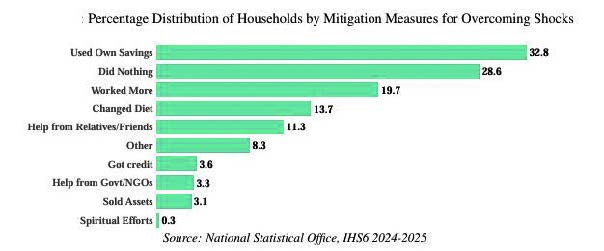
Most Malawian households are struggling to make ends meet, with the Sixth Integrated Household Survey (IHS6) showing that only 3.6 percent have enough income to save for the future.
The survey, published by the National Statistical Office (NSO) on Friday, found that 41.3 percent of households earn just enough to cover daily expenses while another 25.4 percent say their incomes are inadequate such that they must borrow to survive.
This means that nearly two-thirds of households have little or no financial cushion against economic shocks, with 75.8 percent of families perceiving themselves as poor or very poor.
An analysis by place of residence indicates that 40.4 percent of rural households’ current income is insufficient to cover expenses alone, compared with 45.3 percent of urban households.
In a written response yesterday, Centre for Social Concern economic governance officer Agness Nyirongo observed that the inability to save is one of the strongest indicators of economic vulnerability as savings provide security during difficult times and create opportunities for investment.
She said breaking this cycle requires bold and deliberate policy interventions aimed at increasing household incomes and building resilience.
Said Nyirongo: “That growth has not translated into meaningful income gains for most households. At the same time, inflation continues to erode purchasing power.
“The true test of progress is whether ordinary citizens are able to afford decent lives, save for the future and withstand economic shocks without falling deeper into poverty.”
In a separate interview, conomist Milward Tobias observed that the economic growth rate has been below the minimum threshold to lift households from poverty although policies to address these challenges already exist.
He said an aggregate income per capita growth rate has been near zero and at times negative, implying that households are getting poorer in the face of growing income inequality.
“The gap is in lack of decisive and capable leadership to implement what is available,” said Tobias, who previously served as economic aide to former vice-president Saulos Chilima and contested as an independent presidential candidate in the September 16 2025 General Election.
Scotland-based Malawian economist Velli Nyirongo said in an interview the survey findings suggest that poverty is no longer only about unemployment, it is about low and unstable incomes, weak savings capacity and limited protection against shocks.
“If most households are surviving day-to-day and one in four must borrow for basic needs, policy should focus on raising earnings while reducing vulnerability,” he said.
The survey further indicates that 67 percent of households lack adequate food, 56.4 percent lack adequate healthcare and 54.6 percent lack adequate housing.
National-level results indicate that 86.4 of households were affected by unusually high food prices, followed by 73.6 percent affected by elevated costs of agricultural inputs and 49.9 per cent by drought.
World Bank data show that economic growth has averaged 2.2 percent, far below the recommended 10.6 percent required to grow the economy to a lower middle income status by 2030.
The post Households living on hand-to-mouth appeared first on Nation Online.