In a world of blocs, France and Kenya chose the Middle
Why Nairobi? A lot of ink has already been spilled to explain the choice of Kenya to host the upcoming Africa France summit, the first gathering of heads of state from the continent Emmanuel Macron is convening since his election in 2017. But a broader, more geopolitical explanation has largely been overlooked. The origin of mzungu, the word in Kiswahili to designate Westerners, is quite an odd one: it refers to the person roaming and circling around. Over the last decade, France and its president Emmanuel Macron wamezunguka sana in Africa, with multiple trips and initiatives in several parts of […] The post In a world of blocs, France and Kenya chose the Middle appeared first on African Arguments.
 Black News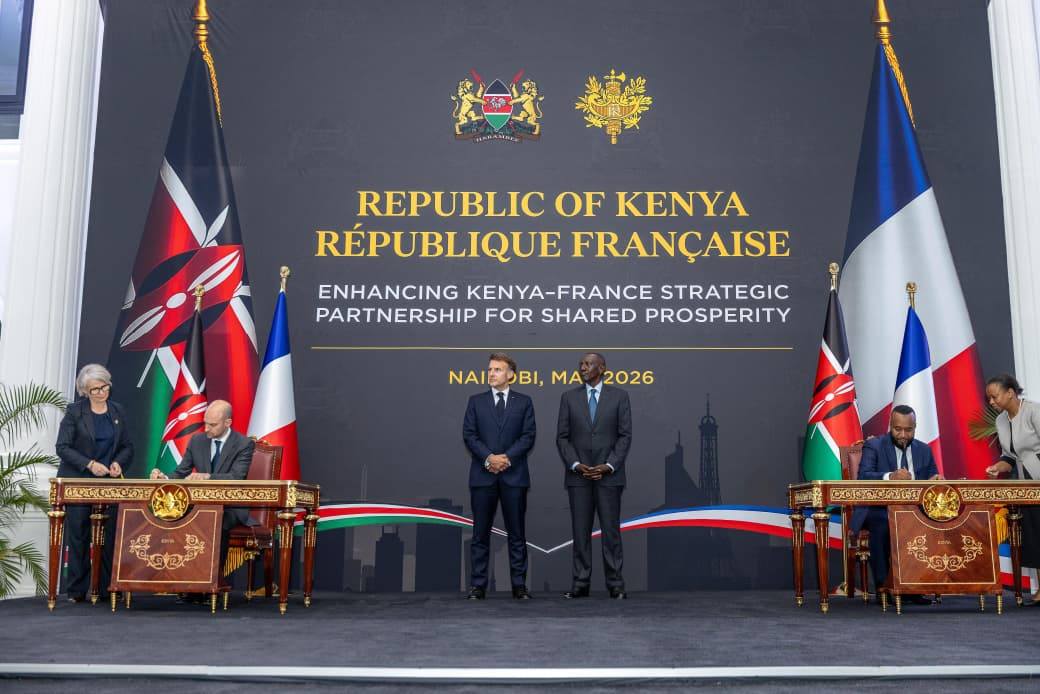
Kenya’s president William Ruto and France’s Emmanuel Macron in Nairobi at the opening of the Africa Forward Summit, 11 May 2026 (Courtesy: State House, Nairobi)
Why Nairobi? A lot of ink has already been spilled to explain the choice of Kenya to host the upcoming Africa France summit, the first gathering of heads of state from the continent Emmanuel Macron is convening since his election in 2017. But a broader, more geopolitical explanation has largely been overlooked.
The origin of mzungu, the word in Kiswahili to designate Westerners, is quite an odd one: it refers to the person roaming and circling around. Over the last decade, France and its president Emmanuel Macron wamezunguka sana in Africa, with multiple trips and initiatives in several parts of the continent.
Over the past decade, most Sahelian countries severed ties with Paris and other West African capitals took some distance too. France has managed to maintain strong relationships with a couple of countries in Francophone Africa, namely Côte d’Ivoire, Gabon, Benin, Cameroon or Congo. The hosting in Nairobi of the Africa-France summit – shrewdly named Africa Forward without any mention of France – on 11th and 12th of May serves as a powerful indicator of a shift in France’s policy in Africa with a broadening towards Non-francophone countries.
To explain the choice of the Kenyan capital, various explanations emerged. It has been argued multiple times that this decline of the French influence in francophone African countries pushed Paris to find new opportunities in the English speaking sphere. This is, indeed, true: no French president has travelled beyond their country’s African sphere of influence, the so called-pré-carré, as much as Emmanuel Macron. Since his election in 2017, he has travelled to Ethiopia, Nigeria, South Africa, Angola, Kenya and Mauritius, sometimes severally – and this list is not exhaustive, nor does it include the numerous visits of these countries’ officials to Paris. To this extent, the hosting is both a confirmation and acceleration of this trend.
It has also been argued that the choice of Nairobi as the venue of the summit is a powerful signal of the shift in France’s policy towards African countries from one of aid to one of trade, investments and partnerships. The event, with its first day dedicated to the private sector, is to showcase Kenya’s vibrant economy, with a robust banking ecosystem and a dynamic tech startup scene – both sectors Macron, a former banker, particularly likes. This is also true: the number of French companies in Kenya has nearly quadrupled in a decade, reaching around 140 in 2026, while France boasts about being the fifth-largest investor in the country. The French development agency has a regional office in Nairobi and claims to have injected €2 billion since the late 1990s.
Both reasons are true: the search for a diplomatic reset from an English-speaking country without any colonial history with France, and the focus on a business and trade-first approach partially explain the choice of Nairobi to host the summit.
But, still, why Nairobi, and not Lagos or Johannesburg? After all, Nigeria and South Africa entertain stronger economic ties with France than Kenya, and Emmanuel Macron has also tried to strengthen his relationship with Presidents Bola Tinubu and Cyril Ramaphosa.
There’s more than meets the eye: William Ruto and Emmanuel Macron share more than a birthday (21st December for those who are curious) and an outsider-from-inside profile in their respective political stages. As both regional powers trying to consolidate their global position, France and Kenya have a common interest in defending various features of the current international order and architecture, including multilateralism and the rule of law. The defence of this global framework also implied, however, the admission of its flaws and the advocacy for its reform.
The French president seeks to use the Africa Forward event both as a platform for transforming Africa-France relations and a venue to support the continued push for reforms of the international order. France will be hosting the G7 summit a month later, where the Africa Forward summit and its deliberations about reforms of the international order will be highlighted by President Ruto who has been invited to the event.
Indeed, Paris keeps a strong position within the current world order, which it inherited from the Second World War: despite coming out bruised from the conflict, France’s then massive colonial empire secured her a seat among the five permanent members of the United Nation’s Security Council. While obviously a member of the Western bloc, the French foreign policy always made sure to keep its autonomy towards it – an attitude that still transpires in Paris’ current positions vis-à-vis Iran, Israel or the US administration.
Nairobi, on the other hand, has been a strong proponent for multilateralism since its independence, hosting UN headquarters – today one of the four main sites in the world – since 1972 and supporting various peacekeeping missions as well as peace mediation initiatives. During the Cold War, Kenya was one of the only allies of the Western bloc in a region dominated by leftist or Marxist regimes. This did not prevent the successive Kenyan regimes from building some links with China, the USSR and the Eastern bloc. In short, both countries tried to maintain a balance in their ties with the world’s various blocs, and the current global institutions were instrumental for them to keep this fragile equilibrium running.
This world order is rapidly changing. Bigger powers are expanding their spheres of influence, each on their own. The potential collapse of these institutions could easily weaken Kenya’s and France’s positions, which are protected by the (relative) checks and balances that prevailed with international laws, on trade, environment and sovereignty.
This is one of the reasons why presidents Ruto and Macron are among the key proponents of a sweeping reform of existing institutions, to bring more non-Western countries to the UNSC and give them more voting rights in multilateral funders. Both presidents are outspoken about multilateralism and developed a “summit diplomacy” that saw Nairobi and Paris host various global events (One Planet Summit, Africa Climate Summit, Paris Peace summit, among many others) that they tried to use to build advocacy coalitions on the global stage.
As East Africa’s main diplomatic hub hosting the world’s biggest UN headquarters, Nairobi has become a significant theatre of influence, in which France does not want to become a spectator. The Kenyan government’s recent high-level engagement with China, India, Russia, the UK and the Commonwealth – which all happened since the beginning of the year, positioned Nairobi as a strategic bargaining partner for France. Kenya has particularly positioned itself as a major regional and global convening hub including through its hosting of the first Sustainable Blue Economy Conference in 2018 and the first Africa Climate Summit in 2023.
The reformist agenda pushed by Paris and Nairobi, with a strong emphasis on combating climate change, significantly differs with the American one under the Trump administration, which has largely sidelined the UN, broke with trade rules and diplomatic practices, and started building a parallel organisation with the Board of Peace – which mostly seems dormant or little active so far. While Russia and China advocate for a reform of the UN, they also started strengthening their own sphere of influence through the BRICS+, the Shanghai Cooperation Organisation.
Exactly a year to the end of his term, it will be difficult for Emmanuel Macron to inspire a whole new vision of the Africa-France relations that can survive him, at the same time his political party will struggle to remain in power after the 2027 elections. As a consequence, his shared position on international matters with William Ruto, offers them one of the last occasions to push for a progressive reform of international institutions, in the hope to stabilise an already crumbling world order. Otherwise, the one running into circles quickly ends up spiralling down.
The post In a world of blocs, France and Kenya chose the Middle appeared first on African Arguments.