People’s Organization For Progress Will Host Community Reading Of Frederick Douglass’ Speech ‘What To The Slave Is The Fourth Of July?’
Photos: Facebook|Wikimedia Commons As the nation begins to celebrate its 250th anniversary of independence, a grassroots civil rights organization will have a public reading of a speech by a nineteenth century slavery abolitionist which offers a unique perspective on the 4th of July. There will be community recitation of “What To The Slave Is The Fourth Of July,” by Frederick Douglass. It will take place on Thursday evening, July 2, 2026, 6:00pm at Bethany Baptist Church, 275 West Market Street in Newark, New Jersey. The program is sponsored by the People’s Organization For Progress. It is free and open to the public. “We are having this program because we felt it was important to hear the perspective of a Black abolitionist on celebrating the nation’s independence while millions of Black people were still enslaved within its borders,” Lawrence Hamm, Chairman, People’s Organization For Progress stated. “We also believe that this activity will give us further insight into the state of race relations in the United States today,” Hamm said. “We are calling this a community reading because the presentation will be a collective effort. We are inviting community leaders, activists and residents to each read portions of the speech,” he said. Frederick Douglass is the most famous abolitionist of his era. He was born Frederick Augustus Washington Bailey. His recognized birthdate is February 14, 1818. He was born into slavery in Talbot County, Maryland. Douglass was self-emancipated and self-educated. He escaped from slavery at age 20 and went on to join the abolitionist movement. He became an author, statesman, and one of the greatest orators of his time. Douglass was also the most photographed person of his century. He was about 77 years old when he died on February 20, 1895 in Washington, DC. The speech was given at an event observing the 76th anniversary of U.S. independence on July 5, 1852 at Corinthian Hall in Rochester, New York. It was organized by the Rochester Ladies’ Anti-Slavery Society. This was nine years before the start of the Civil War. “The program is timely because it takes place after the Juneteenth holiday on June 19th, which celebrates emancipation, and before Independence Day on July 4th, which observes the country’s founding when Black people were enslaved,” Hamm said. “When Frederick Douglass asked the question ‘what to the slave is the Fourth of July?’ in 1852, nearly four million of black people in this country were enslaved,” he said. “So now, 174 years later we must ask the question what should this holiday mean to the descendants of those who were enslaved in this country on July 4,1776,” he said. “In his answer to the question Douglass made a scathing criticism of slavery in the U.S. I am certain that if he could speak now he would be relentless in his critique of the ongoing racism, white supremacy, racial inequality, injustice, and oppression that exists in this country today,” Hamm said. For more information contact the People’s Organization For Progress (POP) at 973 801-0001.
 Black News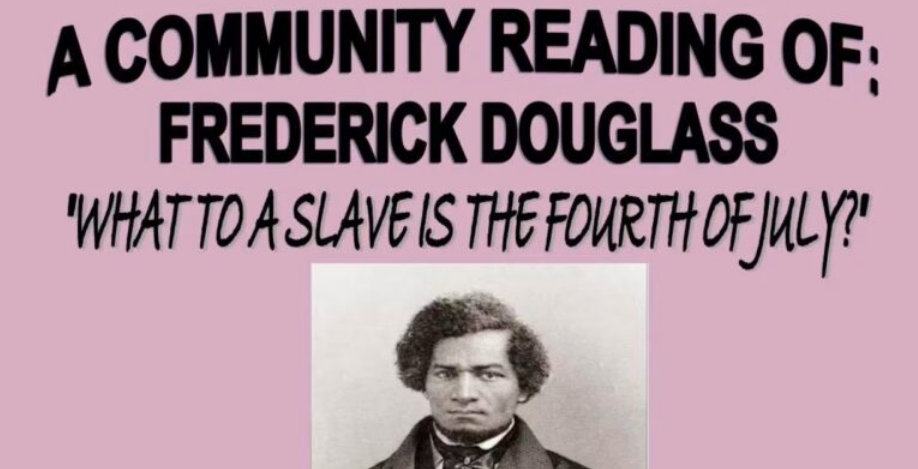
Photos: Facebook|Wikimedia Commons
As the nation begins to celebrate its 250th anniversary of independence, a grassroots civil rights organization will have a public reading of a speech by a nineteenth century slavery abolitionist which offers a unique perspective on the 4th of July.

There will be community recitation of “What To The Slave Is The Fourth Of July,” by Frederick Douglass. It will take place on Thursday evening, July 2, 2026, 6:00pm at Bethany Baptist Church, 275 West Market Street in Newark, New Jersey.
The program is sponsored by the People’s Organization For Progress. It is free and open to the public.
“We are having this program because we felt it was important to hear the perspective of a Black abolitionist on celebrating the nation’s independence while millions of Black people were still enslaved within its borders,” Lawrence Hamm, Chairman, People’s Organization For Progress stated.
“We also believe that this activity will give us further insight into the state of race relations in the United States today,” Hamm said.
“We are calling this a community reading because the presentation will be a collective effort. We are inviting community leaders, activists and residents to each read portions of the speech,” he said.
Frederick Douglass is the most famous abolitionist of his era. He was born Frederick Augustus Washington Bailey. His recognized birthdate is February 14, 1818. He was born into slavery in Talbot County, Maryland. Douglass was self-emancipated and self-educated.
He escaped from slavery at age 20 and went on to join the abolitionist movement. He became an author, statesman, and one of the greatest orators of his time. Douglass was also the most photographed person of his century. He was about 77 years old when he died on February 20, 1895 in Washington, DC.
The speech was given at an event observing the 76th anniversary of U.S. independence on July 5, 1852 at Corinthian Hall in Rochester, New York. It was organized by the Rochester Ladies’ Anti-Slavery Society. This was nine years before the start of the Civil War.
“The program is timely because it takes place after the Juneteenth holiday on June 19th, which celebrates emancipation, and before Independence Day on July 4th, which observes the country’s founding when Black people were enslaved,” Hamm said.
“When Frederick Douglass asked the question ‘what to the slave is the Fourth of July?’ in 1852, nearly four million of black people in this country were enslaved,” he said.
“So now, 174 years later we must ask the question what should this holiday mean to the descendants of those who were enslaved in this country on July 4,1776,” he said.
“In his answer to the question Douglass made a scathing criticism of slavery in the U.S. I am certain that if he could speak now he would be relentless in his critique of the ongoing racism, white supremacy, racial inequality, injustice, and oppression that exists in this country today,” Hamm said.
For more information contact the People’s Organization For Progress (POP) at 973 801-0001.