Supreme Court Justices Alito And Jackson Debate Voting Rights Decision
The argument centered on the Supreme Court's decision to bypass a traditional waiting period before a ruling is formalized.
 Black News
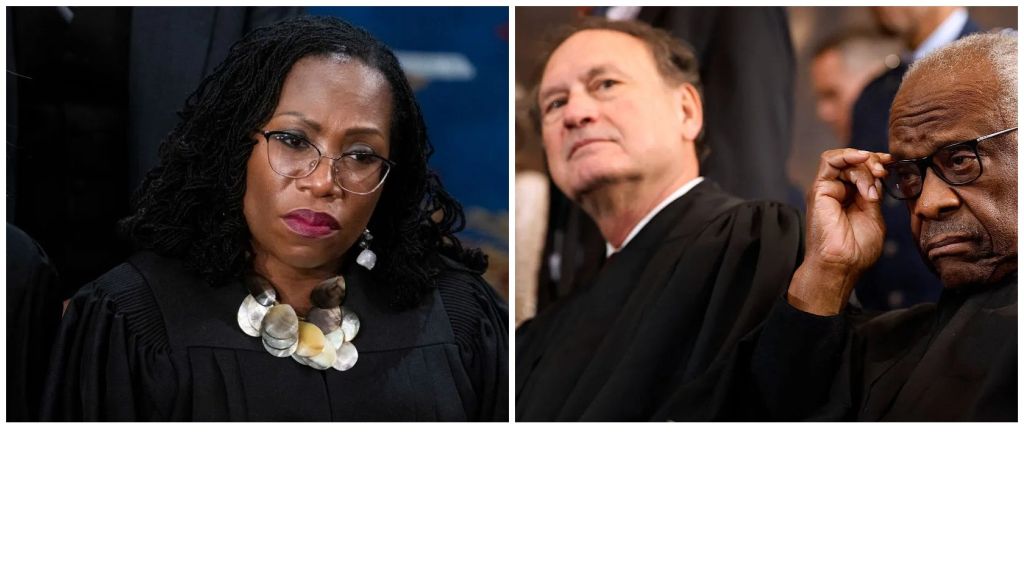
Last week, the Supreme Court finished gutting the Voting Rights Act in its ruling on Louisiana v. Callais. While there’s normally a 32-day period between when a ruling is announced and it’s formally passed down, the Supreme Court ruled that redistricting can begin immediately, sparking a fierce back-and-forth between Justices Samuel Alito and Ketanji Brown Jackson.
CBS News reports that the voters who brought the case to court asked to bypass the 32-day period, arguing that “time is … of the essence” as primary elections are right around the corner. Jackson wrote a dissent that effectively put the Conservative majority on blast and pointed out the hypocrisy of their decision-making.
“Not content to have decided the law,” Jackson wrote of the majority, “it now takes steps to influence its implementation.” The court’s decision to “buck our usual practice,” she added, ”is tantamount to an approval of Louisiana’s rush to pause the ongoing election in order to pass a new map.”
Jackson added that the court should “stay on the sidelines” to “avoid the appearance of partiality,” citing the court’s historical reluctance to make changes right before an election.
“And just like that, those principles give way to power,” Jackson added.
Jackson is just saying what we’re all thinking. I find the hypocrisy of this move astounding, considering that when the Supreme Court struck down a lower-court ruling that the Texas map was racially gerrymandered, they noted that the court shouldn’t be making rulings that could affect upcoming elections. In that ruling, the Supreme Court wrote that it “has repeatedly emphasized that lower federal courts should ordinarily not alter the election rules on the eve of an election.”
That ruling came when we were just under a year from the midterms. This one came six months before the midterms and only weeks before Louisiana voters were set to cast their ballots in their primaries. Yet Justice Samuel Alito decided to play dumb in the concurrence he wrote in response to Jackson’s concerns.
“What principle has the Court violated?” Alito wrote. “The principle that Rule 45.3’s 32-day default period should never be shortened even when there is good reason to do so? The principle that we should never take any action that might unjustifiably be criticized as partisan?”
Unjustifiably? The current Supreme Court is one of the most conservative in history. The current 6-3 Republican supermajority has spent much of its time rolling back long-standing rights and paving the way for President Donald Trump to act with impunity. There are plenty of justifiable reasons to believe the current court is partisan.
“The need for prompt action by this court is clear,” Alito added. The congressional districting map enacted by the legislature has been held to be unconstitutional, and the general election will be held in just six months,” Alito wrote.
The Supreme Court’s ruling undermines Black voting power and pretty much gives Republicans the ability to eliminate majority-Black voting districts completely. It would be nice if Alito were more offended about disenfranchising Black voters than being called out for his partisan, unprincipled, and hypocritical decision-making.
SEE ALSO:
What The SCOTUS Ruling Means For Black Voting Rights And How We Move Forward
SCOTUS Callais Decision Delivers Major Blow To Black Voting Rights
Black Voter Disenfranchisement Is On The Supreme Court Docket
Louisiana v. Callais And Its Impact On Black Voting Rights
Supreme Court Poised To Roll Back Black Voting Rights, Again