The G7 must reset relationships with the Global South
The world is changing faster than the institutions designed to govern it. Over the past few days, the leaders of G7 – joined by Kenya, Brazil, India, South Korea and Syria – gathered in Evian, France. They faced a defining choice: something beyond aid or trade, but about whether the architecture of global power will […] The post The G7 must reset relationships with the Global South appeared first on New African Magazine.
 Black News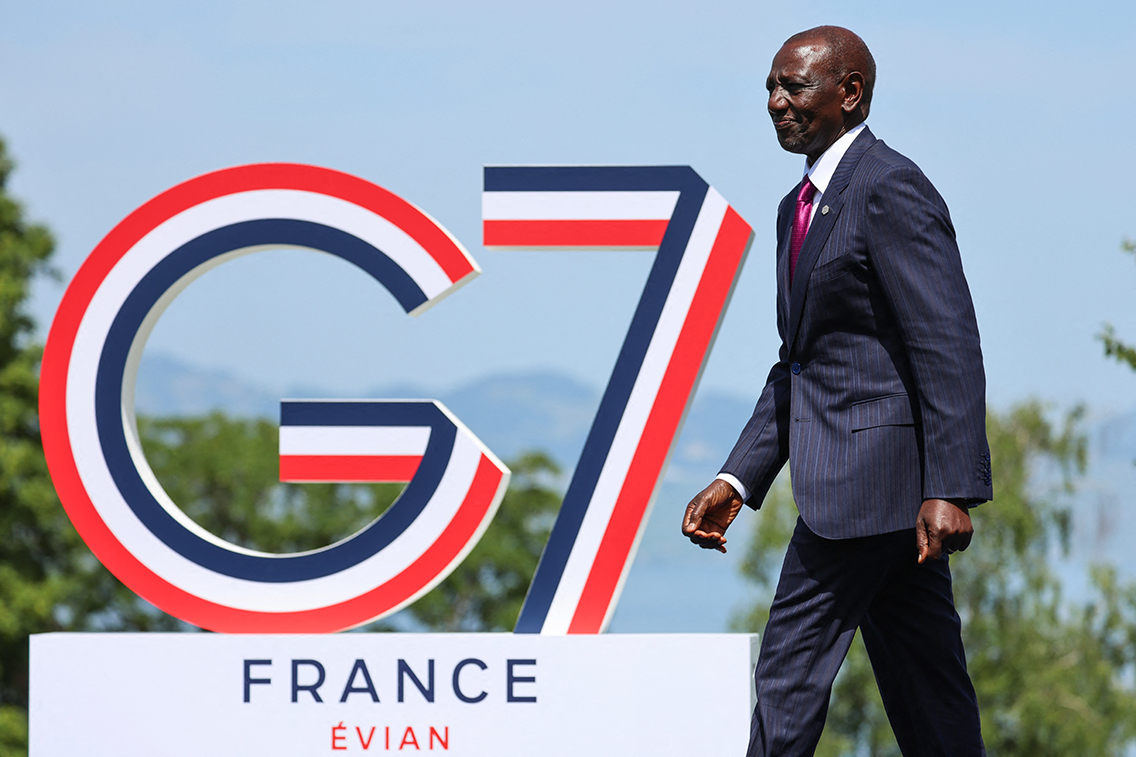
The world is changing faster than the institutions designed to govern it. Over the past few days, the leaders of G7 – joined by Kenya, Brazil, India, South Korea and Syria – gathered in Evian, France. They faced a defining choice: something beyond aid or trade, but about whether the architecture of global power will embrace and reflect the realities of the twenty-first century, or remain trapped in the assumptions and formulas of the twentieth.
But the nations of the Global South do not come to this table on bended knee. For too long, these nations – from Africa to Asia to Latin America and the Caribbean, have been cast as the recipients of development, rather than the fundamental drivers of it.
This framing is no longer fit for purpose and fails to reflect the reality of our world. The Global South has given, and continues to give, far more than resources, markets, and labour. It has given the world ideas, and these ideas have shaped modernity itself.
Nelson Mandela reminded us that freedom counts for little when people lack the means to shape their own future. Mahatma Ghandi taught us that meaningful progress cannot be measured by the wealth of a few, but by whether tangible change reaches the last person in the village. These figures have provided us with the blueprints, and they must guide our approach to building a fair and growing global economy.
But to speak of opportunity exclusively would be to neglect the stark reality of the pressures bearing down on the Global South. Nowhere is this more visible than in Africa, where nations are navigating a world shaped by forces both internal and external, and that navigation is becoming harder and ever more complex.
These governments accommodate the expectations of a young and ambitious population. This generation is educated, connected, and rightfully unwilling to accept a future of diminished horizons. Yet, the fiscal space available to African countries continues to be compressed by inflation driven by events beyond their borders. Simultaneously, there are those who look to them to fuel our technological competitions, coveting their raw materials, with little thought to the partnership of equal terms necessary to make this possible.
The choices available to governments are narrowing. Those nations which have fought hard for democratic principles find themselves contending with a popular but dangerous alternative: limiting choice, concentrating power and imposing policy by decree.
This is happening now. Indeed, more dangerous still is the increasing risk that governments feel obligated to sell their continent’s wealth cheaply, rather than building it for the next generation of who will inherit it. The assumption no longer holds that the multilateral structures will provide the collective path to a secure and prosperous future.
A perilous moment
Our global co-responsibility hangs in the balance: with privateering replacing partnership, we face a new international landscape where major players seek to carve out spheres of influence, with diplomacy giving way to protection rackets.
This is a perilous moment, but not one without hope – if we are willing to look at it through a different angle of the prism.
The world is waking up to the fact that the next era of rapid economic development is unlikely to be forged in the old capitals of the industrialised world, whether it be London, Washington or Paris.
It will be crafted in Nairobi and Jakarta, in Bogota and Accra – and beyond. Young growing populations, rapid urbanisation, abundant energy potential, and rapidly expanding innovation ecosystems mean that the Global South is truly the engine of growth.
The G7’s challenge – and a challenge the West must own – is the move beyond the tired development models of the past, and build a new compact, grounded in equal partnership and shared prosperity. The Global South has learned – painfully – that a new scramble from the outside is a road better not taken.
This means we must change the terms – literally – under which we discuss this era. The Global South is, in fact, the world’s Future Majority.
These are the countries that will drive population growth, energy production and demand, urban expansion and economic dynamism in the decades to come.
There is no waiting for permission to join the future: we are already building it. The outstanding question is whether the international institutions, capital markets and cross-border partnerships will be capable of evolving quickly enough to be part of that transformation, or whether they will once again arrive too late.
Therefore, this Future Majority deserves institutions that recognise that reform is needed to match this pace. The bodies that have long upheld the international order are at risk of becoming ceremonial, and were designed for the realities of 1945, not 2026.
But that isn’t to say we don’t need them. To remain effective, these global governance mechanisms must be pragmatic and reflect the shifting balances of economic, demographic and geopolitical weight.
If the remarks made by President William Ruto of Kenya (during the G7 to which Kenya was invited in place of South Africa, and he asked for a reset of the economic and financial relationships between Africa and the developed world) are anything to go by, Africa has signalled that it is ready to be a partner in investable and equitable growth.
It is a continent in unparalleled transformation – from infrastructure, to digital systems, to artificial intelligence, to connectivity and healthcare – the question is whether the levers of international capital and political will are ready to meet this momentum with the respect it deserves.
We must look beyond the caricature of this continent. Look at the numbers. Look at the explosive growth of the private sector. Look at the land not yet cultivated, the roads not yet constructed, and the comprehensive infrastructure that will emerge.
A durable partnership is a mutual partnership. We cannot deny that there is more work to do: on strengthening governance, deepening regional integration and creating the conditions in which investment can take root and flourish.
But equally, the old order – indeed the G7 – must move beyond rhetoric and amicable tones. It must deliver on meaningful investment; genuine market access; robust supply chains, and above all else, institutions that recognise the complex contemporary realities. Neither side can demand from the other what it is unwilling to do itself.
Dependency and charity do not represent the path to a prosperous future. It is about mutual accountability and shared responsibility.
The Future Majority will rise. This is indisputable and already taking shape. What is unknown is whether the world’s leading economies will choose partnership over paternalism and shift from an age of entrenched advantage to shared prosperity.
We have the means, but we need the will to craft a global order that is resilient, inclusive and sustainable. For those of us in the West, our inheritance – the post-war order we built and from which we have long benefited – must not become our excuse for inaction. But if we do not act, and act decisively, we risk engendering a world where the fractures we see today – and, frankly, the consequences of our own histories – deepen every year.
We all have the opportunity, and the obligation, to choose wisely.
Lt Col Tobias Ellwood is a former Chair of the Defence Select Committee and Minister for Defence Veterans, Reserves and Personnel in the UK Government.
The post The G7 must reset relationships with the Global South appeared first on New African Magazine.