They called it historic. Somali women have heard that before.
The first time I heard a Somali female parliamentarian describe her experience of the quota system, she did not use the word “opportunity.” She used the word “chess piece.” “They give us seats,” she told me, “but silence our votes.” I was in the middle of four years of doctoral research on women’s political participation in post-conflict Somalia, interviewing women politicians, clan elders, civil society leaders, and international programme officers. That sentence, eight words, captured something I had spent hundreds of pages trying to articulate. The problem in Somalia was never simply that women were absent from parliament. It was […] The post They called it historic. Somali women have heard that before. appeared first on African Arguments.
 Black News

The first time I heard a Somali female parliamentarian describe her experience of the quota system, she did not use the word “opportunity.” She used the word “chess piece.”
“They give us seats,” she told me, “but silence our votes.”
I was in the middle of four years of doctoral research on women’s political participation in post-conflict Somalia, interviewing women politicians, clan elders, civil society leaders, and international programme officers. That sentence, eight words, captured something I had spent hundreds of pages trying to articulate. The problem in Somalia was never simply that women were absent from parliament. It was that the systems designed to include them had been quietly repurposed to contain them. This pattern, documented in detail in my 2025 peer-reviewed study, is what I call “patriarchal hybridity”: the process by which clan-based power structures absorb and domesticate formal gender reforms without surrendering actual decision-making authority.
Somalia is now at what observers are calling its most significant democratic crossroads since independence. On 4 March 2026, the Federal Parliament approved the final amendments to the country’s Provisional Constitution, formally instituting one-person-one-vote elections for the first time since 1969. For women’s rights advocates, this moment carries real weight. The shift away from the indirect, clan-mediated 4.5 power-sharing mode, in which women were officially classified alongside minority clans as the “0.5”, has been a demand of Somali women’s movements for years. The Nagaad Network campaigned for it. The 2019 Somali Women’s Charter called for it. Women who sat through indirect elections and watched clan elders select male candidates for seats ostensibly reserved for them wanted exactly this.
But Somalia also has a long tradition of celebrating firsts while the machinery of exclusion reassembles itself quietly in the background.
The crisis before the campaign
Before anyone talks about what direct elections mean for Somali women, it is worth being precise about what is happening on the ground right now.
Puntland and Jubbaland have refused to recognise the constitutional amendments. The Council for the Future of Somalia, a coalition of opposition leaders and several Federal Member State presidents, is threatening a parallel political convention. The government of President Hassan Sheikh Mohamud, whose mandate expires on 15 May 2026, has appointed eighteen electoral commissioners, all backed by his ruling Justice and Solidarity Party. Al-Shabaab made significant territorial gains in 2025, including expanding operations around Mogadishu. The voter registration process, launched in April 2025, is the first of its kind in over fifty years.
This is the environment into which Somali women are expected to campaign, fundraise, canvass, and win.
The risks are not abstract. In fragile electoral environments, women face threats that are concentrated and specific: harassment that drives them from public life, financial barriers that structurally disadvantage them, and political crises that create last-minute bargaining in which women’s seats have historically been the first concession traded. During the 2021–2022 electoral cycle, women’s representation in the House of the People ended at 20%, down from 24% in 2016. In Hirshabelle, seats held by women dropped from ten to five between those two cycles. The reason was not the voters. It was the architecture of how candidates were selected and what happened when elite negotiations required sacrificial compromises.
In a direct election environment, the gatekeeping moves it does not disappear.
“They give us seats but silence our votes.” Female MP, Somalia, interview conducted during doctoral fieldwork, 2024
Fifty-seven years is a long time
It is worth pausing on what it means that Somalia has not held a direct election since 1969. That is not a statistic. It is a lived reality for millions of Somalis, and it means that the infrastructure, norms, culture, and habits of genuine popular participation simply do not exist yet at scale.
The shift to direct elections does not eliminate gatekeeping; it relocates it. This is not a pattern unique to Somalia. Across sub-Saharan Africa, the introduction of multiparty electoral systems has consistently transferred the control of women’s access to political office from one set of informal gatekeepers to another. In Kenya, Uganda, and Nigeria, research has documented how party nomination processes function as the primary site of women’s exclusion: women who survive the formal electoral contest are frequently eliminated in the internal selection processes that precede it. The gatekeeper is no longer a single identifiable figure. It is the party executive that controls candidate lists, the financier who decides which campaigns are viable, and the network of endorsements that determines whose name appears in a position voters can actually reach. None of these mechanisms appear in electoral law. All of them shape electoral outcomes.
Somalia’s transition to one-person-one-vote introduces this layer of exclusion into a political system that has not yet developed the countermeasures strong, autonomous political parties with internal democracy requirements, independent campaign finance regulation, or enforceable gender parity rules for candidate lists that have proved necessary, though rarely sufficient, to contain it elsewhere on the continent.
For women, the implications are acute. Direct elections require candidates to build name recognition, organise constituency support, manage campaign finances, and navigate public life safely. In Somalia, women who enter politics describe a reality in which their clan membership is contested if they marry into another clan, who do they represent and in which the financial cost of running is prohibitive. My research found that women candidates routinely sold personal assets to meet registration fees while their male counterparts accessed clan and business networks. The 2021 electoral law doubled registration costs to $10,000. That figure does not change because the voting model does. Research published in 2026 in Frontiers in Political Science, confirms that cultural beliefs continue to suppress women’s political self-efficacy even where legal frameworks support their participation and that without strong enforcement mechanisms, formal equality remains largely on paper.
What the Constitution still does not guarantee
The most important unresolved question in Somalia’s 2026 elections is not which voting model prevails. It is whether the 30% gender quota, which has never been fully met in any electoral cycle since it was first introduced, will be constitutionally codified with real enforcement mechanisms.
Currently, the quota exists as a policy aspiration, not a binding law. There are no sanctions for non-compliance. There is no constitutional provision that deregisters a party for failing to field women candidates, no independent body empowered to reject electoral lists that do not meet the threshold. What exists is an appeal to clan elders, to party leaders, to international donors to do the right thing. And across four electoral cycles, we have seen repeatedly that appeals are not sufficient when political interests are at stake.
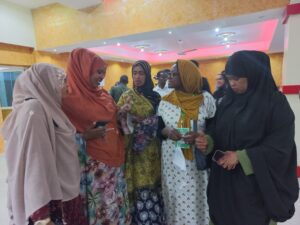
Women gather at a political engagement event in Somalia
Women’s organisations have not been passive about this. The Somali Women’s Charter demanded 50% representation across all levels of government. Women MPs have drafted legislation, built caucuses, and negotiated inside systems structured to exclude them. The Puntland Women’s Parliamentary Caucus invoked customary law (xeer) and Islamic jurisprudence to pass Somalia’s first gender-sensitive penal code, criminalising rape, in 2018. They did not wait to be included. They found the leverage they had and used it.
But individual resilience does not substitute for structural protection. And in a political environment as fragmented and volatile as Somalia’s 2026 moment, protection requires enforcement.
“Quotas are chess pieces for clan bargaining.” — Civil society leader, Mogadishu, interviewed during doctoral fieldwork
Three things that must happen
The first is straightforward: the 30% quota must be written into the permanent constitution as a binding, sanctioned provision, not a target, not a guideline, but a legal floor with consequences for parties that fall below it.
The second requires a change in how progress is measured. Too much of the existing gender programming in Somalia has counted women on candidate lists and called it success. What matters is whether women, once elected, chair committees, author legislation, and hold budget oversight positions. The African Union’s Gender Monitoring Mechanism, deployed in Somalia since 2022, provides a template for tracking real influence beyond numerical presence.
The third is the hardest: any negotiated settlement between the Federal Government and the Federal Member States, and there will be one, must include women at the table and an explicit, monitored commitment to women’s inclusion. Every previous Somali political crisis has produced a deal made by men, for men, in rooms where women were not present. The 2026 process is already heading in a familiar direction.
Somalia’s elections in 2026 are genuinely historic. After fifty-seven years, citizens may directly choose their representatives. After fourteen years of constitutional drafting, the country has a permanent framework. These things matter.
But so does the pattern. Constitutional milestones in Somalia have, again and again, arrived draped in language about inclusion while leaving the structures of exclusion largely intact. Women have been told their moment is coming since at least the Garowe Principles of 2012. They have been classified as a minority. They have had their seats reclassified for male cousins after quotas were announced. They have been offered symbolic presence and denied actual power.
One-person-one-vote can change that. But only if the people with the power to enforce inclusion decide that this time, “historic” means something real. There is a particular cruelty in a constitution that guarantees equality while the system it creates perpetuates exclusion. Somalia’s Provisional Constitution has contained a commitment to gender equality since 2012. It has coexisted, without apparent contradiction, with the systematic sidelining of women from the committees, the budgets, and the legislative drafting that constitute actual governance. The permanence of the new constitution changes the document. It does not, by itself, change that coexistence. Rwanda changed its constitution in 2003 and now has the highest proportion of women in parliament in the world; not because Rwandan women were more determined, but because the legal architecture made exclusion structurally costly rather than structurally convenient. Somalia has the blueprint. What it has consistently lacked is the political will to make the blueprint binding. The 2026 elections will not be remembered for the fact that they happened. They will be remembered for what they produced or failed to produce for the half of Somalia’s population that has been promised inclusion in every electoral cycle since 2012 and delivered it in none.
The post They called it historic. Somali women have heard that before. appeared first on African Arguments.