Uganda’s Cabinet: Museveni Defies Cries Over Bloated Public Administration
By Black Star News Photos: YouTube Screenshots|Wikimedia Commons On October 8, 2025, Gen Yoweri Museveni dispatched striking humanities’ teachers to the Democratic Republic of Congo (DRC) to work as ‘mercenaries’ saying there was no money to meet their salary enhancement demands: “From 1971 up to now, I have been working for very little pay. Those mercenaries [striking arts’ teachers] saying money, money, money; me, me, me; should leave us alone and go to Congo or other places where they want mercenaries.” The war-plagued DRC has had mercenaries fighting alongside government forces to help contain groups of insurgents there. Museveni has claimed that his salary is Shs3.6 million (roughly US$1,000) only, and that he has chosen to resist titillations from his acolytes to have his monthly income revised upwards. In the supplementary budget Parliament passed on May 5, however, classified expenditure for State House stood at Shs410 billion (over US$114 million) with Shs300 billion (approximately US$83 million) already spent at the time requiring no legislative approval. Parliament approved Shs110 billion (over US$31million) for State House in the supplementary. Shs3 billion (above US$833,000) was approved for Museveni’s swearing-in activities for the seventh elective term on May 12. In May 2022, at the height of the sky-rocketing cost of living when commodity prices soared astronomically occasioned by Russia’s full-scale invasion of Ukraine on February 24 that year, opposition doyen Dr. Kizza Besigye took to the streets claiming citizens were suffering while State House expenditure gobbled Shs2.8 billion (over US$556,000) daily. As usual, security was quick to foil his agitations. And days to Museveni’s swearing-in on May 12, six Uganda People’s Defence Forces-Airforce (UPDF-AF) Sukhoi su-30MK2 fighter jets started burning jet fuel in manoeuvres to entertain guests at the ceremony. “The UPDF-AF’s multirole combat aircrafts consume around 10,200 litres/hour. The fuel consumption spikes inexorably when using afterburners during either combat or rapid acceleration as expected during Tuesday’s [May 12, 2026] swearing-in ceremony…Could the aviation fuel being burned by the Sukhois have been redirected to ease the pain?” the independent Weekend Monitor asks in its May 9-10, 2026 edition. Jet fuel had doubled between $150 and $200 per barrel due to the US/Israel-Iran war in the Middle East; prompting domestic flight operators to slap a surcharge of $25 and $50. An apex economic earner, tourism fuels domestic flights in Uganda. As if that was not painfully taxing enough, government on May 28, through the Leader of Government Business in Parliament, has increased the number of ministers in its cabinet; an elasticity that stretches the burden on tax payers further. Museveni’s cabinet he unveiled on May 26 increases slots from 21 to 30. State ministers (or deputy ministers) jump from 21 to 51. Article 113(2) of the 1995 Constitution mandates the president to appoint 21 ministers and their deputies in Article 114(2). But the same supreme law allows the chief executive to revise his or her cabinet upwards through a motion in Parliament. The practice in government continues to defy cries against the ballooning cost of a bloated public administration. Resident District Commissioners (RDCs), for example, are earmarked to start earning a whopping Shs9 million (about US$2,500) per month. This is despite the fact that the same government complaining that it does not have money for paying intern doctors; just to name one State necessity. There are also cries of inadequate equipment, understaffing and dilapidated infrastructures in government schools and medical facilities across the country. RDCs are the eyes and ears of the president in a given district or city of their jurisdiction. They are fully-staffed with equally well-facilitated deputies and assistants. The in-coming 556 lawmakers of the 12th Parliament have each earned themselves Shs315 million (about US$87,500) for buying cars of their choices. Moreover, at the April 2026 ruling National Resistance Movement retreat, Museveni gave each of his over 372 MPs Shs100 million (approximately US$28,000). The list is as long as personal caprice dictates even before the revulsion of wasteful expenditure straggles through. And fundamentally, the elasticity of public administration in what increasingly appears to be a numb government remains as costly and back-breaking as ever for citizens to bear.
 Black News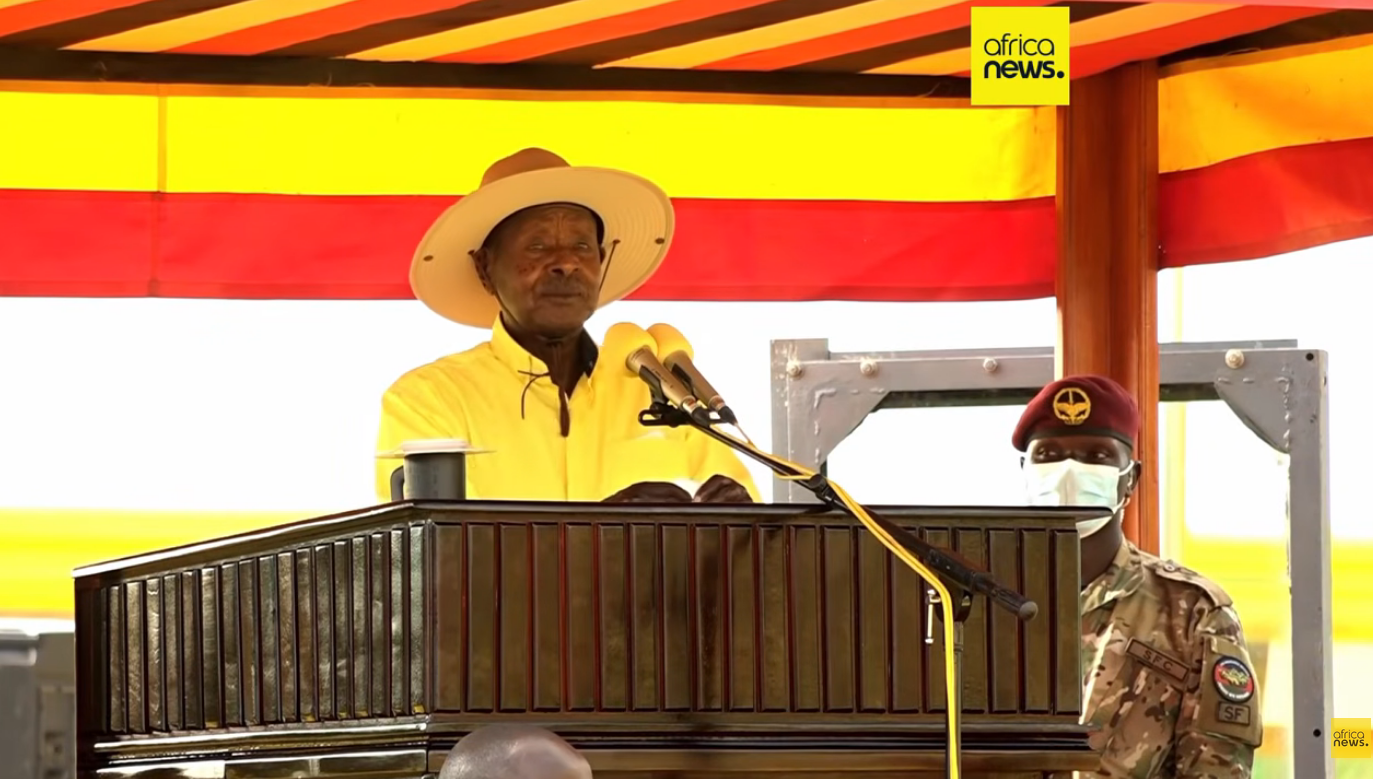
By Black Star News
Photos: YouTube Screenshots|Wikimedia Commons
On October 8, 2025, Gen Yoweri Museveni dispatched striking humanities’ teachers to the Democratic Republic of Congo (DRC) to work as ‘mercenaries’ saying there was no money to meet their salary enhancement demands: “From 1971 up to now, I have been working for very little pay. Those mercenaries [striking arts’ teachers] saying money, money, money; me, me, me; should leave us alone and go to Congo or other places where they want mercenaries.” The war-plagued DRC has had mercenaries fighting alongside government forces to help contain groups of insurgents there.

Museveni has claimed that his salary is Shs3.6 million (roughly US$1,000) only, and that he has chosen to resist titillations from his acolytes to have his monthly income revised upwards.
In the supplementary budget Parliament passed on May 5, however, classified expenditure for State House stood at Shs410 billion (over US$114 million) with Shs300 billion (approximately US$83 million) already spent at the time requiring no legislative approval. Parliament approved Shs110 billion (over US$31million) for State House in the supplementary. Shs3 billion (above US$833,000) was approved for Museveni’s swearing-in activities for the seventh elective term on May 12.
In May 2022, at the height of the sky-rocketing cost of living when commodity prices soared astronomically occasioned by Russia’s full-scale invasion of Ukraine on February 24 that year, opposition doyen Dr. Kizza Besigye took to the streets claiming citizens were suffering while State House expenditure gobbled Shs2.8 billion (over US$556,000) daily. As usual, security was quick to foil his agitations.

And days to Museveni’s swearing-in on May 12, six Uganda People’s Defence Forces-Airforce (UPDF-AF) Sukhoi su-30MK2 fighter jets started burning jet fuel in manoeuvres to entertain guests at the ceremony. “The UPDF-AF’s multirole combat aircrafts consume around 10,200 litres/hour. The fuel consumption spikes inexorably when using afterburners during either combat or rapid acceleration as expected during Tuesday’s [May 12, 2026] swearing-in ceremony…Could the aviation fuel being burned by the Sukhois have been redirected to ease the pain?” the independent Weekend Monitor asks in its May 9-10, 2026 edition. Jet fuel had doubled between $150 and $200 per barrel due to the US/Israel-Iran war in the Middle East; prompting domestic flight operators to slap a surcharge of $25 and $50. An apex economic earner, tourism fuels domestic flights in Uganda.
As if that was not painfully taxing enough, government on May 28, through the Leader of Government Business in Parliament, has increased the number of ministers in its cabinet; an elasticity that stretches the burden on tax payers further. Museveni’s cabinet he unveiled on May 26 increases slots from 21 to 30. State ministers (or deputy ministers) jump from 21 to 51.
Article 113(2) of the 1995 Constitution mandates the president to appoint 21 ministers and their deputies in Article 114(2). But the same supreme law allows the chief executive to revise his or her cabinet upwards through a motion in Parliament.
The practice in government continues to defy cries against the ballooning cost of a bloated public administration. Resident District Commissioners (RDCs), for example, are earmarked to start earning a whopping Shs9 million (about US$2,500) per month. This is despite the fact that the same government complaining that it does not have money for paying intern doctors; just to name one State necessity. There are also cries of inadequate equipment, understaffing and dilapidated infrastructures in government schools and medical facilities across the country. RDCs are the eyes and ears of the president in a given district or city of their jurisdiction. They are fully-staffed with equally well-facilitated deputies and assistants.
The in-coming 556 lawmakers of the 12th Parliament have each earned themselves Shs315 million (about US$87,500) for buying cars of their choices. Moreover, at the April 2026 ruling National Resistance Movement retreat, Museveni gave each of his over 372 MPs Shs100 million (approximately US$28,000). The list is as long as personal caprice dictates even before the revulsion of wasteful expenditure straggles through.
And fundamentally, the elasticity of public administration in what increasingly appears to be a numb government remains as costly and back-breaking as ever for citizens to bear.