Bahamian Contractors Association (BCA)
The post Bahamian Contractors Association (BCA) appeared first on Business View Caribbean.
 Black News

Building the Bahamian Horizon
The Association Driving Sovereignty and Resilience in Caribbean Construction and Development
National prosperity always begins with a unanimous commitment to self-reliance. And for decades, the Bahamian Contractors Association (BCA) has stood as a driver of progress from within.
Established in 1958 and charted even before the Bahamas became independent in 1973, the BCA began with a firm desire for the Bahamas to emerge as an independent nation.
Of course, central to every nation is its infrastructure, so when the BCA’s founders came together, their goal was to shine a light on the importance of construction, advocate for the licensing of contractors, and have a regularized, true legislation construction industry for the Bahamas.
Since its establishment, the BCA has operated as a highly effective, central conduit that turns massive industry potential into tangible economic power. And the association’s leadership is keenly aware that it represents the driving force behind the nation’s second-leading GDP indicator.
Operating under the stalwart oversight of Leonard Sands, BCA President, the association has shown incredible prowess through establishing critical cross-industry partnerships, securing international project leads, and distributing vital tender information daily to a diverse membership.
“We are still the number one contracting industry association in the country,” Sands says, confirming just how capable the BCA has been in representing contractors across the entire construction industry over the years.
“We have memberships across all disciplines. Our memberships span from members who do half a billion dollars’ worth of work per year to members who do several hundred dollars’ worth of work per year.”
At the highest level of structural advocacy, Sands and the BCA are pushing to finalize a 35-year legislative battle by demanding the government appoint the regulatory board needed to fully enact the Construction Contractors Act of 2016.
And at the most foundational level, the BCA is transforming individual tradesmen into corporate leaders through rigorous local education, while embedding that same construction expertise directly into national junior high and high school curricula.
The Foundation of National Infrastructure
As the second-leading contributor to gross domestic product within the Bahamian economy, trailing only the dominant tourism sector, the construction industry exerts an influence that extends far beyond the physical structures it builds.

BCA membership and scope span approximately 200-250 active members out of a broader 500-600 registered in the past five years. The association also maintains critical alliances through formal memoranda of understanding (MOUs) with essential partners, including the Bahamas Institute of Architects, the Bahamas Society of Engineers, and the Bahamas Real Estate Association.
Furthermore, its alignment with the Bahamas Chamber of Commerce has been key in keeping structural development integrated within the country’s broader corporate ecosystem.
Project leads, tender documents, international investment proposals, and cross-border commercial opportunities are processed and distributed by the BCA, ensuring that its financial members receive rapid, exclusive access to vital economic data.
The association acts as a central hub, pulling data not just from the Caribbean economy but from key areas in the U.S., like Florida, a prominent source of construction materials, allowing members to immediately take advantage of new sales offerings or adapt to price fluctuations.
However, apart from its partnerships and member benefits, a core focus of the BCA for the past two decades has been transforming how Bahamaian professionals view their roles.
“We’ve been promoting the idea that construction and construction professionals need to move more like business owners and less like tradesmen or builders,” Sands says, explaining his approach to helping contractors adopt a more corporate industry mindset.
To support this objective, specialized educational modules have been deployed across New Providence and various Family Islands.
The modules’ practical, targeted courses in precise plan reading and detailed project estimating have become an excellent way of preparing BCA members for advanced operational responsibilities.
And the push for this mindset shift is happening at multiple levels. “We actively engage stakeholders from the Ministry of Public Works, the office of the Prime Minister, trying to impress upon them ways to get more construction education into our schools,” Sands says.
These efforts are part of a broader public awareness campaign regarding the need to couple construction education with national apprenticeship programs, because, as Sands states, “if we can get younger Bahamians involved in construction careers from junior high, going into high school, and then into the trade sectors with the Bahamas Technical and Vocational Institute, we have a great opportunity to establish a clear career pathway for younger citizens.”
And to complement these educational pathways, plans are underway to conduct comprehensive field audits across the Family Islands.
The strategy aims to evaluate local technical capacity, establish clear baselines for professional talent, and design standardized examinations that ensure a uniform minimum standard of practice nationwide.
Address National Needs and Standards
In terms of championing standards beyond construction education, the BCA plays an important role as a member of the Bahamas Institute of Standards and Quality.
In addition to helping the nation adhere to ISO standards, Sands and his team have helped in the standardization of things like petroleum, readings and measurements, pneumatic tires for heavy and light equipment.
This position provides the BCA with an incredibly high vantage point within the industry, and because of that perspective, it has identified a gap between public infrastructure demands and existing state execution capacity.
This has manifested as an acute national deficit of approximately 10,000 residential homes, while state initiatives have managed to deliver only two hundred and fifty units over the past four years.
However, it’s nothing to lament over, as the association has managed to turn this obstacle into yet another opportunity for organized networks of private entities.
One method is through the collaboration of local builders, who are urged to pool their financial resources and technical capabilities into strategic consortia of fifteen to thirty entities, allowing them to pitch comprehensive solutions more effectively directly to state authorities.
This way, projects have stronger financial backing, and builders can confidently take on the more lucrative, larger-scale developments needed in the region.

Sands lays it out clearly, speaking directly to Bahamian contractors, saying, “The volume is out there, and you know the government wants to build on this scale, but doesn’t have the capacity… solving that problem for the Bahamas and its government is a $100 million opportunity just sitting right out there.”
Furthermore, this collaborative approach is increasingly relevant for cross-border opportunities within the wider Caribbean region, having shown great potential during discussions with regional partners, such as authorities in Jamaica and Turks and Caicos.
Innovating Structural Resilience Amidst Rising Costs
Another method is through innovation. The BCA has embraced the new pathways that have opened up in the industry due to the presence of innovative, sustainable materials.
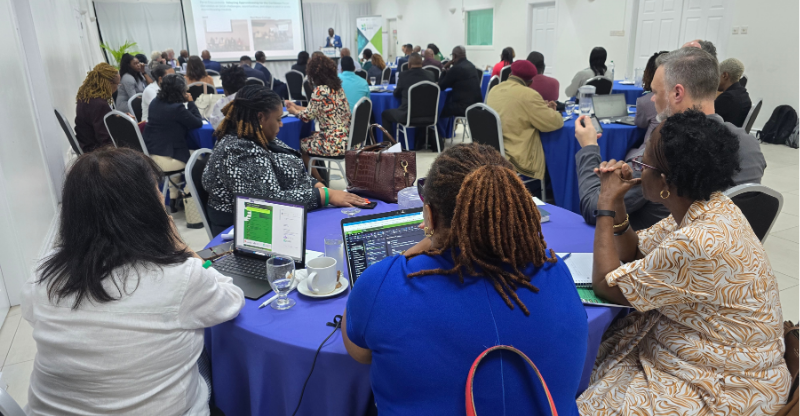
The association conducts monthly meetings, where it allows anyone to present a new product or service. “We’ve had presentations on 100% green homes, living off-grid, backup power systems, and different types of glazing applications, and even 3D printed buildings,” Sands confirms.
The cutting-edge has been very well received by BCA members, as it presents them with faster, more efficient, and cost-effective ways of building the homes that the Bahamian landscape desperately needs.
As a region prone to intense weather, these modern solutions provide a direct solution that prioritizes structural longevity and energy efficiency over short-term savings.
While these structural upgrades inevitably increase initial construction costs, they are essential for protecting communities from escalating climate risks.
In fact, embracing robust building materials and updated architectural methods, such as raising foundations in low-lying, flood-prone areas and utilizing advanced poured concrete systems, is likely to be the more cost-effective path in the long-term.
For all Caribbean communities, proactive mitigation is undoubtedly the way forward.
Advancing the Battle for Licensing and Regulatory Advocacy
For the past decade, a top priority for the BCA has been to not only raise professionalism but also reduce risks in the construction market. And the way it did that was through the landmark legislation that it charted back in 2016, the Construction Contractors Act.
According to Sands, the act goes far in advancing how Bahamian construction is perceived both locally and internationally. It creates the framework for contractors to be recognized as licensed professionals in the space.
“We have licenses for architects, realtors, and engineers, but none for construction contractors. So, we need that final license so that the Bahamas is viewed internationally as a place to do business in the billions,” Sands explains.
The logic is very straightforward. The failure to have licensed contractors is a legal and financial risk for anyone doing business in the Bahamas.
If even the Bahamian government itself went abroad seeking international investors for its developments, the wall they’d run into would be the fact that investors would be dealing with unlicensed contractors.
In this regard, the BCA has done its part, and the legislation has been passed; however, there’s one final thing needed to cross the finish line: a regulatory board to manage the licensing of contractors.
That part lies squarely in the hands of the Bahamian government. “ The government of Parliament just needs to do its part and appoint a board so we can manage and regulate the industry for the benefit of all stakeholders,” Sands explains.
Once that is in place, Bahamian contractors can boldly claim a spot at the development table, because as of now, they often lose out to foreign, licensed developers for projects based in their own nation.

True domestic sovereignty is achieved when a nation actively cultivates, trusts, and protects its own professional talent. And a major solution to the Bahamian housing shortage lies in helping all of its contractors get recognized on a larger international scale.
Moving forward, the Bahamian Contractors Association is committed to positioning itself as a central regulatory authority that determines professional participation in major national projects.
This isn’t just about securing better investments for the Bahamas; it’s also about doing right by the skilled Bahamian contractors who have a right to be the ones building the horizons of their homeland.
AT A GLANCE
Who: Bahamian Contractors Association (BCA)
What: The premier organizing body and structural voice for the commercial, industrial, and residential construction industry in the Bahamas.
Where: Headquartered in New Providence, with strategic structural oversight extending across the entirety of the Family Islands and regional trading corridors.
Website: www.bahamiancontractors.org
DIG DIGITAL?

The post Bahamian Contractors Association (BCA) appeared first on Business View Caribbean.