Beyond the Border Case: Guyana, Venezuela and the battle for global narrative
By Ron Cheong Guyana has undergone a remarkable transformation over the last decade following the discovery of vast offshore oil reserves, emerging as the world’s fastest-growing economy. President Irfaan Ali has expressed confidence that the coming decade could prove even more extraordinary, driven by rapid advances in infrastructure, energy, technology, and national development. Yet amid […] The post Beyond the Border Case: Guyana, Venezuela and the battle for global narrative appeared first on Caribbean News Global.
 Black News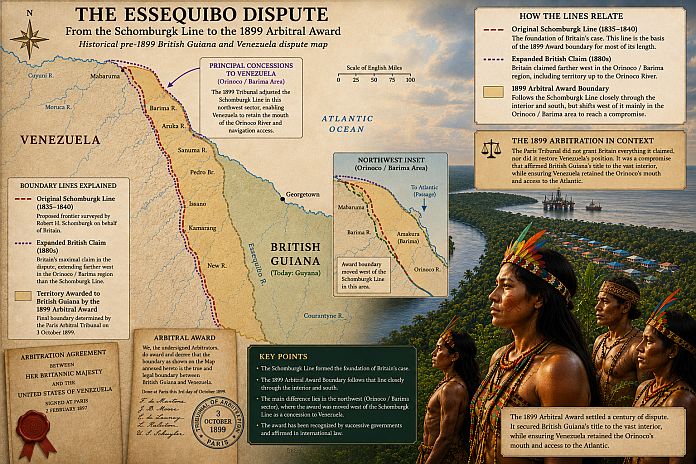
By Ron Cheong
Guyana has undergone a remarkable transformation over the last decade following the discovery of vast offshore oil reserves, emerging as the world’s fastest-growing economy. President Irfaan Ali has expressed confidence that the coming decade could prove even more extraordinary, driven by rapid advances in infrastructure, energy, technology, and national development.
Yet amid this unprecedented progress, a serious shadow remains: Venezuela continues to lay claim to nearly two-thirds of Guyana’s territory, including the resource-rich Essequibo region. Although Venezuela maintains that it does not recognize the jurisdiction of the International Court of Justice, the long-running border controversy has nevertheless finally come before the Court for adjudication.
The law, historical record, and established practice favour Guyana
Based on the evidence presented so far, it appears highly likely that Guyana will prevail in the case now before the International Court of Justice at the Peace Palace. This may not be the end, but hopefully it might at least be the beginning of the end.
The law, the historical record, and decades of established state practice all strongly favour Guyana’s position. Venezuela itself celebrated the 1899 Arbitral Award as a victory at the time, having secured control of both banks of the strategically vital Orinoco River – a settlement that remained effectively uncontested for more than 60 years.
Since then, Guyana’s engagement with Venezuela, including during the 1966 Geneva Agreement process, has consistently reflected the posture of a responsible neighbour: acknowledging Venezuela’s differing position while steadfastly maintaining its sovereignty and territorial integrity.
Venezuela’s two-pronged gambit: Invoking post-colonial injustice
Despite its claims and periodic provocations, including the recent brooch controversy, Venezuela increasingly appears to understand that its legal position before the Court is weak. As a result, Caracas seems to be pursuing a parallel strategy aimed at shaping international perceptions – not only through legal submissions before the ICJ, but also through a broader diplomatic and public-relations campaign rooted in the language of colonial injustice.
Venezuela argues that the 1899 arbitral process was tainted by manipulation and that the country, weakened and vulnerable at the time, was effectively overpowered by the then-dominant British Empire. That narrative carries emotional and political resonance, particularly across the Global South, where many nations still bear the scars of colonial exploitation and unequal power relations.
Moreover, Venezuela’s diplomatic and public relations offensive appears to be entering a more aggressive – yet far more polished and strategically disciplined phase. Ironically, the removal of Nicolas Maduro, whose administration was widely associated with international isolation, confrontation, and criticism, may have created an opening for a recalibrated Venezuelan leadership to refine its messaging and international posture. The tone is now more measured and sophisticated, crafted to appeal to global audiences and diplomatic institutions, but the substance remains every bit as strident, uncompromising, and expansionist in advancing Venezuela’s longstanding claims over Guyana’s Essequibo region.
On Saturday, Venezuela’s acting President made a dramatic televised announcement declaring that she was travelling to The Hague to personally represent Venezuela in the case before the International Court of Justice, asserting that it was her duty to defend what she described as Venezuela’s “inalienable rights.” The highly choreographed declaration underscored Caracas’ increasingly assertive diplomatic campaign – one designed not only to challenge Guyana’s position legally and politically, but also to project confidence, legitimacy, and resolve on the international stage.
Guyana’s options are therefore either to actively, though discreetly, counter this international public-relations offensive or to allow the eventual ICJ ruling to speak for itself.
Building a Global South narrative of its own
Guyana would likely be better served by not allowing Venezuela to monopolise anti-colonial language. Guyana itself is a post-colonial state: a small developing country of fewer than one million people and approximately 83,000 square miles, facing sustained pressure from a neighbour of roughly 28.6 million people and more than 384,000 square miles in size.
This reality significantly undermines Venezuela’s attempt to invalidate the 1899 Award based on power imbalance. If historical asymmetry alone were grounds to reopen settled borders, countless international frontiers across the developing world could become vulnerable to revisionist claims.
Guyana’s diplomatic messaging should therefore emphasise a central principle: post-colonial justice cannot mean overturning settled international borders whenever historical grievances are invoked.
At the same time, Guyana would benefit from quietly deepening relations not only with Caribbean states – where it remains a leading voice for regional unity, but also with members of the African Union, ASEAN states, and moderate Latin American governments. The broader framing should be clear: this is not “Britain versus Venezuela”; it is about the protection of small-state sovereignty, international stability, and the sanctity of international law.
Guyana’s posture: Dignified and committed to international law
If the ICJ rules decisively in Guyana’s favour, as many observers expect, Venezuela’s political establishment, regardless of ideology, may still find it domestically difficult to abandon the claim immediately.
For that reason, Guyana’s post-ruling messaging should avoid framing the outcome as a humiliating defeat for Venezuela. A measured and statesmanlike approach would lower the political cost for Venezuelan leaders to gradually moderate their position over time. By contrast, triumphalist rhetoric could unintentionally harden Venezuelan nationalism for generations.
Any future provocations should continue to be addressed through the ICJ, the United Nations, CARICOM, the Commonwealth of Nations, the Organization of American States, and established diplomatic channels.
Guyana must continue to position itself, as it largely has throughout the dispute, as calm, lawful, restrained, and principled – thereby retaining the moral and diplomatic high ground as a defender of the rules-based international order while Venezuela risks being viewed as revisionist.
Going forward: Reinforced sovereignty and greater diplomatic influence
Guyana could ultimately emerge from this dispute with internationally reinforced sovereignty, enhanced investor confidence, stronger diplomatic stature, greater regional influence, and recognition as a mature defender of international law.
A successful outcome before the ICJ would also significantly stabilise the environment for offshore energy development and long-term economic planning. In doing so, Guyana could become a modern example of how small states can successfully defend their sovereignty not through force, but through law, diplomacy, and international legitimacy.
The post Beyond the Border Case: Guyana, Venezuela and the battle for global narrative appeared first on Caribbean News Global.