From California to Georgia: Everything You Need To Know About Tuesday’s Primaries
In gubernatorial races, the primary elections have yielded mixed results for President Donald Trump-endorsed candidates.
 Black News
On Tuesday, Alabama, California, the District of Columbia, Georgia, and Oklahoma all held primary elections to determine the candidates who will run for Congress or a governor’s seat this Fall. Here’s everything you need to know.
The primaries have shown that President Donald Trump still holds a grip on the Republican Party, though the tightness of that grip is increasingly debatable. AP reports that Georgia Lt. Gov. Burt Jones lost his runoff election against Rick Jackson to become the Republican nominee for Georgia governor. Jackson will go on to face former Atlanta Mayor Keisha Lance Bottoms in the governor’s race this fall.
What makes Jackson unique is that he’s a billionaire and sunk $100 of his own money into his campaign, drastically outspending Jones by $70 million. This is the second time during the primaries that a Trump-endorsed candidate lost in a governor’s race, as U.S. Rep. Randy Feenstra lost to Zach Lahn in Iowa’s governor’s primary.
While former Oklahoma state Sen. Mike Mazzei didn’t lose his race to become the Republican nominee for Oklahoma governor, he was essentially dead even with State Attorney General Gentner Drummond, resulting in a runoff.
It wasn’t all bad news for Trump-endorsed candidates on Tuesday. U.S. Rep. Barry Moore, a three-term congressman, secured the Republican nomination to take over the Alabama Senate seat being vacated by Sen. Tommy Tuberville. The Washington Post reports that Trump also endorsed Rep. Mike Collins (R-Ga.), who secured the Republican nomination to challenge incumbent Democratic Sen. Jon Ossoff this November.
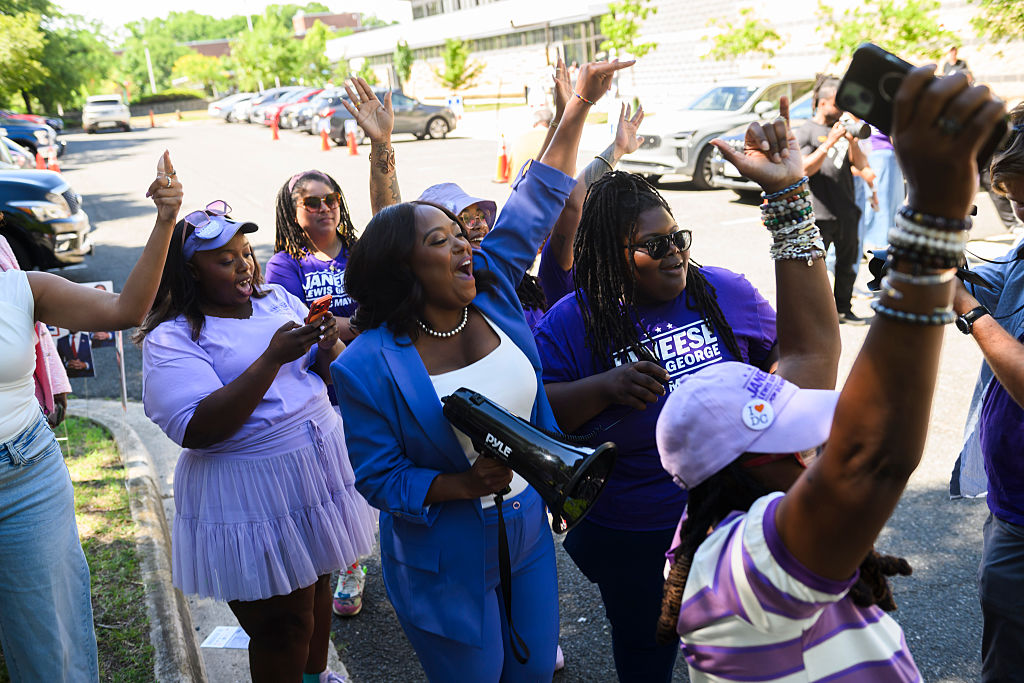
Washington, D.C., held its mayoral primary on Tuesday using a new, ranked-choice system. Janeese Lewis George, a self-described democratic socialist, is currently the front-runner in the mayoral race. Trump has cast a large shadow over the race, as many D.C. residents feel current Mayor Muriel Bowser hasn’t done enough to push back against the president. Lewis George has campaigned on protecting “Home Rule” with “leaders that stand up and fight back, not shrink in the face of injustice.”
Lewis George has already been the subject of Trump’s ire, with the president saying his administration “won’t put up with it” if she’s elected mayor and threatening to take control of the city. Lewis George called Trump’s threat “an attack on democracy itself.”
While on 63% of the votes have been counted as of this writing, The New York Times currently shows Lewis George leading the race with 52% of the vote. Should Lewis George maintain that lead, she will secure the nomination and will face no serious competition come November in the heavily Democratic district. Should her lead fall below 50%, that’s when D.C.’s new ranked choice system will come into play and determine who goes into a runoff.
Lastly, a special primary election was held in California to decide who will carry out the rest of former Rep. Eric Swalwell’s (D-Calif.) term. Swalwell exited the California governor’s race and resigned from Congress in April after a former staffer accused him of sexual assault. Democratic state Sen. Aisha Wahab secured her nomination for the Aug. 18 special election, with Melissa Hernandez currently favored to secure the second nomination. Wahab, a progressive, and Hernandez, a moderate Democrat, have already both secured nominations for the general election this November and will likely face each other twice this Fall.
SEE ALSO:
From California To Iowa, Here’s What Happened In Tuesday’s Primaries
What’s At Stake In The North Carolina Primary