Gov’t distributes ‘certified seeds’ to farmers worth D241M
The distribution, carried out in partnership with development agencies and agricultural projects, is more than just a handover of inputs; it is a statement of intent. By providing high‑quality, rigorously tested seeds free of charge, the government is equipping farmers with the tools they need to boost yields, expand hectarage, and strengthen rural livelihoods. Officials emphasise that the programme covers all seven agricultural regions, reaching more than 1,500 communities nationwide, and targets staple crops such as rice, maize, groundnut, findi, and cowpea. Speaking at the distribution ceremony held at the National Seeds Secretariat in Abuko, Demba Sabally, the Minister of Agriculture, underscored the significance of the event, stating: “The overall objective is to extend reach, avoid duplication, support complementarity and synergy, and ultimately increase yields and hectares under production.” Minister Sabally added that the total hectarage is estimated at 20,082 hectares, covering all seven agricultural regions, including the urban region, with approximately 1,500 communities expected to benefit nationwide. He explained: “Rice accounts for 66% of the overall budget, amounting to 159 million dalasis and covering 11,280 hectares. This reflects the government’s commitment to achieving self-sufficiency in rice by 2030. Maize accounts for 23%, with 7,592 hectares. This is highly relevant to nutrition security, particularly for our rural population, but it is also a critical ingredient for the livestock sector.” Groundnut, he continued, represents 6%, covering 800 hectares, while the remainder of the investment is directed towards findi and cowpea. Mamour Alieu Jagne, Project Coordinator for CCPCU, urged project coordinators to avoid duplication among the various initiatives by clearly mapping out their respective geographical areas of intervention. He further explained: “What we are trying to do in terms of complementarity is to present the entire package to our farmers wherever possible. This means not just providing seeds, but also ensuring that two projects can work together — for example, one supplying seeds while the other provides ploughing services, among others.” Jagne added that efforts are also being made to harmonise input application rates, relying on guidance from the National Agricultural Research Institution. “They provide us with the recommended seed application rates for the various commodities, including fertilisers, herbicides, and other inputs,” he noted. Lamin Drammeh, speaking on behalf of the WFP, highlighted the significance of providing high‑quality seeds to farmers. He noted that the timely delivery of seeds reflects the commitment of both the government and development partners to strengthening agricultural production, thereby improving food security and enhancing rural livelihoods. Morro Manga, Director of the National Seeds Secretariat, explained that the seeds are of exceptionally high quality, having undergone rigorous seed quality control assessment procedures. He highlighted that seeds are among the most critical inputs in agriculture, as they directly enhance crop production and ensure better yields. “The Government of The Gambia has placed high priority on the provision of quality seeds with the aim of improving production. We are confident that the inputs provided will be properly utilised for their intended purposes,” he assured. Papia Badjie, the Regional Director for Urban WCR, underscored the significance of the event, describing the seeds as highly yielding and certified. She stressed that such support, particularly for farmers, is vital in the drive towards achieving the country’s food self-sufficiency. “The government is doing everything possible to ensure that farmers’ challenges are addressed. Providing quality seeds to farmers is key to overcoming those challenges,” she emphasised. Lamin Jarju, speaking on behalf of the beneficiary farmers, thanked the government for its continued support to farmers across the country. He stressed that the timely provision of certified seeds would go a long way towards increasing production and productivity, thereby ensuring a successful farming season.
 Black News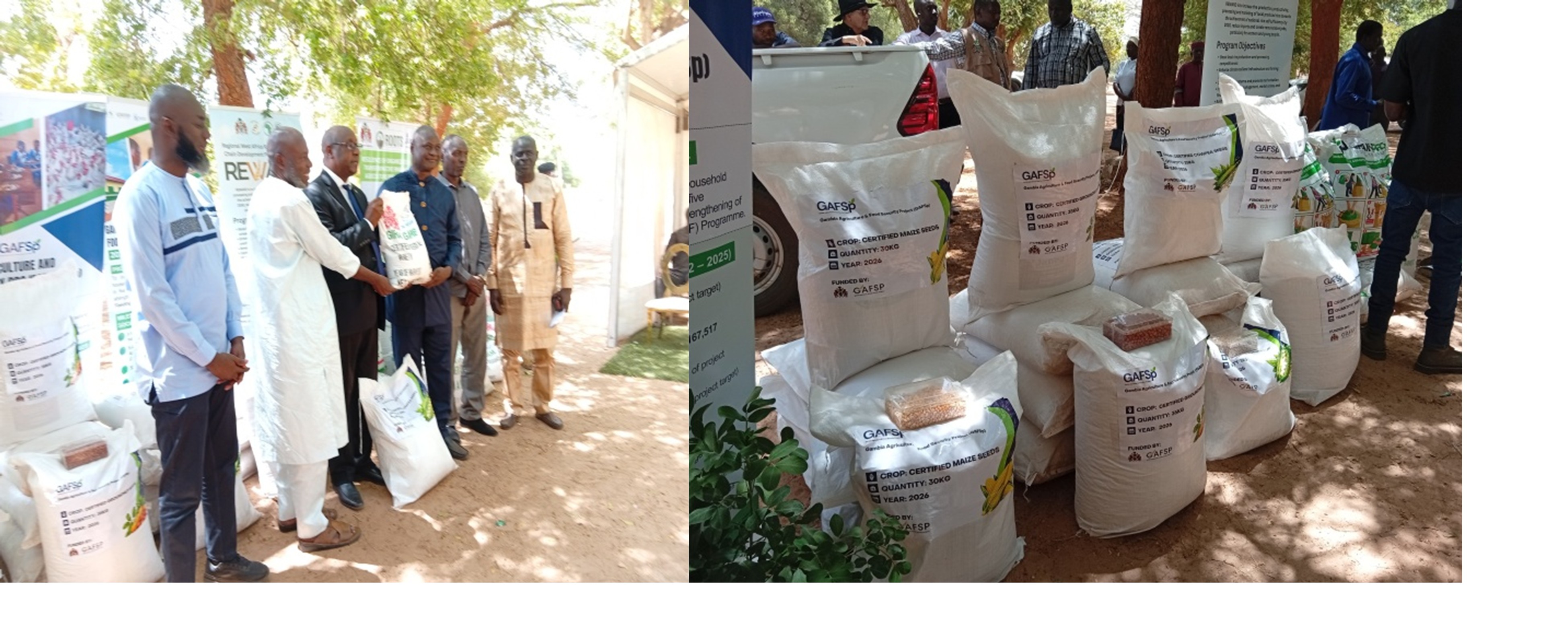
The distribution, carried out in partnership with development agencies and agricultural projects, is more than just a handover of inputs; it is a statement of intent. By providing high‑quality, rigorously tested seeds free of charge, the government is equipping farmers with the tools they need to boost yields, expand hectarage, and strengthen rural livelihoods.
Officials emphasise that the programme covers all seven agricultural regions, reaching more than 1,500 communities nationwide, and targets staple crops such as rice, maize, groundnut, findi, and cowpea.
Speaking at the distribution ceremony held at the National Seeds Secretariat in Abuko, Demba Sabally, the Minister of Agriculture, underscored the significance of the event, stating: “The overall objective is to extend reach, avoid duplication, support complementarity and synergy, and ultimately increase yields and hectares under production.”
Minister Sabally added that the total hectarage is estimated at 20,082 hectares, covering all seven agricultural regions, including the urban region, with approximately 1,500 communities expected to benefit nationwide.
He explained: “Rice accounts for 66% of the overall budget, amounting to 159 million dalasis and covering 11,280 hectares. This reflects the government’s commitment to achieving self-sufficiency in rice by 2030. Maize accounts for 23%, with 7,592 hectares. This is highly relevant to nutrition security, particularly for our rural population, but it is also a critical ingredient for the livestock sector.”
Groundnut, he continued, represents 6%, covering 800 hectares, while the remainder of the investment is directed towards findi and cowpea.
Mamour Alieu Jagne, Project Coordinator for CCPCU, urged project coordinators to avoid duplication among the various initiatives by clearly mapping out their respective geographical areas of intervention.
He further explained: “What we are trying to do in terms of complementarity is to present the entire package to our farmers wherever possible. This means not just providing seeds, but also ensuring that two projects can work together — for example, one supplying seeds while the other provides ploughing services, among others.”
Jagne added that efforts are also being made to harmonise input application rates, relying on guidance from the National Agricultural Research Institution. “They provide us with the recommended seed application rates for the various commodities, including fertilisers, herbicides, and other inputs,” he noted.
Lamin Drammeh, speaking on behalf of the WFP, highlighted the significance of providing high‑quality seeds to farmers. He noted that the timely delivery of seeds reflects the commitment of both the government and development partners to strengthening agricultural production, thereby improving food security and enhancing rural livelihoods.
Morro Manga, Director of the National Seeds Secretariat, explained that the seeds are of exceptionally high quality, having undergone rigorous seed quality control assessment procedures. He highlighted that seeds are among the most critical inputs in agriculture, as they directly enhance crop production and ensure better yields.
“The Government of The Gambia has placed high priority on the provision of quality seeds with the aim of improving production. We are confident that the inputs provided will be properly utilised for their intended purposes,” he assured.
Papia Badjie, the Regional Director for Urban WCR, underscored the significance of the event, describing the seeds as highly yielding and certified. She stressed that such support, particularly for farmers, is vital in the drive towards achieving the country’s food self-sufficiency.
“The government is doing everything possible to ensure that farmers’ challenges are addressed. Providing quality seeds to farmers is key to overcoming those challenges,” she emphasised.
Lamin Jarju, speaking on behalf of the beneficiary farmers, thanked the government for its continued support to farmers across the country. He stressed that the timely provision of certified seeds would go a long way towards increasing production and productivity, thereby ensuring a successful farming season.