MPs question govt over spending Shs 122bn to collect Shs 129bn from Entebbe Expressway
Parliament has tasked the government to justify spending Shs 122 billion to collect Shs 129 billion in toll revenue from the Kampala-Entebbe expressway, raising concerns over whether the country’s first tolled highway is delivering value for money. The physical infrastructure committee on Thursday questioned the financial viability of the expressway after uncovering discrepancies in toll […] The post MPs question govt over spending Shs 122bn to collect Shs 129bn from Entebbe Expressway appeared first on The Observer Media Ltd.
 Black News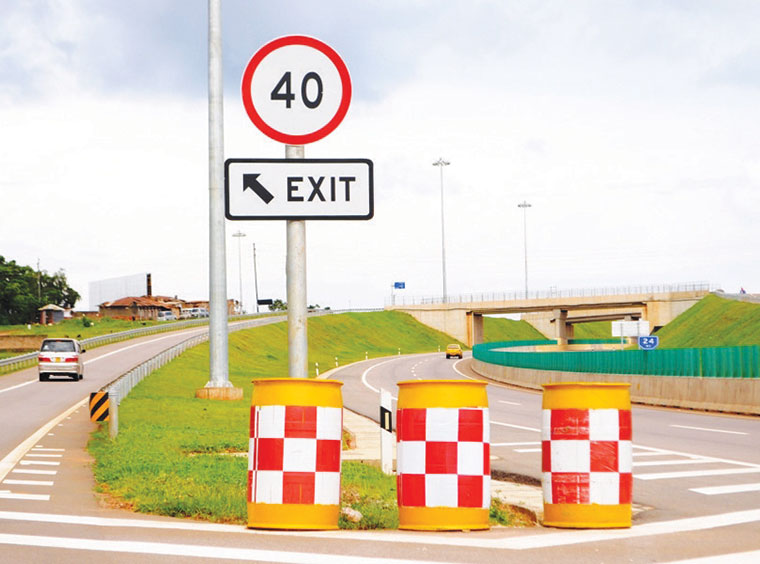

Parliament has tasked the government to justify spending Shs 122 billion to collect Shs 129 billion in toll revenue from the Kampala-Entebbe expressway, raising concerns over whether the country’s first tolled highway is delivering value for money.
The physical infrastructure committee on Thursday questioned the financial viability of the expressway after uncovering discrepancies in toll collections, missing vehicle records and concerns about the operation and maintenance contract.
The committee met officials from the ministry of Works and Transport, former toll operator EGIS and the current operator Pinnaco while examining the Auditor General’s report on the management of the expressway.
Constructed using a $350 million loan, the Kampala-Entebbe expressway was initially managed by the Uganda National Roads Authority (Unra). Following the rationalisation of government agencies, responsibility for the road was transferred to the ministry of Works and Transport.
During the meeting, lawmakers questioned why the government had spent Shs 122 billion to collect only Shs 129 billion in toll revenue, calling for a detailed explanation of the cost-effectiveness of the tolling system.
Internal audit reports presented to the committee revealed significant discrepancies in vehicle records. According to the reports, 586 vehicles were unaccounted for in November 2024, resulting in an estimated revenue shortfall of Shs 407 million.
In December 2025, another 2,860 vehicles were not captured by the tolling system, while more than 7,000 vehicles went unrecorded in May 2026, leading to estimated revenue losses exceeding Shs 1 billion.
The committee directed the ministry to explain the missing vehicle records and account for the apparent loss of public revenue. Lawmakers also scrutinised the procurement and engagement of companies contracted to operate and maintain the expressway, seeking clarification on their selection, contractual obligations and overall performance.
Defending the performance-based maintenance contract, ministry of Works engineer Isaac Menya told MPs that contractor payments are tied to compliance with Key Performance Indicators (KPIs).
He explained that deductions are imposed whenever inspections identify non-functional street lighting, damaged guardrails, poor road cleanliness, defective road signs or failure to operationalise the overload control system.
Menya added that Shs 55 million has consistently been deducted from contractor payments because the overload control system has never become fully operational.
The committee also questioned why Shs 1.6 billion allocated for the installation of weigh-in-motion bridges remains unspent. Ministry engineers said the funds were never utilised because suitable flat sections near the toll plazas could not be identified for installing the equipment.
They said the money has since been rolled into the next contract to facilitate the installation of weigh-in-motion bridges on the Northern Bypass and the activation of fixed weighbridges at the toll stations.
However, committee members argued that overload control is critical to protecting the structural integrity of the expressway and questioned why that component had been deferred while other elements of the project, including the tolling infrastructure and street lighting, had been completed.
Committee chairperson Mwine Mpaka directed the ministry to submit a detailed breakdown of all items under the original design and construction contract, saying several inconsistencies had emerged during the inquiry.
He also said the committee would summon the companies involved to explain issues highlighted in the Auditor General’s report. Lawmakers further scrutinised exemptions granted to certain categories of vehicles from paying toll fees.
Officials told the committee that the Roads Act empowers the minister of Works and Transport to exempt vehicles undertaking official government functions upon request from the relevant ministries.
However, MPs questioned whether all exemptions were supported by the statutory instruments required under the law and demanded copies of the approvals.
Ajuri County MP Fred Jalameso also raised concerns about the operation of the Automated Payment Collection Unit (APCU), an account established to temporarily receive electronic toll payments before remitting them to the Consolidated Fund.
Jalameso sought an explanation after the Auditor General reported withdrawals from the account despite officials maintaining that it was intended solely as a transit account for electronic payments.
The committee also examined Shs 200 million spent on capacity building under the expressway contract. Bunyole West MP James Waluswaka questioned the value of the expenditure, noting that despite the training, the ministry continues to rely on external contractors to manage the tolling system.
Officials explained that 12 officers from the Ministry of Works and Transport and the National Information Technology Authority-Uganda (NITA-U) underwent training at the Indian Academy of Highway Engineers in New Delhi in March 2025.
The programme covered toll road operations and maintenance, structuring operation and maintenance contracts, tolling systems, project development and supervision, as well as India’s institutional framework for toll road management.
Officials further said that although the training itself was financed under a Shs 200 million provisional sum managed by EGIS, the ministry separately met the participants’ airfares and subsistence allowances.
The committee also learnt that Ivan Katamba, who served as general manager of EGIS Uganda during implementation of the contract, is now the general manager of Pinnaco, the company currently managing the expressway.
MPs questioned the distinction between the two companies and whether the intended transfer of knowledge had been achieved. Legislators also asked why ministry officials were trained in India rather than France, where EGIS is headquartered.
The ministry responded that India was selected because its toll road operating environment more closely resembles Uganda’s and offers practical experience relevant to developing toll road systems.
The committee directed the ministry to submit a comprehensive report detailing the beneficiaries of the training, the expenditure incurred, the training modules undertaken and how the knowledge acquired has been applied in managing the Kampala-Entebbe expressway.
The post MPs question govt over spending Shs 122bn to collect Shs 129bn from Entebbe Expressway appeared first on The Observer Media Ltd.