Parasocial Ball: The Price Of Proximity In The WNBA
The WNBA’s growth has been powered by connections between players and fans. Now players and fans are negotiating where familiarity ends, and intrusiveness begins.
 Black News
Back when I was a kid, I was a huge Lakers fan. It was the first sports team I was obsessed with. I’d watch every game and consume every interview about them.
I took a special interest in Magic Johnson. I emulated his moves when I played basketball. I had a secret dream of meeting him one day. I watched so many of his games, and I knew so much about his back story, it felt like we’d have so much to talk about. I felt like I already knew him.
One afternoon, my mother and I were on a freeway in LA when I spotted a convertible with the top down. The driver looked too short to be Magic, but I recognized the shape of his head from having watched so many Lakers’ games. I begged my mom to speed up and pull alongside him. Sure enough, it was Magic. She honked, and he turned his head. We locked eyes, and he waved. His signature grin had my pre-teen self believing for a split second that he was as excited to see me as I was to see him. The warm rush of being seen by my basketball hero made my year. That I felt entitled to catch his attention off the basketball court and get any acknowledgment back was, by definition, me engaging in parasocial activities.
That exchange happened in the 1980s, decades before social media would give us even more direct access to celebrities and sports figures like Magic Johnson.
The WNBA, which is in the middle of the fastest growth stretch in its history, is in the business of connecting its players with their fans. The league and its teams spend millions of dollars in marketing every year to create content and all-access coverage that gives fans unprecedented access to players.
This access has created a parasocial dynamic. Sociologists Donald Horton and Richard Wohl coined the term parasocial in 1956 to describe the one-sided relationship an audience forms with a celebrity or public figure, marked by intense investment in and fascination with every part of that person’s life.
We’ve seen this pop up more and more among WNBA fans as they react to the personal lives and on-court performances of their favorite players.
For players, this investment has become a double-edged sword. Players have traditionally welcomed support when it shows up as positive feedback. They resent it when the same fans express their dislikes about them and weigh in on their personal lives, even when players have voluntarily revealed those parts of themselves publicly.
Last fall, when WNBA players DiJonai Carrington and NaLyssa Smith, who had been openly together as a couple, broke up, fans who had spent years rooting for their union turned the breakup into a spectacle, circulating rumors about what might have led to their split.
When Minnesota Lynx guard Courtney Williams toasted Carrington’s new single status during a StudBudz live, declaring Carrington was “ready for the field,” some fans attacked Williams for airing out Carrington’s personal business. Williams later went on live to defend herself, saying she was simply showing up for Carrington as a friend in a way that anyone supporting a friend going through a breakup might do.
The Angel Reese and Caitlin Clark rivalry was born on the court but blossomed in the online comments section, with each player’s fanbase policing the other in ways that belie their proximity to either.
For the bulk of the WNBA’s 30-year history, the stardom and salaries that NBA players generated were never on offer. With both pay and visibility low, women wanted to play in the WNBA not for fame or money but for the chance to play the game at its highest level, and did so in practical anonymity.
Now WNBA players are adjusting to the increased visibility that comes with a larger fan base. For the veterans who have spent most of their careers in the league in virtual obscurity, this has been an even bigger adjustment. LA Sparks guard Kelsey Plum recently called out fans staking out the team hotel for autographs. She signed the autographs but told them it was weird.
Fans camping outside hotels for a glimpse of a star might always be a little weird, but it is a trend that has been around for longer than the WNBA has existed. In 2002, superstar Michael Jackson held his infant son over a Berlin hotel balcony for his ocean of fans gathered below to see. Madonna, in her 1991 documentary Truth or Dare, could be seen opening the window of her hotel and waving down at her legions of fans who had been chanting her name in hopes they’d get a glimpse of the pop star. With the fans’ chants audible from back inside, Madonna mused introspectively, “Even when I feel like sh*t, they still love me.”
In Hollywood, many people become celebrities because they want to feel the level of adoration Madonna enjoyed in that moment. The seasoned ones understand that the attention, and even the rumors, come with the territory. It is an industry where thick skin is required, and being known translates into higher paychecks and longer careers. It is an uncomfortable but understood and expected trade-off.
In the WNBA, business and marketing have fostered a close bond between fans and their favorite players. Today, each team has a content shop, with staffers whose job it is to capture the players in moments that extend far beyond the box score. The tunnel walks, the locker-room celebrations, and random q&a’s are all produced, edited, and pushed out to fans who increasingly expect this access.
Increasingly, sports reporters spend time before and after games asking players about their personal lives, knowing that fans are eager for this content. WNBA players use their social media accounts to offer additional insight into their personal lives.
When the coverage turns critical or the comment section turns hostile, players have reached for the word “parasocial” themselves, pulling a term from sociology journals to name a boundary being crossed. They are right to. The trouble is mostly structural: a league cannot sell closeness as its growth product and then ask the audience to keep a respectful distance, because distance is precisely what the product was designed to eliminate.
Brand deals and the possibility of them loom large for the league, teams, and players. In a recent Lovesac commercial, Las Vegas guard Chelsea Gray sits in her family room beneath framed movie posters, walking the audience through why the couch, with its removable covers (she and her wife are parents of a toddler), is perfect for her family’s needs. Lovesac is asking the viewer to imagine living like Chelsea Gray and to trust her recommendation the way you’d trust a friend’s. Ads like this bridge the gap between athlete and consumer by suggesting an intimacy that the consumer feels but the player doesn’t and has never really granted in that way.
In a conversation about parasocial relationships and fandom on her podcast, Full Circle, WNBA Seattle Storm guard Lexie Brown suggests that part of what fuels parasocial relationships in the WNBA is that women players engage differently online: “Historically, we are so much more accessible and forward-facing than our male counterparts,” she said.
WNBA players like A’ja Wilson, Dearica Hamby, Natasha Cloud, and Alysha Clark regularly communicate with their fans on social media. Alysha Clark, for instance, has a running joke with her Threads followers who playfully accuse her of being a vampire. She leans into the bit, replying with denials to fans who are in on it.
Brown also believes fans need to be more responsible and think about their intentions, and asks them, “Do you really care about women’ s basketball growing? Do you really care about this player improving? Or are you trying to be mean-spirited?” She urges fans to think about the responses they might receive when they do go after a player, “When you’re putting something out publicly, you’re opening up something for criticism, and you’re opening it up for dialogue, whether you intended it to be that or not.”
Dallas Wings’ players Paige Bueckers and Azzi Fudd have been working through this ongoing tension and dialogue. Bueckers hard-launched the romantic relationship between her and Fudd in an interview during the 2025 All-Star weekend. Fans of the duo took that revelation and ran with it. Bueckers and Fudd then pulled back on sharing more online, fueling speculation that the pair might have broken up.
Later, in an interview with former WNBA star Sue Bird on Fudd’s podcast, Bird shared veteran guidance on navigating disclosures about one’s private life. “You want to be yourself, but always with the understanding that once it’s out there, you can’t take it back. That’s the juggle,” she warned.
Bueckers seems to have absorbed the lesson. When she and Fudd were reunited as teammates with the Wings, speculation about their relationship status surged online again. During Wings media day, Bueckers drew the line, telling reporters that her and Azzi’s personal relationship was “nobody’s business but our own,” and that what they chose to share with the public was their decision to make.
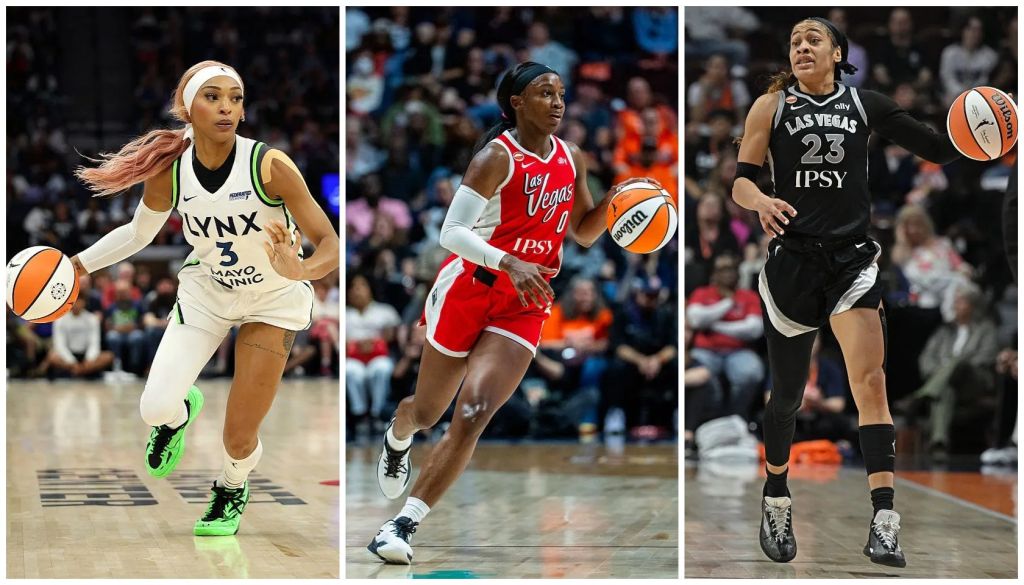
It’s a useful reminder that the loudest corners of the online world rarely see the rest of the players’ lives. Las Vegas Aces’ players Jackie Young and Chennedy Carter were each picked apart for their performance during games recently. Both went to social media to tell their followers what the criticism had missed: that each had been navigating something heavy in their personal lives.
Washington Mystics’ rookie, Lauren Betts, wrote a Player’s Tribune essay during her UCLA years about her struggles with anxiety, depression, and thoughts of suicide. The essay required a great deal of vulnerability and offered a lens into the hardships she was experiencing personally, even as demands that she perform well on the court continued to mount.
The bridge the WNBA has built between players and fans has produced careers, money, and visibility that none of these players expected.
For those eager to be a part of online conversations about the league and its players, it’s important to remember, that the player on the other side of the screen is a working person in a high pressure job that is physically demanding and emotionally taxing, with feelings that get hurt, a family that might read what you wrote, and a mental health state that does not always match what the highlight reels convey.
Being a fan used to mean something closer to what I felt when Magic waved back at me from the next lane on that Southern California freeway. Recognition, admiration, the warm thrill of being seen for a second by someone you’d watch play your favorite sport for years. The tradeoffs and access were smaller then, and it asked less of all sides.
What these players deserve from us, if we are to call ourselves fans, is grace and care. Before you hit send, the question to keep front and center is whether you would say those words to that player’s face, in front of her mother. Or, just as usefully, whether you would want a stranger to say them to you in front of yours.
SEE ALSO:
WNBA: Free Raven Johnson, Or At Least Protect Her
An Open Letter To WNBA Commissioner Cathy Engelbert