Revitalizing Black Literacy in Nashville: A Community-Driven Movement
By BuyBlack.org Newsroom Robin Griffin didn't set out to become the book lady of her Nashville neighborhood. It started with her twin sons, a stack of Dolly Parton Imagination Library books, and a hashtag — #AtoZLearningClub — that she po...
 Black News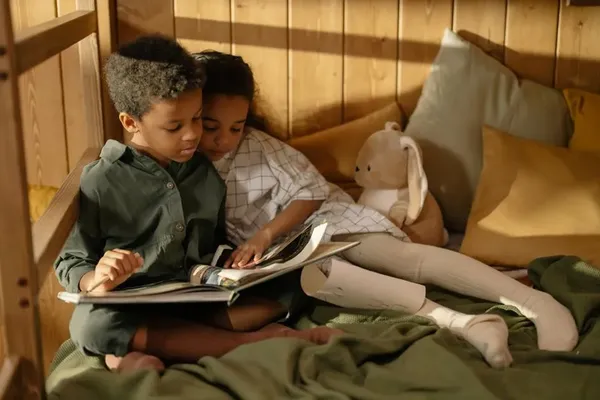
By BuyBlack.org Newsroom
Robin Griffin didn't set out to become the book lady of her Nashville neighborhood. It started with her twin sons, a stack of Dolly Parton Imagination Library books, and a hashtag — #AtoZLearningClub — that she posted to Instagram because she wanted other parents to see that their kids could love reading too. What grew out of that impulse is now a full nonprofit organization, a catalog of multilingual and multicultural titles, and a network of little free libraries going up in barber shops, beauty salons, and community centers across East and North Nashville.
Griffin's story sits at the heart of something larger happening in Nashville right now — a coordinated, community-driven push to reimagine what Black literacy looks like, who gets to define it, and how to make it accessible in the neighborhoods that have historically been left out of that conversation.
The Gap Nobody Talks About Honestly
When Tiffeni Fontno and Eno Richardson met at a Vanderbilt conference on Black education two years ago, they were both already circling the same problem from different angles. Fontno had a vision for connecting organizations working on Black literacy across the city. Richardson, an educator, had been thinking about silent reading as a social experience — a way to make books feel like community rather than homework.
Together, they built the Nashville Black Literacy Coalition (NBLC).
What they both understood — and what often gets flattened in policy conversations — is that the literacy gap in Black communities isn't about intelligence or interest. It's structural. It's historical. It's the result of systemic racism that created unequal access to trained instructors, quality materials, and the kind of early intervention that more affluent families can simply buy their way into with private tutors.
"There's a method to this," Fontno said. "It's not just handing a kid a book and [knowing] they'll be OK. Literacy is a relationship and a science."
Richardson puts it even more directly: reading "has to be intentionally and systematically taught." When that intentionality is missing early on, students develop gaps that compound over time — and without resources to close them, those gaps follow children into adulthood.
Books That Look Like You
When Griffin started doing research for A to Z Learning Club, she found that only around 10 percent of children's books at the time featured at least one Black primary character. That number stopped her cold — because it explained so much about what she was already hearing in her community.
"The first thing people say is, 'I don't like it,'" she said. "We hear that all these children don't like to read and can't get into books. It's not their fault. It's because they don't see books around them."
Representation in literature isn't a soft, feel-good add-on. It is a direct literacy intervention. When a child can locate themselves in a story — their name, their neighborhood, their family structure, their culture — they are more likely to engage, more likely to keep reading, more likely to build the habit that carries them forward. Griffin's catalog reflects that understanding. It includes books in Spanish and Vietnamese, books by Black and Brown authors, books featuring characters from every background. She also runs A to Z Family, a program that brings parents into the process and helps the whole household build literacy habits together.
Last year, Griffin received a grant from Read in Color that funded a series of little free libraries stocked with culturally affirming books — placed specifically in the kinds of community spaces where people already gather. She's already installed one at the East Nashville indoor playground Play All Day, with more planned for East and North Nashville and the McGruder Center. Each community partner she works with also receives a $225 gift card to Alkebu-Lan Images, the only Black-owned bookstore in Nashville. That detail matters — the ecosystem Griffin is building intentionally cycles dollars and attention back into Black-owned institutions.
Reading as a Social Act
One of the most quietly radical things NBLC has done is reframe reading as something you do with other people. Their silent reading parties — officially called Well Read: The Silent Reading Experience — started at All People Coffee with 30 attendees. By February of this year, 60 people showed up. Writers sit next to educators. Elders share tables with young people. Everyone picks up a book, chats with their neighbor, and leaves with the energy of having been in community.
The choice to host these events in Black-owned spaces like the Loading Dock in North Nashville is not incidental. It's a statement about where Black intellectual life belongs — not just in universities or libraries, but in the neighborhoods and businesses that have always been the cultural backbone of the community.
Mapping the Work
Data is part of the coalition's strategy too. Working with Vanderbilt University student Ryan La Barrie and the university's GIS Lab, Fontno and Richardson built an interactive map that visualizes what Black literacy looks like across Nashville — tracking literacy organizations, libraries, schools, wireless hotspots, and reading efficacy data across the city's school clusters. The map contains around 1,000 data points and took more than a month to build.
The point isn't just to display numbers. It's to connect them to real stories.
"It's one thing to have data and it's another thing to have actual stories to give context to the data that we're seeing," Fontno said.
That combination — community narrative plus geographic data — gives NBLC and its partners a tool to identify gaps, deploy resources more strategically, and make the case to funders and policymakers in language they understand without losing the human center of the work.
The Book Lady and What She Represents
Griffin describes herself as a midwife of literacy — a reference to how author Jessie Redmon Fauset served as a connector and nurturer during the Harlem Renaissance. The comparison is apt. A midwife doesn't create the life; she creates the conditions for it to arrive safely. That's exactly what Griffin is doing in her neighborhood, and what NBLC is doing citywide.
"I wanted to be able to connect families and I feel like my community sees that," Griffin said. "They see me having books and working with community partners to get access to books — not just any type of book, but also Black and Brown books for children."
The community is responding. NBLC's next convening, Ink, Imagination and Possibilities, is set for July 18 from 10 a.m. to 2 p.m. at American Baptist College. Griffin is hosting her own event, "Building Our Own Stories," on July 11 — an author read-aloud where families will learn to write and archive their own stories.
That last detail is worth sitting with. These aren't just programs about consuming literacy. They're about producing it — helping Black and Brown families in Nashville see themselves not just as readers, but as authors of their own narratives. That's the trajectory NBLC and A to Z Learning Club are pointing toward, and Nashville is watching to see how far it goes.