The Untold Story of the Battle of Adowa: How Anti-imperialism can be rebuilt from the ground up
I. Magdala The mountainside fortress is called Magdala. It is perched above the Ethiopian highlands, a stone fist raised against the sky. In its austere regality an eleven-year-old boy named Sahle Maryam witnessed the brutal birth of modern statecraft in 1855. His captor, Emperor Tewodros II, was a brilliant but volatile unifier who dreamed of forging a centralised Ethiopian state from the feudal wreckage of the Zemene Mesafint, the chaotic “Era of Princes”. Tewodros treated the boy as a son, arranged his marriage to his own daughter, and granted him an education in theology, statecraft, and the harsh arithmetic of […] The post The Untold Story of the Battle of Adowa: How Anti-imperialism can be rebuilt from the ground up appeared first on African Arguments.
 Black News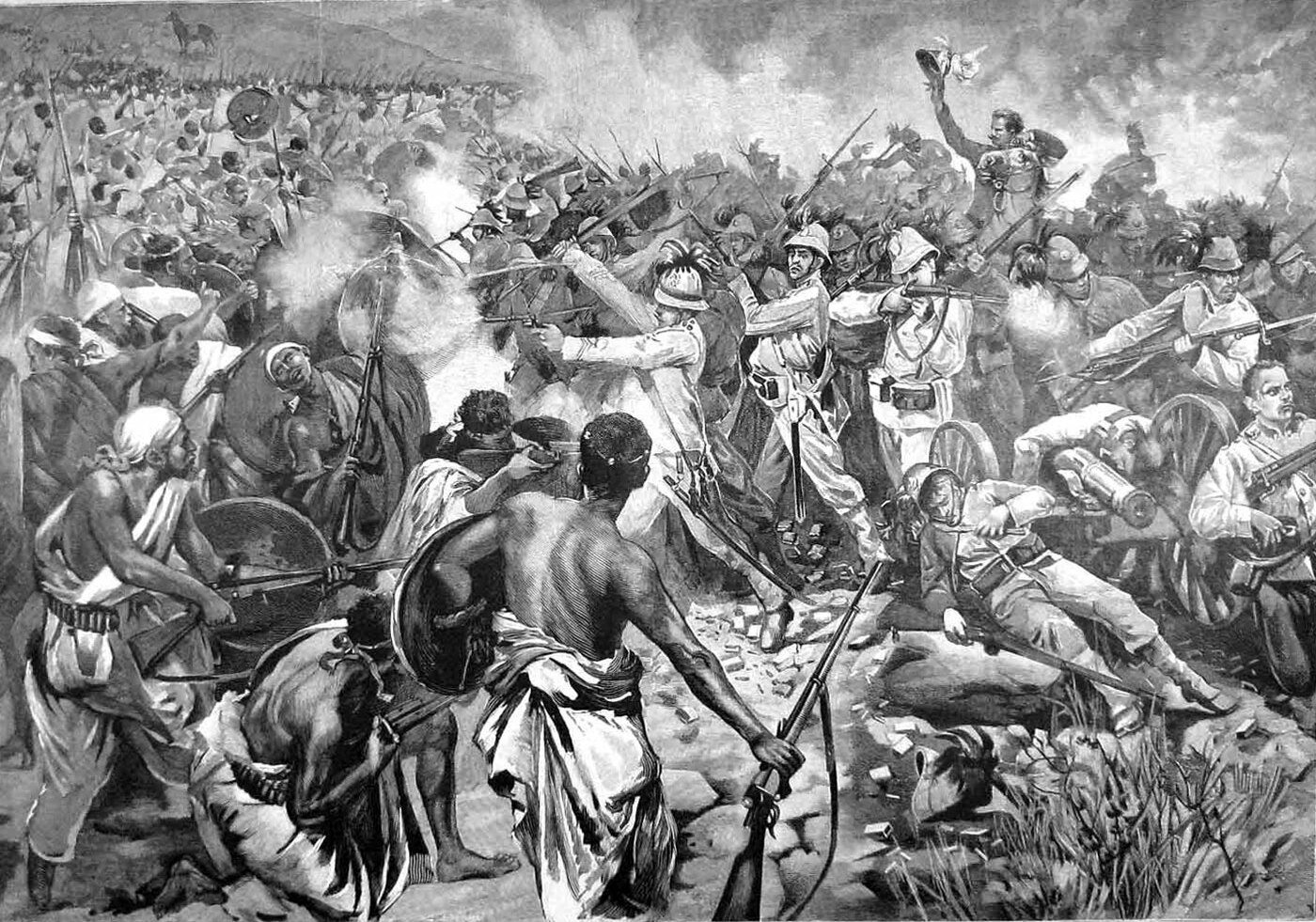
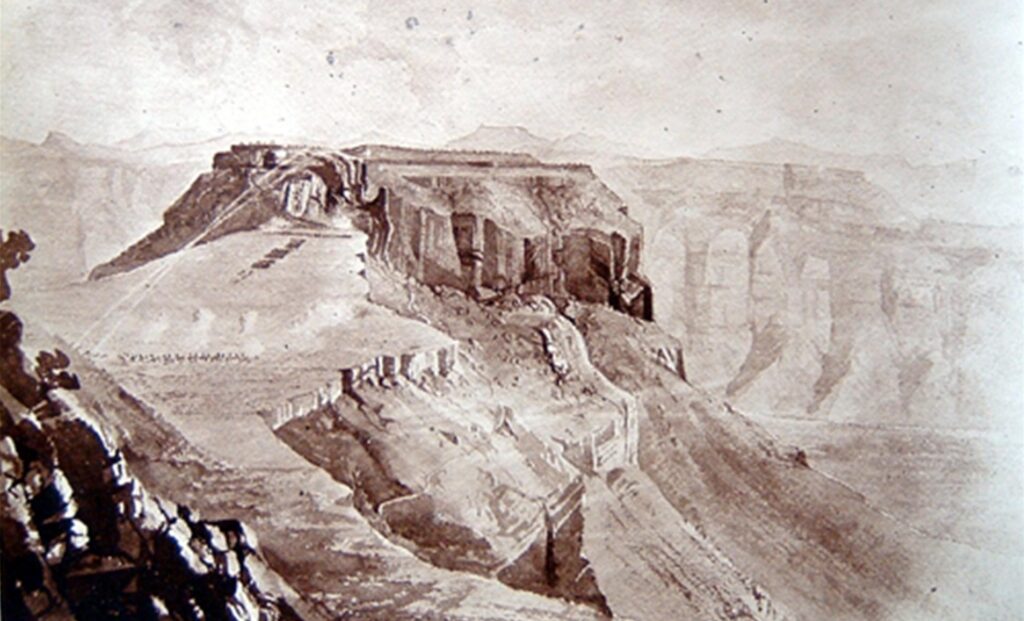
The fortress at Magdala in 1868 when the British invaded. (Photo – Unknown source, Public Domain, https://commons.wikimedia.org/w/index.php?curid=4236644)
I. Magdala
The mountainside fortress is called Magdala. It is perched above the Ethiopian highlands, a stone fist raised against the sky. In its austere regality an eleven-year-old boy named Sahle Maryam witnessed the brutal birth of modern statecraft in 1855. His captor, Emperor Tewodros II, was a brilliant but volatile unifier who dreamed of forging a centralised Ethiopian state from the feudal wreckage of the Zemene Mesafint, the chaotic “Era of Princes”. Tewodros treated the boy as a son, arranged his marriage to his own daughter, and granted him an education in theology, statecraft, and the harsh arithmetic of highland warfare. A golden cage, perhaps. But one with an extraordinary view.
What Sahle Maryam absorbed at Magdala would prove more consequential than any formal schooling. Tewodros was fascinated by European technology: he commissioned missionaries to cast cannons and build roads. Yet he lacked the temperamental discipline to manage the diplomatic and logistical systems required to sustain such ambitions.
His volcanic rages alienated the very technicians he depended on, and his indifference to diplomatic subtlety eventually provoked a British expeditionary force to march upon his mountain stronghold. In 1868, as British engineers hauled heavy artillery up impossible gradients with logistical precision that left Ethiopian observers awestruck, the young prince saw the ultimate cost of political genius unaccompanied by methodical policy. Rather than submit to capture, Tewodros placed a pistol to his temple and blew his brains onto the ramparts.
Tewodros sealed the image in the prince’s head with a lesson. Sovereignty is a hard slog.
Sahle Maryam escaped from Magdala in July 1865, aided by his mother Ejigayehu’s network of Oromo and Muslim loyalists. Arriving in his ancestral province of Shewa, he found a usurper on the throne. Thousands of Shewans rallied to the returning prince. By 1866, at twenty-one, he had proclaimed himself Negus of Shewa and adopted the name history would remember: Menelik II. European visitors consistently noted a quality that distinguished him from every other ruler they encountered on the continent: an almost preternatural, and calculating, patience.
2. Aggregation versus Disaggregation: a Katanomic Lens
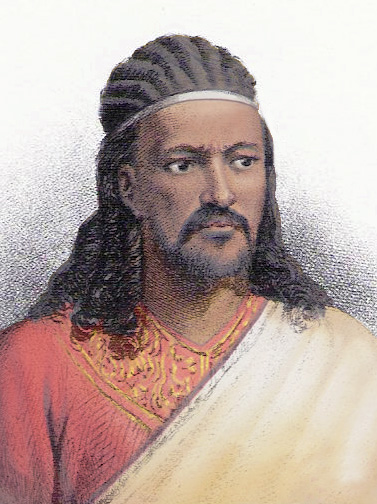
Tewodros II (reigned: 1855-1868): The first ruler after the chaotic zemene mesafint (the era of the princes), Tewodros II’s considerable gifts were undermined by his legendary temper. Resistant till the end, he shot himself rather before the British could capture him (Image: Uncredited derivative work: Vob08 (talk) – Berhanou Abebe, Histoire de l’Éthiopie d’Axoum à la Révolution, Paris, Maisonneuve & Larose, coll. « Monde africain », 1998 (ISBN 2-7068-1340-7), Public Domain, https://commons.wikimedia.org/w/index.php?curid=10234865)
To read Menelik’s achievement clearly, a specific analytical framework helps. We have given it the name, Katanomics. It describes a fault line in governance that is easily missed, yet ruinous if ignored. Katanomics distinguishes between political aggregation – the art of compressing complex problems into messages that populations can grasp, rallying coalitions under banners of “national dignity” or “independence”; and policy disaggregation, the patient, unglamorous work of breaking grand goals into concrete, technical, iterated pathways to drive implementation.
Africa’s nineteenth-century history overflows with leaders of stupendous political gifts. Shaka kaSenzangakhona remade southern African warfare through the impi system. The Asantehene built a confederacy of gold and disciplined armies. Samori Ture fought the French to exhaustion for nearly two decades. Each possessed political genius of the highest order. Each, ultimately, could not translate that genius into the institutional and technological infrastructure required to withstand industrialised European warfare over the long run and break imperialism upon contact.
Consider the Asante predicament in its final campaigns against Britain: armies frequently lacked bullets and were compelled to fire iron slugs from flintlocks against Maxim guns. Or the Kingdom of Dahomey, whose rulers purchased Krupp cannons and wielded blunderbusses without the policy infrastructure for training or deployment, resulting in rapid defeat by French Lebel rifles and the exile of King Béhanzin.
Menelik’s distinction lies squarely in his capacity to bridge two patterns. While his predecessors and peers treated sovereignty as a martial spirit or a political fact (or, even worse, a legal abstraction), he treated it as a sequence of concrete, technical problems. The capacity to summon 100,000 warriors is a hollow achievement if the state cannot ensure each warrior carries a functioning, loaded rifle, for instance.
3. Commerce as anti-imperialist resistance
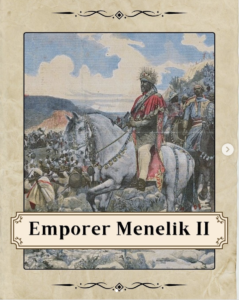
Menelik II (Ge’ez: ዳግማዊ ምኒልክ dagmawi mənilək; horse name Aba Dagnew (Amharic: አባ ዳኘው abba daññäw); 17 August 1844 – 12 December 1913), baptised as Sahle Maryam (ሣህለ ማርያም sahlä maryam), was king of Shewa from 1866 to 1889 and Emperor of Ethiopia[nb 2] from 1889 to his death in 1913. A member of the Solomonic dynasty, Menelik expanded the Ethiopian Empire to its greatest historical extent and defeated Italian colonial forces at the Battle of Adwa in 1896. He is widely regarded as the founder of the modern Ethiopian state.
Tewodros had been too impulsive to maintain the steady diplomatic relationships this demanded. Yohannes IV, though a superb general, had narrow diplomatic horizons. Menelik cultivated multiple, competing suppliers simultaneously. He played French merchants against Italian diplomats, British interests against Egyptian ambitions, and Russian Orthodox solidarity against Western colonial appetites. His confidant, Afeworq Gebre-Iyesus (branded a traitor by some), noted that the Emperor’s notorious “ponderousness” – his refusal to commit quickly – was a deliberate instrument of negotiation that kept him alive and independent while peers were signing away their lands.
By 1887, Menelik had imported approximately 25,000 modern rifles, a volume of procurement rarely recorded in sub-Saharan African annals. He used Italian arms to deter Italian ambitions and French commercial interests to counterbalance British territorial designs. This was procurement as strategic agency: diversified, relentless, and methodical. It represented a technology acquisition mindset that many modern African leaders have yet to fully grasp.
4. An Engineer from Frauenfeld: Aligning Expert Incentives
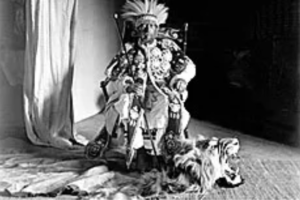
Blurry image of Menelik II in his palace. Alfred Ilg (b. 1854) arrived in Addis Ababa in 1879 and served Menelik for 27 years (Photo courtesy: Völkerkundemusuem Zürich).
A pivotal moment in Menelik’s policy maturity was the arrival in 1879 of Alfred Ilg, a twenty-five-year-old Swiss engineer who had studied at the Federal Polytechnic in Zurich – the same institution that would later produce Albert Einstein. Menelik specifically sought a technician from a neutral country, inspired by the example of Werner Munzinger in Sudan. To his mind, advisors from France, Italy, or Britain would always harbour primary loyalty to their own colonial governments. A citizen of landlocked Switzerland, with no coastline and no territorial ambitions in Africa, had incentives perfectly aligned with the Emperor’s.
Ilg learned Amharic, built bridges, and installed the first piped water supply in the imperial palace. His most consequential contribution, however, was the establishment of an ammunition factory in Addis Ababa.
Here was the ultimate act of policy disaggregation: recognising that owning rifles is worthless if the sovereign depends on foreign powers for bullets. The factory gave Menelik independence from the coastal embargoes that frequently paralysed other African militaries. Ilg would remain at Menelik’s side for over two decades, eventually serving as the country’s first foreign minister. He had earned the rank on the back of personal trust, contractual clarity, and the structural neutrality of Swiss political culture. Menelik II was a detail-oriented man.
5. A Treaty with Two Tongues
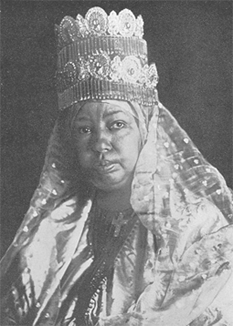
Empress Taitu Betul (1851-1918). The third wife of Menelik II, she stood side by side with her husband in the fight against imperialism. (Photo: Unknown author – Imperial Ethiopia, Public Domain, https://commons.wikimedia.org/w/index.php?curid=35063039)
The tension between Menelik’s patient policy-building and Italian colonial ambitions reached a crescendo on 2 May 1889 at Wuchale. The Treaty of Wuchale is perhaps the most infamous mistranslation in diplomatic history. Article 17 had two versions. The Amharic text, which Menelik signed, stated that Ethiopia could use Italy as an intermediary in its dealings with other European powers. The Italian text stated that Ethiopia must do so. Essentially converting an ancient empire into a protectorate with the stroke of a pen.
When the discrepancy surfaced, Empress Taitu Betul became the emotional and strategic anchor of the resistance. She confronted the Italian representative Antonelli with a directness her more cautious husband sometimes avoided, declaring that Ethiopia would never accept the status of a protectorate. Taitu recognised that Italy’s colonial appetite could ultimately be met only with resolute dignity and, if necessary, force. But her political sagacity was not enough.
The four years following the treaty’s signing were a masterclass in strategic escalation. Menelik did not immediately declare war. Instead, he used the interval to finalise arms procurement and build domestic consensus. He systematically clarified, objected to, and finally denounced the treaty in 1893. This was calculated patience. It meant a refusal to act until the policy infrastructure of ammunition factory and rifle supply lines had reached full maturity.
6. Political Aggregation at Scale
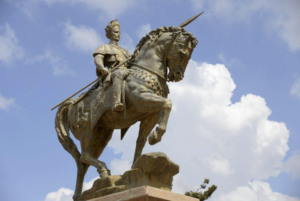
Statue of Ras Makonnen, Menelik II’s chief of staff and the father of the future Emperor, Haile Selassie. Placed in city of Harar, Ethiopia, in 1958, it was destroyed by hooligans in 2020. (Photo: Equestrian statues by Gerard Huber)
On 17 September 1895, Menelik issued a proclamation that remains one of the most remarkable acts of political aggregation in African history. He summoned every regional lord and every able-bodied warrior to march against the “moles” who were “digging into the country.” The response was unprecedented in both scale and diversity. Amhara, Oromo, Tigrean, Gurage, and Somali forces – many of whom had been rivals, and some of whom had been conquered by Menelik himself within living memory – converged on the northern front.
Empress Taitu marched with her own contingent of 5,000 infantry and 600 mounted troops. Ras Makonnen, the father of the future Haile Selassie, served as de facto chief of staff. Ras Alula, the legendary Tigrayan warrior who had defeated the Italians at Dogali in 1887, lent his tactical brilliance despite deep personal reservations about Shewan dominance. By the time these forces converged, Menelik commanded an army estimated at over 100,000 troops, the majority armed with modern rifles.
Here the distinction between political aggregation and policy disaggregation reaches its apex. The political achievement – uniting heterogeneous forces under a single command – was spectacular. But it would have been futile without prior decades of policy work: the procurement networks, the ammunition factory, the logistical planning that sustained an army of a hundred thousand in the arid terrain of northern Tigray.
7. One Day at Adowa: 1 March 1896
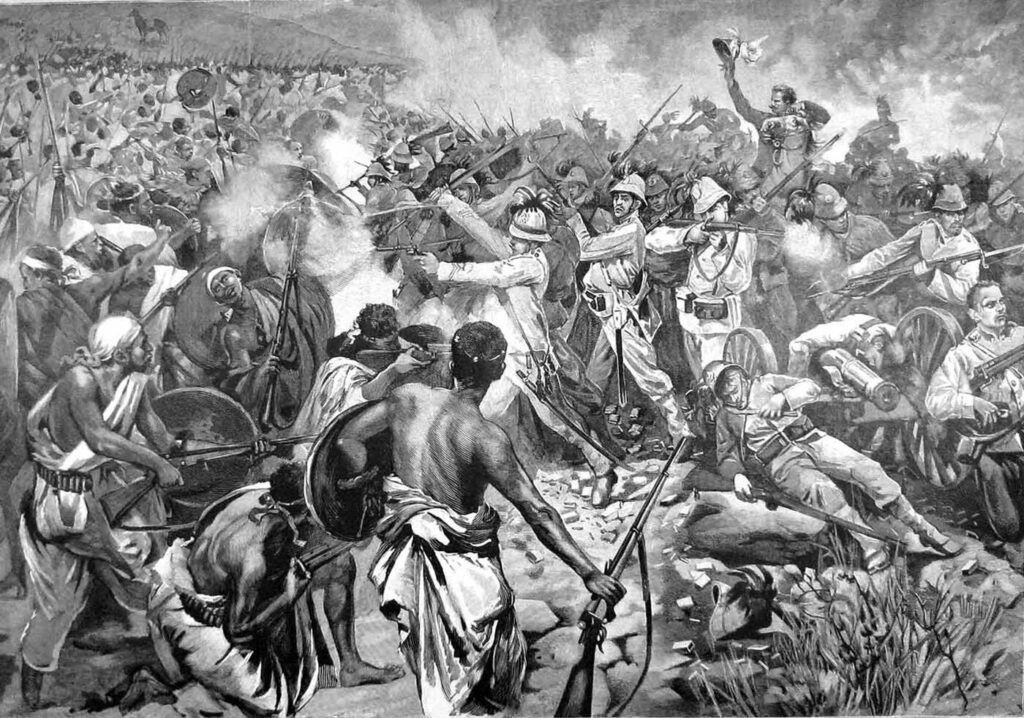
Battle of Adowa, 1 March 1896. Image by The Graphic, from details supplied by survivors – http://blog.libero.it/wrnzla/9919267.html, Public Domain, https://commons.wikimedia.org/w/index.php?curid=6791403
The Battle of Adowa was a collision between policy deftness and bureaucratic arrogance. The Italian commander, General Oreste Baratieri, was under ferocious pressure from Prime Minister Crispi in Rome to deliver a decisive victory. His supply lines were stretched thin across difficult terrain; his maps were woefully inaccurate, confusing mountain peaks and mislocating villages. On the night of 29 February, Baratieri gambled on a night march toward Ethiopian positions.
The result was a textbook case of tactical fragmentation. Three Italian columns advanced in darkness over terrain their maps described with a confidence their accuracy did not warrant. General Albertone’s brigade mistook one mountain for another and marched directly into Ethiopian positions. By dawn on 1 March, all three columns had separated from one another and from their reserves.
Menelik had risen early to pray. When Ras Alula’s scouts brought word that the Italians were advancing, the Emperor set aside his psalter and summoned his forces. Empress Taitu stood beside him. Separate armies moved forward in a coordinated assault that exploited every advantage of numbers, terrain, and local knowledge. By mid-morning, Albertone’s brigade had been overwhelmed. By noon, General Arimondi’s forces had been decimated. By early afternoon, only General Dabormeda’s brigade remained engaged. Menelik dispatched Ras Mikael’s 20,000-strong cavalry to annihilate the retreating column.
By nightfall, 6,000 Italian and Eritrean askari lay dead. Another 3,000 had been captured, including General Albertone. Ethiopian losses were grievous: approximately 4,000 killed and 8,000 wounded. When Menelik heard victory chants rising from his encampment and learned that the dead included fellow Christians, he ordered the rejoicing to cease and replaced the red royal umbrella with a black one in mourning. He was not a man to waste emotions.
8. Sovereignty Consolidated

Empress Taitu Betul in 1905: Deeply suspicious of European intentions towards Ethiopia, she was a key player in the conflict over the Treaty of Wuchale with Italy. The Empress held a hard line against the Italians, and when talks eventually broke down, and Italy invaded the Empire from its Eritrean colony, she marched north with the Emperor and the Imperial Army, commanding a force of cannoneers at the historic Battle of Adwa that resulted in a humiliating defeat for Italy in March 1896. This victory was the most significant of any African army battling European colonialism. Menelik, who often postponed unpleasant decisions by answering “Yes, tomorrow” (Ishi, nega), found it useful to have his wife in a powerful enough position to say “Absolutely not”. Image by by Georgios Prokopiou.
Menelik’s conduct after Adowa proved as instructive as the battle itself. Despite pleas from Ras Alula to pursue the retreating Italians and reclaim Eritrea, Menelik chose to halt at the Mereb River. He understood that invading Eritrea would provoke a broader European coalition and potentially exhaust his own fragile state. His goal was less about the annihilation of a European army that could easily be replaced and far more about the international recognition of Ethiopian independence.
His foresight was rewarded. By October 1896, the Treaty of Addis Ababa had abrogated the Treaty of Wuchale in its entirety and recognised Ethiopia’s full sovereignty. In the years that followed, Menelik defined Ethiopia’s borders through treaties with Britain and France, established a national bank and modern currency, introduced cabinet-style ministerial governance, and initiated the Addis Ababa-Djibouti railway. He had converted a battlefield triumph into durable institutional and infrastructural gains.
9. Shadows and Contradictions
No serious analysis of Menelik can glide past the suffering that accompanied his empire-building. His southward expansion into Oromo, Wolayta, Kaffa, and Somali territories was often brutal. Conquered peoples were subjected to the gabar system of forced labour and land dispossession, creating grievances that surfaced with devastating force in the Ethiopian Revolution of 1974 and in the ethnic federalism debates that continue to shape the country. The historian Beauregard’s accusation – that Menelik practised “wanton aggression” against prosperous agricultural peoples – contains truths that can’t be wished away.
It is a cruel irony that the same capacities that enabled resistance to European colonialism equipped Menelik to practise a variant of colonialism upon his own continent. His armies marched south with rifles purchased from the same Europeans whose designs on Ethiopia he was simultaneously resisting. For the student of policy-based sovereignty anti-imperialism, these contradictions are instructive rather than merely troubling. They reveal that a state’s “design” can serve as a shield against external powers whilst functioning as a cage for those on its periphery. Anti-imperialism is an essentialist struggle that must be waged within and without.
II. Contemporary Parallels: Katanomic Fractures Persist
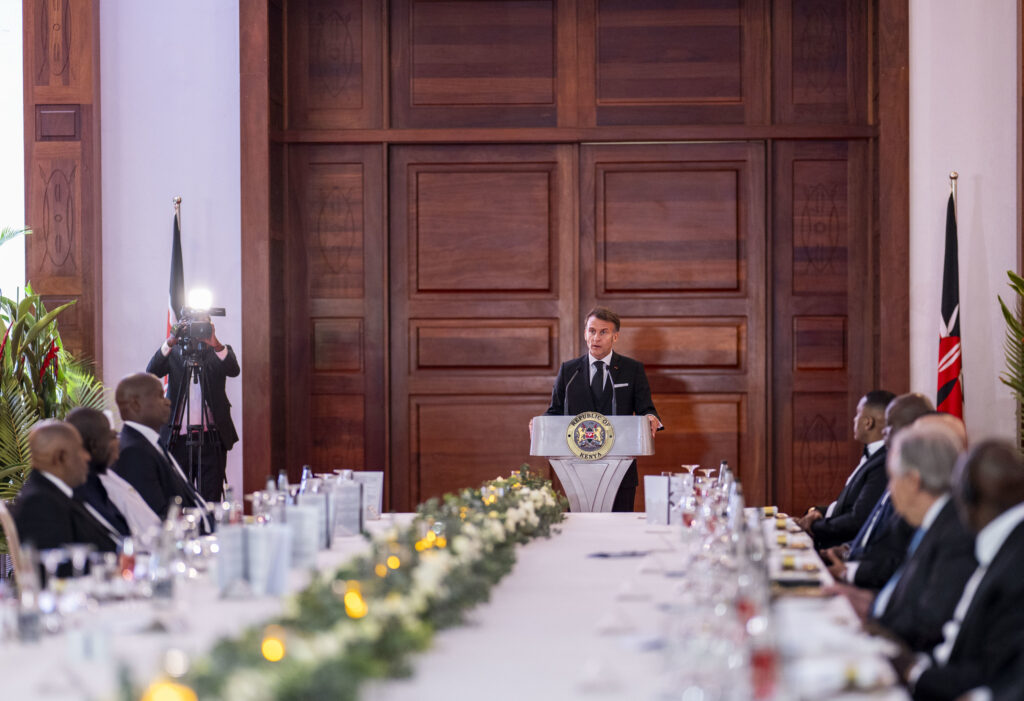
France’s Emmanuel Macron addresses African Heads of State at a state banquet hosted by Kenya’s William Ruto during the ‘Africa Forward’ summit in May 2026. As France tries to reposition itself after FrançAfrique, the neocolonial system of exploitation, is Africa negotiating back into the future? Photo courtesy: Paul Kagame
Strip away the romance, account for the brutality, and what remains at Adowa is a strategic achievement that yields specific, transferable lessons. Technology parity is a policy problem. Careful importation of expertise can be a strategic asset. Restraint when total victory looks tantalisingly close is as genuine an expression of sovereignty as any. And political aggregation without policy disaggregation is a formula for heroic defeat. Each of these lessons finds startling resonance in the struggles of twenty-first-century African states to assert sovereignty over their most critical assets.
1. Cobalt, Lithium, and the New Scramble
Luwowo coltan mine, near Rubaya, North Kivu – one of the few mines in the region certified as conflict-free. Photo: MONUSCO
If Menelik’s rifles were the strategic technology of 1896, critical minerals are the rifles of the 2020s. The Democratic Republic of Congo holds roughly 50 per cent of the world’s proven cobalt reserves and supplies approximately 70 per cent of global demand – a mineral essential to the lithium-ion batteries powering electric vehicles, smartphones, and the artificial intelligence revolution. Guinea possesses a quarter of global bauxite reserves; and South Africa dominates platinum-group metals vital to hydrogen technologies. And, yet, Africa is not the dominant mineral reserves owner it is often made out to be. These are selective endowments to be deployed strategically.
Mere possession is a long way from sovereignty. By some analyses, Africa manages to capture barely 10 per cent of the value added across the mineral export chain and refines fewer than 5 per cent of those minerals locally. Chinese companies control roughly 41-50 per cent of African cobalt production, including 15 of the DRC’s 19 cobalt operations. The battle is no longer over who owns the resource; it is over who controls the processing, infrastructure, and value chain. Menelik understood this instinctively. Owning rifles meant nothing without an ammunition factory. Owning cobalt means little without a refinery.
The DRC’s recent trajectory illustrates the katanomic fracture with painful clarity. In February 2025, with cobalt prices at a nine-year low, the government halted all cobalt exports. Here was a bold act of political aggregation intended to stabilise prices and assert sovereign leverage over global supply chains. When exports resumed in October 2025, they came with strict quotas: roughly half the country’s previous output. The political signal was clear.
Yet the policy disaggregation – the refining capacity, the reliable electricity, the skilled workforce, the transparent regulatory framework – lagged far behind the rhetorical ambition. Sequencing keeps tripping. Within weeks of the resumed exports, a Trump-era trade truce with Beijing saw China and the United States secure mineral access through bilateral accommodation rather than African diversification. Kinshasa heard the message loud and clear: when Washington and Beijing negotiate, the Global South can be sidelined regardless of geological endowment.
Meanwhile, the December 2025 Strategic Partnership Agreement between the United States and the DRC – framed as a landmark for peace and economic integration – drew sharp criticism. The agreement was not presented to the Congolese parliament for debate. Critics argued it lacked seeding in DRC’s fraught policy struggles. The lack of cohesive strategy raises uncomfortable parallels with Wuchale. It invokes images of a treaty drafted in the language of partnership that functions, on closer reading, as a mechanism of constraint. Is it too glib to suggest that Menelik would have recognised the signals immediately?
Scattered across the continent, other states are attempting the same balance. Zimbabwe has banned exports of unprocessed lithium ore, forcing firms to build local processing plants. Burkina Faso has nationalised gold mines and raised government mining stakes. These are exhilarating acts of political assertion. Whether they can be matched by the patient policy work – the stable legal frameworks, energy infrastructure, and skilled workforces – sequenced smartly and the trade-offs and analytical tensions used as the fuel required to make export bans productive rather than merely punitive will determine a lot. Including whether they amount to Menelik’s ammunition factory or Tewodros’s cannon cast in haste.
2. Digital Sovereignty and the Worldcoin Lesson

August 2022: Kenyans queue to get their biometrics taken by Worldcoin agents. Photo courtesy: Weetracker.
If critical minerals represent the hardware of sovereignty, data represents its epistemic substrate – the raw material of intelligence, identity, and governance itself. Here the katanomic fracture threatens to burst the cast asunder.
In mid-2022, Worldcoin – the crypto-backed digital identity project co-founded by OpenAI’s Sam Altman – launched a mass registration drive in Kenya, offering cryptocurrency tokens worth approximately $55 in exchange for iris scans captured by a spherical scanner called the “Orb.” Within a week, over 350,000 Kenyans had been enrolled, amounting to 25 per cent of Worldcoin’s global customer base. The iris scans were transferred to servers in Germany without a Data Protection Impact Assessment, without meaningful informed consent, and without any clear framework governing how the biometric data would be stored, processed, or monetised.
The Kenyan government suspended Worldcoin’s operations in August 2023. In May 2025, the High Court of Kenya declared the data collection unlawful, ordering the permanent deletion of all collected biometric data – an order subsequently confirmed as executed under ODPC supervision in Germany by late 2025. The ruling was among the most forceful legal rebukes of a global technology platform by any African court.
Yet the pattern of the breach matters more than its resolution. Worldcoin deployed at retail speed while Kenyan regulators operated on legislative timelines. The ICT Ministry, eager to position Kenya as the “Silicon Savannah,” initially hesitated to “stifle innovation”. The policy apparatus seemed to have succumbed to the political rhetoric in spectacle form about “innovation” that katanomics warns against. The word is used in its aggregative sense. It is about Kenya’s ambition to be a continental tech leader. The slip was on the disaggregating end: no data protection impact assessment protocols were enforced, no technical audit capacity existed to evaluate the Orb’s data flows in real time, and no contingency plan addressed what happens when a foreign entity extracts biometric data from hundreds of thousands of citizens and then absconds with value before local beneficiation strategy can be formulated.
The Worldcoin episode is to digital sovereignty what Tewodros’s cannons were to military sovereignty: evidence that acquiring or inviting technology without the institutional architecture to govern it is an act of self-exposure dressed as modernisation. Menelik’s insistence on structural neutrality – hiring a Swiss engineer rather than a French or Italian one – finds its contemporary echo in the growing calls across Africa for sovereign AI strategies that prioritise true data stewardship, independent audit capacity, and regulatory frameworks that move in step with the technologies they govern.
3. Transmediaries and the Missing Middle
Another lesson from the lead up to Adowa is that Menelik’s relationship with Ilg illuminates a persistent structural gap in African state capacity. Ilg was what the katanomic framework calls a “transmediary”: an individual or organisation that links the discrete pieces of a value chain so that complexity becomes navigable for the decision-maker. He translated between European manufacturing protocols and Ethiopian imperial logistics, between technical specification and political priority.
Modern African states face an analogous deficit. The African Continental Free Trade Agreement aspires to create a single market of 1.4 billion people – a breathtaking act of political aggregation. Yet implementation has been hobbled by the absence of precisely these kinds of Transmediary institutions. The standardisation bodies, cross-border logistics coordinators, harmonised regulatory agencies, the rank of file of connectors to translate the vision into functioning trade corridors.
The encouraging news is that modern Africa does not need to import its transmediaries from Frauenfeld. The continent’s own societies and diasporas are brimming with the technical talent that Menelik once had to recruit from across the Mediterranean. The problem has been underutilisation. It has been a failure to create the institutional structures, compensation frameworks, and career pathways that would draw this expertise into sustained public-interest work rather than leaving it to circulate in the private sector or the diaspora.
Sebene: Sovereignty is in the Residue of Calculation
Menelik’s legacy and the victory at Adowa provide a permanent curriculum for those seeking to build genuine sovereign and anti-imperialistic capacity in an asymmetric world. They teach that the red umbrella of political authority is an empty gesture without the black umbrella of strategic restraint and the unglamorous craft of the ammunition factory.
Menelik’s achievement was his ability to disaggregate the grand challenge of anti-imperialism into a sequence of technical problems – procurement, negotiation, logistical planning, incentive alignment etc – and then to solve them, one by one, over three decades. In the DRC’s cobalt negotiations, in Kenya’s data protection battles, in the AfCFTA’s implementation struggles, the same katanomic fracture persists: grand political visions that dissolve upon contact with the prosaic realities of execution.
Bridging that fracture demands the same qualities Menelik embodied: patience that refuses to be rushed by the hunger for spectacle; technical literacy that refuses to be dazzled by rhetoric; the structural wisdom to align expert incentives rather than merely hire expertise; and the self-discipline to pursue calculated restraint when maximalism beckons.
Anti-imperialism and counter-neocolonialism, when they are real, do not need to be trumpeted from mountaintops. They bubble up like the accumulated residue of a thousand policy decisions made well before the sun rises over the hills of Adowa.
The post The Untold Story of the Battle of Adowa: How Anti-imperialism can be rebuilt from the ground up appeared first on African Arguments.