US, Iran Sign Landmark Truce Deal, Paving Way for Sanctions Relief and $300 Billion Reconstruction Plan
The United States and Iran have signed a landmark Memorandum of Understanding (MoU) aimed at ending months of hostilities and laying the foundation for a comprehensive peace agreement, in what analysts are describing as the most significant diplomatic breakthrough between the two nations in decades. The agreement, which entered into force immediately after being electronically […] The post US, Iran Sign Landmark Truce Deal, Paving Way for Sanctions Relief and $300 Billion Reconstruction Plan appeared first on Daily Star.
 Black News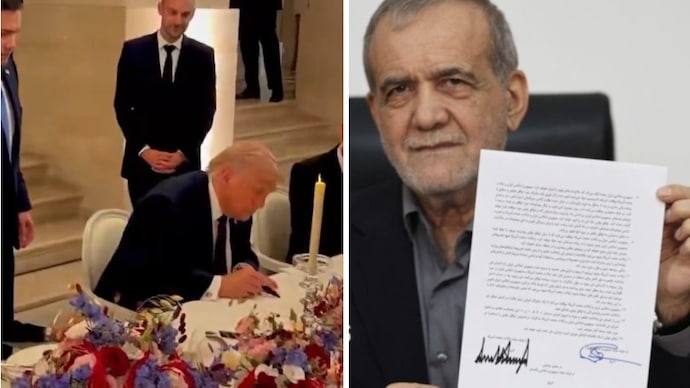
The United States and Iran have signed a landmark Memorandum of Understanding (MoU) aimed at ending months of hostilities and laying the foundation for a comprehensive peace agreement, in what analysts are describing as the most significant diplomatic breakthrough between the two nations in decades.
The agreement, which entered into force immediately after being electronically signed by U.S. President Donald Trump and Iranian President Masoud Pezeshkian on June 17, commits both countries to a framework designed to halt military confrontation, address longstanding nuclear concerns, and support Iran’s economic recovery.
According to details released by officials familiar with the negotiations, the accord was facilitated through mediation efforts by Qatar and Pakistan. President Trump later signed a ceremonial paper copy during a dinner attended by French President Emmanuel Macron at the Palace of Versailles, while a photograph of the signed document was transmitted to Tehran through diplomatic intermediaries.
Iran’s Foreign Ministry confirmed that the electronic signatures constitute the legally binding version of the agreement.
At the heart of the MoU is a commitment by both countries to respect each other’s sovereignty and territorial integrity and to refrain from interference in internal affairs. The accord also outlines a pathway toward the lifting of U.S. sanctions on Iran within a timeframe to be agreed upon during negotiations for a final peace settlement.
One of the most consequential provisions is the establishment of a reconstruction programme for Iran valued at no less than $300 billion. The initiative is expected to be developed by the United States in partnership with regional and international allies to support the rebuilding of infrastructure, revive economic activity, and address the damage caused during months of conflict.
The reconstruction commitment is likely to be closely watched by both investors and regional governments, given Iran’s strategic position in the Middle East and its importance to global energy markets.
The agreement also addresses concerns surrounding Iran’s nuclear programme. Tehran has pledged that it will neither produce nor acquire nuclear weapons, while outstanding issues relating to nuclear materials will be resolved under the supervision of the International Atomic Energy Agency (IAEA).
Diplomats involved in the talks say the nuclear provisions are intended to create confidence among regional and international stakeholders while providing Iran with a pathway toward greater economic integration.
In a move expected to ease pressure on global shipping and energy markets, Iran has also agreed not to charge vessels passing through the Strait of Hormuz for a period of 60 days. The waterway, through which a significant portion of the world’s oil exports transit, has been a focal point of international concern throughout the conflict.
The temporary suspension of transit charges is expected to facilitate the restoration of normal maritime traffic and help stabilize energy supplies. The agreement has already triggered a sharp reaction in global oil markets, with prices falling as traders responded to the easing of geopolitical tensions and the reopening of one of the world’s most important energy corridors.
Brent crude, the international benchmark, fell from about $79 per barrel before the signing to around $78.43 per barrel in Asian trading on June 18, extending losses recorded earlier in the week. U.S. West Texas Intermediate (WTI) crude also declined to below $78 per barrel. Analysts said the drop reflected the removal of a war-risk premium that had accumulated during nearly four months of conflict and uncertainty in the Gulf region.
The reopening of the Strait of Hormuz is expected to restore normal shipping operations within 30 days, reassuring markets over the uninterrupted flow of crude oil. Nearly one-fifth of the world’s seaborne oil supplies pass through the strategic waterway, making any disruption a major concern for global energy security. The decline in oil prices is expected to provide relief to importing economies and ease inflationary pressures that had intensified as the conflict threatened supplies.
The two sides have committed to using the next 60 days to negotiate a comprehensive final peace agreement that would formalize the provisions contained in the memorandum and establish mechanisms for long-term cooperation.
Observers say the success of the accord will ultimately depend on the willingness of both governments to implement their commitments and navigate deep-seated mistrust that has characterized relations between Washington and Tehran for decades.
Nevertheless, the signing of the MoU represents a rare moment of diplomatic convergence between two longstanding adversaries and offers a potential roadmap toward regional stability at a time of heightened geopolitical uncertainty.
Should the agreement hold, it could mark the beginning of a new chapter in U.S.-Iran relations, with implications extending far beyond the Middle East to global energy markets, international security, and diplomatic engagement worldwide.
The post US, Iran Sign Landmark Truce Deal, Paving Way for Sanctions Relief and $300 Billion Reconstruction Plan appeared first on Daily Star.