As fuel hits record highs, Kenya’s president tells Kenyans why taxes must stay
The president of Kenya, William Ruto, continues to be torn between cutting down fuel costs and maintaining fuel levies, despite pressure from protesters to introduce initiatives that ease energy costs.
 Black News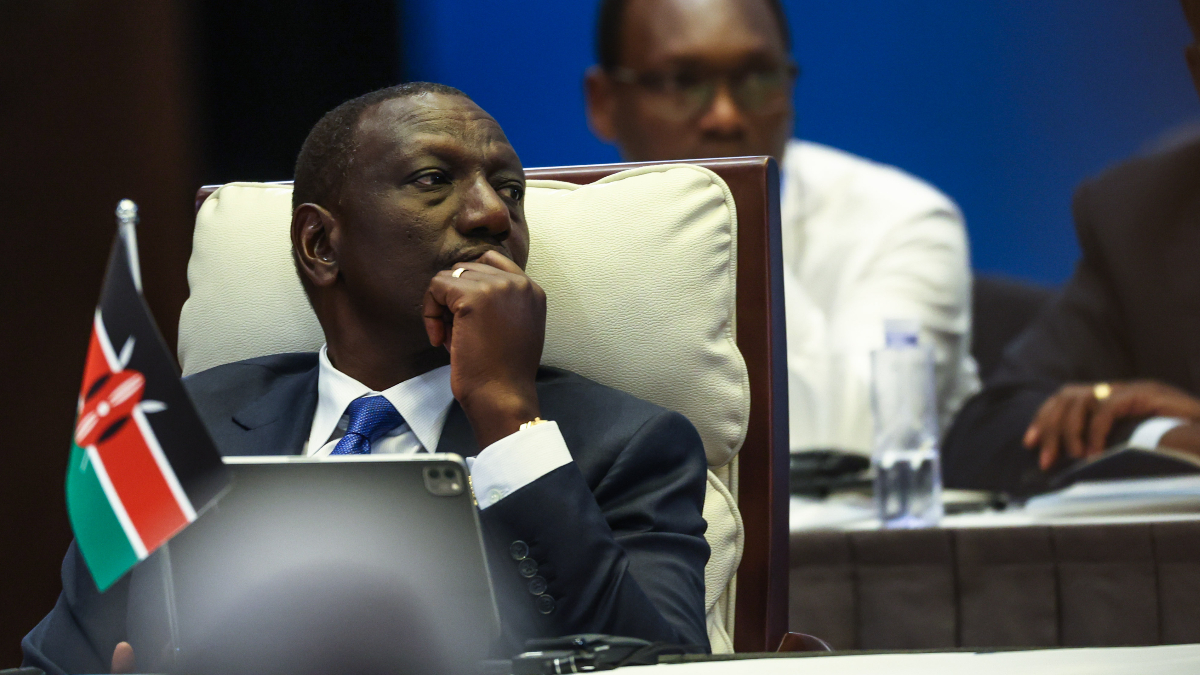
![Kenya's President William Ruto. [Photo by Wu Hao - Pool/Getty Images]](https://ocdn.eu/pulscms/MDA_/d8d6b92aee600c90026b90f02c2276df.jpg)
The president of Kenya, William Ruto, continues to be torn between cutting down fuel costs and maintaining fuel levies, despite pressure from protesters to introduce initiatives that ease energy costs.
- President William Ruto defends Kenya's current fuel policy despite public protests and calls for measures to lower energy costs.
- Ruto insists that removing taxes and levies on fuel would lead to a funding shortfall impacting essential public services and development projects.
- Recent price hikes have pushed diesel to a record high in Kenya, worsening the financial burden on households and businesses already struggling with rising living costs.
Kenyans who are concerned about the effects of the current energy inflation on the local economy, brought on by the Iranian war, have taken to the streets to demand better relief programs from the government.
Despite this, President William Ruto has defended his administration’s response to the global shock, which seems contrary to the protesters' demands, noting that energy inflation is a problem affecting the entire planet and not just Kenya.
Since the beginning of the US-Israeli war on Iran, the East African country has spent 28.2 billion shillings ($217 million) on tax cuts and subsidies to keep fuel prices artificially low, Ruto told reporters in the port city of Mombasa on Friday.
As seen on Bloomberg, he stated that although the authorities will cut the price of diesel by 10 shillings per liter next month, there won't be any additional charges lowered.
Furthermore, he maintained that the matter is being overflogged by certain elements looking to exploit the situation for political gain.
DON'T MISS THIS: Kenya is turning its space ambition into a national priority
“I know there are those who are trying to turn this global crisis into politics. People seeking to exploit public pain for political gain, making reckless claims and pretending there are easy options,” he stated.
The Kenyan president further defended the decision to keep fuel taxes and levies in place, despite public concerns about the expense of living, claiming that doing away with them would result in a significant funding shortfall and have an impact on the provision of necessary services.
“There are those asking the government to remove all taxes and levies on fuel immediately. But we must ask ourselves honestly: if we stop collecting this revenue entirely, what public services shall we stop funding?” he said, citing roads, security, fertiliser subsidies, healthcare, and education as key programmes dependent on fuel-related revenue.
As seen on The Eastleigh Voice, Ruto noted that eliminating fuel taxes could lead to bottlenecks in some of the current development projects in the country.
“Do we go back to the spectacle of stalled road projects that had become a hallmark across the country? Do we stop the fertiliser subsidy programme?” he said.
“These are not simple decisions. Leadership requires us to make responsible decisions not only for today, but also for the long-term stability of our country,” he added.
Kenya’s recent debacle with fuel prices
In April, the Kenyan president defended the soaring fuel prices in the country by affirming that Kenya is a middle-income country.
On Sunday, April 19, Kenya's president spoke at a church in Karen, explaining why Kenya's fuel expenses are higher than those in Tanzania and Uganda.
Addressing popular discontent over rising fuel costs, President William Ruto stated that Kenya's current economic situation is the principal cause of the country's energy inflation.
He noted that, unlike the surrounding countries, which are low-income, Kenya is a middle-income country, and hence is facing a more aggressive price increase.
Earlier in May, Kenya responded to energy pressures by authorizing a six-month waiver for increased sulfur levels in gasoline and diesel.
The temporary policy essentially allows the country to return to previous levels before the adoption of stronger environmental regulations, with the sulfur limit set at a maximum of 50 milligrams per kilogram.
Last week, it was reported that Kenya had raised fuel prices for the second straight month, pushing diesel to a record high and worsening pressure on households and businesses already battling rising living costs.
Kenya’s Energy and Petroleum Regulatory Authority (EPRA) said diesel prices jumped by 23.5 per cent to 242.92 Kenyan shillings ($1.88) per litre from 196.63 shillings.
It also disclosed that petrol prices rose to 214.25 shillings per litre from 206.97 shillings, while kerosene remained unchanged at 152.78 shillings.