From Cartagena to Chelsea: Ruby Rumié Brings ¿How Are the Children? to New York
At Nohra Haime Gallery, in Manhattan’s white-walled Chelsea district, Cartagena-based artist Ruby Rumié is asking a deceptively simple question: How are the children? It is not a casual greeting, nor the sentimental title of a new exhibition. Instead, it draws from the Maasai expression “Kasserian Ingera,” a phrase that measures the wellbeing of an entire […]
 Black News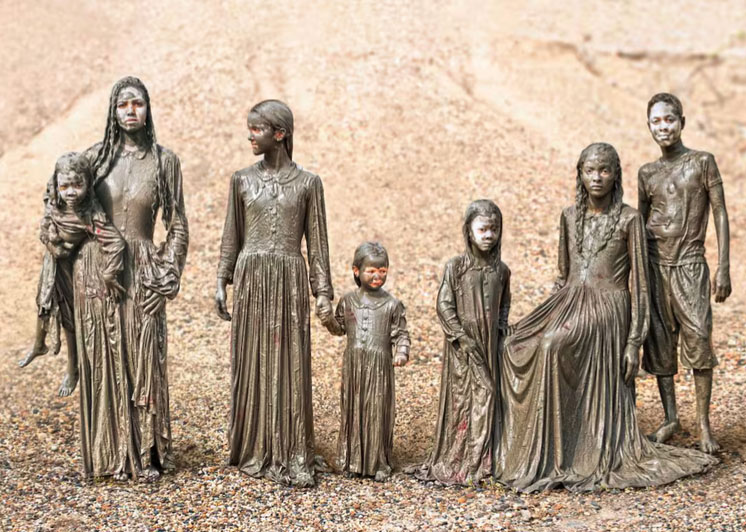
At Nohra Haime Gallery, in Manhattan’s white-walled Chelsea district, Cartagena-based artist Ruby Rumié is asking a deceptively simple question: How are the children?
It is not a casual greeting, nor the sentimental title of a new exhibition. Instead, it draws from the Maasai expression “Kasserian Ingera,” a phrase that measures the wellbeing of an entire community through the condition of its youngest members. If the children are well, the society is functioning; if they are not, everything else is called into question.
For Rumié, whose socially engaged practice has long examined dignity, memory and the politics of the body through installation and portrait photography, the question becomes the conceptual spine of her latest New York presentation. The exhibition, titled ¿How Are the Children?, marks a significant moment for the Cartagena-based artist, bringing her work once again into an international conversation that moves between Latin America, the Caribbean and the wider Global South.
Rather than beginning with a grand theoretical premise, the project emerged from something quieter: an old newspaper clipping documenting the disappearance of several children on a distant island. Nearly lost among family albums and forgotten papers, the fragment offered no resolution, only a trace. For Rumié, that absence became more powerful than explanation.
The result is an exhibition that does not attempt to solve a mystery but instead inhabits a state of unresolved concern. It asks viewers to remain with discomfort rather than consume a narrative neatly packaged for closure. In a cultural moment increasingly shaped by speed, certainty and spectacle, this refusal feels deliberate.
Within the work’s imagined structure, eleven children leave behind the violences of contemporary life: the pressure to perform, the normalization of fear, and the relentless demand to adapt to adult systems of productivity and control. Their destination is a volcano, a symbol that carries both danger and possibility.
Rumié anchors that image in a distinctly Colombian geography: the Totumo Mud Volcano, located between Cartagena and Barranquilla on Colombia’s Caribbean coast. Known locally as both a tourist curiosity and a place of ancestral ritual, the volcano is less about eruption than immersion. Visitors descend into a dense crater of warm mineral mud, confronting the instinctive fear of sinking—only to discover that the body floats.
This paradox sits at the heart of the exhibition and of Rumié’s photographic narratives.
Using portrait photography staged on the sandy slopes surrounding Totumo, she transforms her young subjects into something resembling living ceramics. Their bodies, coated in volcanic mud, appear sculptural and elemental – figures suspended between portrait and artifact, between childhood and myth. The mud gives them a tactile permanence, as though they have emerged from the earth itself rather than simply stood before the camera.
Here, mud is not scenic backdrop but primary material and metaphor. It is organic and mineral, medicinal and unsettling. It obscures the body while revealing something more essential beneath the surface. Covered in mud, distinctions of age, class, gender and origin begin to dissolve. The body ceases to be an object for display and returns to its simplest state: matter.
There is a quiet political force in that gesture. In a world saturated by images and increasingly hostile standards of beauty, the act of covering oneself in mud becomes a rejection of polished performance. It resists visibility as spectacle and proposes instead a form of symbolic density—one in which the body is not consumed but encountered.
The children in Rumié’s exhibition do not perform innocence. They do not dramatize suffering for the viewer’s emotional satisfaction. Instead, they surround the volcano with calm insistence, each holding a red ribbon that descends from its summit into their hands. The ribbon suggests connection rather than rescue, lineage rather than alarm. The volcano ceases to be a site of threat and becomes something closer to a shared origin: a matrix, a beginning.
That restraint is perhaps the work’s greatest strength. Rumié avoids the familiar traps of political art that over-explains its intentions or aestheticizes trauma into digestible symbolism. Instead, she builds an atmosphere of attention. The exhibition trusts silence. It asks not for interpretation alone, but for ethical presence.
This has been a defining feature of Rumié’s extensive projects. Her work often moves between installation, photography and social intervention, examining how communities remember violence and how institutions choose to see – or not – the vulnerable. Her native Cartagena, with its layered histories of colonialism, tourism and exclusion, remains both context and counterpoint.
Showing this work in New York adds another dimension. Chelsea galleries are not typically spaces associated with collective care or recetive to questions of social reparations. Yet that friction is productive. To pose “How are the children?” in the commercial heart of the international art market is to redirect attention from value to responsibility.
It is also a reminder that contemporary Latin American art is often at its most compelling when it resists exotic labels and insists on moral complexity instead. Rumié does not offer folklore, nor easy allegory. She offers a question as elusive as the landscape itself, echoing the vast and shifting terrains once depicted by the Prussian explorer Alexander von Humboldt during his travels across the continent.
And perhaps that is Rumié’s point. The exhibition offers no definitive answers, nor any final declaration of hope or despair. Instead, it leaves visitors carrying the weight of the original inquiry – returned intact, urgent and impossible to ignore, just like a volcano.
¿How Are the Children? opens on 7 May at Nohra Haime Gallery
Nohra Haime Gallery: 500A West 21st Street, New York.