Skipper Wills Dedefines Success
Namibian hip-hop artist Malima William, known as Skipper Wills, is showing that success does not have to be achieved in either the office or the entertainment world alone. As he continues to develop his career in the music industry, the Ondangwa-born rapper has also developed himself into a skilled boilermaker by applying both music and […] The post Skipper Wills Dedefines Success appeared first on The Namibian.
 Black News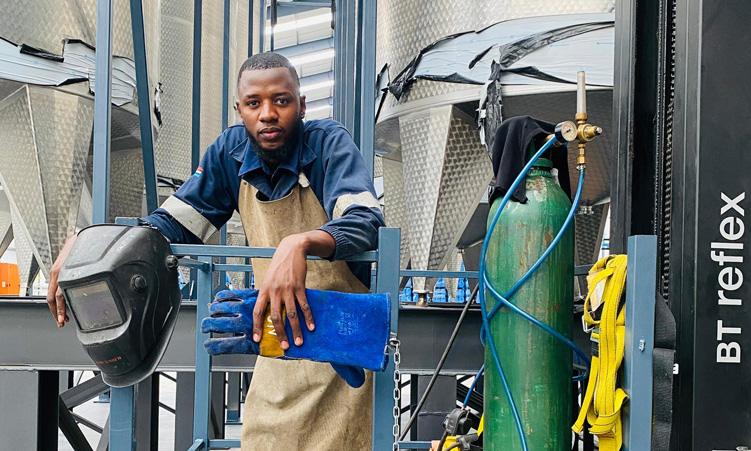
Namibian hip-hop artist Malima William, known as Skipper Wills, is showing that success does not have to be achieved in either the office or the entertainment world alone.
As he continues to develop his career in the music industry, the Ondangwa-born rapper has also developed himself into a skilled boilermaker by applying both music and technical skills to shape his future.
With hits such as ‘Dankie Botswana’, ‘Message in a Bottle’ and ‘I Am Ready’, Skipper Wills has emerged as one of the most recognised independent hip-hop artists in northern Namibia.
Besides being on stage and in the studio, he is also doing technical work as a boilermaker at an Ondangwa company.
MUSIC AND TECHNICAL PASSION
In an interview with The Weekender this week, the rapper said his love for both music and technical work started at a young age.
“Growing up in the north, my love for music was heavily inspired by family influences, especially my uncle Dunga Nambudunga, who was part of the Mighty Dreads as a skilled guitar player and backup singer,” Skipper Wills said.
He said his mother’s involvement in church choirs also shaped his musical foundation, while poetry writing during high school later pushed him into songwriting and rap music.
“On the other hand, I realised I had a natural feeling towards working with my hands,” he stated.
“In high school, I would assist my uncle in fixing radiators on cars and welding petrol tanks that were leaking. I enjoyed fixing things, understanding how they worked and solving practical problems.”
That passion eventually led him to study boilermaking at the Namibian Institute of Mining and Technology, where he qualified as a boilermaker artisan while still pursuing music professionally.
“To me, music and boilermaking are different, but both are creative in their own way – music and storytelling on one side and skills, precision and making something valuable with my hands,” he added.
Skipper Wills was introduced to the limelight in 2017 when he appeared in the ‘Old and New Namibian Hip-hop’ documentary that discussed the challenges and development of emerging and successful artists in Namibia.
He later went on to establish himself further through projects like his EPs ‘Thankful’ and ‘JumpMan23’.
In 2022, he joined Brandberg Global, a company owned by Namibian artist Hilifa 94, to enhance his music career, under which he also released his latest single, titled ‘Pequena’, featuring Hilifa 94.
Skipper Wills believes there are many myths surrounding vocational careers that need to be busted.
“One of the key reasons why vocational and trade careers get stigmatised is that society has for a long time promoted the notion that success can only come through college or university degrees and white-collar jobs,” he said.
“Most young people were brought up with the mentality that wearing a suit in front of a desk is more respected than wearing a uniform.”
According to him, many people fail to recognise the level of expertise, discipline and intelligence required in technical professions.
“Without artisans, welders, electricians, plumbers and technicians, many systems and industries would simply not function,” he added.
He believes Namibia needs more awareness campaigns, youth programmes, podcasts, school outreach initiatives and career fairs that highlight the value of vocational careers.
“We require our artists, musicians, and influencers to make use of their channels to demonstrate that technical jobs are honourable, lucrative and necessary for the growth of the nation,” he said.

BALANCING MUSIC AND CAREER
Balancing music with a technical career has not been easy for Skipper Wills, but with discipline, he said he made it possible.
“As an artisan, my job is strenuous and takes up time, while music requires me to be creative and focused. What has worked for me is realising that they are both part of me and not two identities fighting each other.”
He added that during work hours he is fully immersed in his profession, while in his leisure time he focuses on music recording, songwriting and performing.
“Sometimes it calls for sacrifice of comfort, sleep and leisure time, but when you love something, it is worth the effort,” he said.
The rapper opened up about some difficult years after qualifying as a boilermaker, revealing that he struggled for almost five years to find stable employment.
“There have been times when I doubted myself, when I was feeling pressured, even depressed, and as a young man, trying to make my way in the world.”
He said those experiences made him who he is today – strong and independent.
“Success is not always instant. Real strength is continuing to push forward even during difficult seasons,” he said.
Today, he wants fellow artists and young Namibians to understand that pursuing a technical profession does not mean abandoning creativity or your dreams.
“Talent alone is not always enough. Having a vocational skill or qualification can create stability, independence and long-term opportunities,” he said.
“The advice I give to the youth is not to confine themselves to just one route. If your passion is music or entertainment, pursue it wholeheartedly, but also think about taking up a trade or technical course.”
Commenting on the importance of combining creativity with technical skills, Mathew Hango, a senior technical and vocational education and training (TVET) professional with over 20 years of experience, says Skipper Wills’ story will help reshape perceptions around talents and vocational careers in Namibia.
“It is vital for young people, particularly those who are creative, to integrate their skills with vocational or technical skills. Technical skills will enable the youth to have sustainable careers and be independent,” he says.
Hango says the integration of creative skills with technical or vocational skills enhances career prospects.
“A musician who understands sound engineering, a fashion designer with tailoring and business skills or a digital artist with coding, animation or marketing knowledge becomes more competitive and self-sufficient.
“Namibia’s creative industry is increasingly seen not only as an artistic space but also as a source of entrepreneurship and job creation for young people,” he says.
Hango adds that stories of young people balancing creative passions with skilled trades challenge the outdated belief that success only comes through office jobs or academic professions.
“These examples promote dignity in skilled work and encourage young people to see vocational and technical careers as valuable, respected and important for economic growth and youth empowerment,” he says.
The post Skipper Wills Dedefines Success appeared first on The Namibian.








![Taylor Polidore Williams Says Indie Film ‘HPV: Her Pretty Vagina’ Is Bigger Than Entertainment: ‘I Knew It Was A Necessary Conversation’ [Exclusive]](https://bossip.com/wp-content/uploads/sites/28/2026/05/17794757122146.jpg?quality=80&strip=all&w=1024&crop=0,0,100,683px#)