UWP calls for crime masterplan and judicial reforms
“What is a plan without the political will to implement it?” asked former Government Minister Sarah Flood-Beaubrun. On Thursday, Flood-Beaubrun and two of her UWP colleagues spoke about crime, saying the situation was serious enough to hold a press conference. The media invitation explained that they wanted to address rising concerns about violence against women, […] The article UWP calls for crime masterplan and judicial reforms is from St. Lucia Times.
 Black News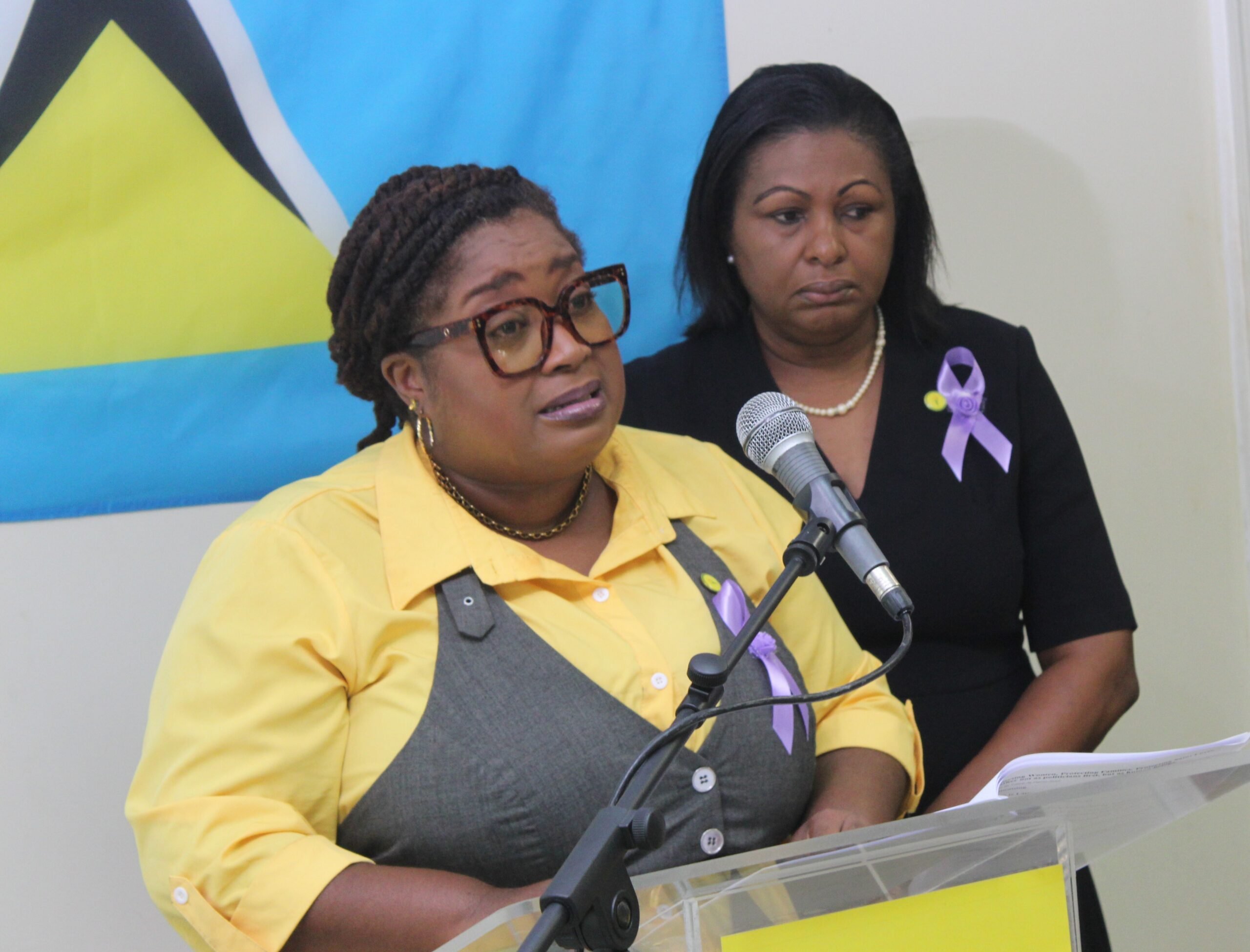
“What is a plan without the political will to implement it?” asked former Government Minister Sarah Flood-Beaubrun.
On Thursday, Flood-Beaubrun and two of her UWP colleagues spoke about crime, saying the situation was serious enough to hold a press conference. The media invitation explained that they wanted to address rising concerns about violence against women, domestic abuse, violent crime and the urgent need for better interventions and protection systems in Saint Lucia.
Also present were Laura Jn Pierre-Noel and Titus Preville, who were UWP candidates in the last general elections.
Laura Jn Pierre-Noel, who spoke first, described herself as a community leader, an aunt, a godmother and a daughter. “And yes, I am someone who stepped into public life because I deeply care about people,” she said.
She shared a story from last summer, when a young woman called her looking for a place to stay.
“That young woman stayed with me for over six months because she was running away from a situation that could have cost her her life,” Jn Pierre-Noel said.
“Today, as Saint Lucians mourn Joy’s death, I cannot help but think if I had said no, if I had turned my back, if I had decided that her problem was not my responsibility? Then, perhaps today, we would have been mourning yet another young woman.
“I believe that leadership should help people, leadership should protect the vulnerable, leadership should inspire hope, leadership should remind people that even in their darkest moments they are not alone.”
According to Jn Pierre-Noel, Joy’s tragic death is not an isolated incident. “It is another painful reminder that too many women in Saint Lucia are suffering in silence.
“Behind closed doors, many women are suffering with fear, intimidation, threats, emotional trauma, humiliation and uncertainty. Some remain silent because they are afraid. Some because they feel ashamed. Some because they are financially dependent, and some because they are not sure whether help will truly come.”
Jn Pierre-Noel, visibly emotional, listed some Saint Lucian women who spoke up in the past and were killed.
“Joy St Omer, not much older than my own niece, spoke up, and she’s dead. The reality should trouble each and every single one of us. Because abuse rarely begins with the headlines. It often begins quietly – with control, with manipulation, with isolation, with emotional wounds that deepen over time while the outside world sees nothing,” Jn Pierre-Noel explained.
She pointed out that communities, families, and friends often notice warning signs, but sometimes ignore them.
She went on to call for a Saint Lucia where people feel heard, valued, protected and supported. “A country where women feel safe seeking help, a country where victims are believed, a country where support systems respond before situations escalate into tragedy and we must be honest enough as a country to admit sometimes we ask women to speak up while failing to build an environment where they feel safe enough to do so. That must change,” she said.
“Beyond policy, we need compassion. Because domestic violence is not just a legal issue, it is an emotional issue, it is a social issue, a cultural issue, a public health issue and solving it requires all of us – Government, Opposition, churches, schools, community leaders, men, women, families, choosing to care enough to intervene before it is too late.”
Titus Preville said that St Omer’s death is similar to many past cases, and that feeling sorry is not enough. “We need to act in a manner that ensures no such recurrence takes place,” he said.
Preville, who is an economist, talked about the costs of crime and lawlessness, saying they affect society in social, emotional, spiritual, and economic ways. “The social cost of crime is reflected in the fear and suspicion that is developed amongst the people in the community. When people can no longer trust each other,” Preville explained.
He said the emotional costs of crime show up as higher anxiety among people, which can even lead to chronic illnesses.
“And for those of us who believe in God…then we understand that criminality and crime and those atrocious acts of criminality and homicides, this is actually sinful, and it denies us the chance at eternal life,” he went on to say.
“And of course, there is the economic cost that we can more easily identify with or associate with. This is why civil society, Community organisations, the Church, the business community and yes, political organisations. must speak about crime, especially when we see violent crime being committed on a scale and for such a prolonged period, for us to conclude that, as we must, that crime is a crippling situation in our country, Saint Lucia.”
Preville stressed that the government is ultimately responsible for keeping crime as low as possible.
“Whether the administration is SLP or UWP, the buck stops with the administration in office. The government must provide leadership to all elements in society,” Preville said.
He said that preventing crime should be a top priority and requires strong, coordinated institutions. However, he warned that these institutions should not be politicised if they are to serve the people effectively.
Sarah Flood Beaubrun said that even though crime is a serious problem in the country, current approaches are not working and urgent change is needed.
“Now, I made a suggestion, a recommendation for a commission of enquiry with regard to Joy, because there is so much information that we have, and we clearly can all see that she did everything that the system allowed her to do or said that she ought to have done to protect herself. And yet, the system itself failed her,” she said.
Flood-Beaubrun, a lawyer, is also calling for a complete overhaul of the justice system.
“So, even if we were to get recommendations on domestic violence, those recommendations would still have to exist within a broken framework of the legal system, the judicial system, the justice system. So, it behoves us also to overhaul the entire system,” she said.
Flood-Beaubrun, who has been in politics for 29 years, said she has seen many commissions, consultations, and recommendations that were never implemented. She urged the government to create a master plan using past suggestions and to involve experts and criminologists.
Moving to the subject of faith, she noted that we are a Christian nation.
“We say it all the time. Our constitution acknowledges the supremacy of the Almighty God. So I am not speaking out of truth when I bring faith into the equation here and I am doing this because we will not solve crime unless we ourselves take personal responsibility for our actions,” she said.
“Most of us,” she added, “will do good because of our faith.” She was, however, quick to point out that she was not advocating that prayers alone would solve the problem, but that we need to take personal responsibility as well.
“I want you to quote me correctly on this. Say that I spoke about God, but also say that I spoke about doing the practical things,” she said.
Flood-Beaubrun says she firmly believes there is a supernatural element to all that’s happening in Saint Lucia.
“Evil is taking over or has taken over this land. There’s no doubt about it. The crimes, the extent of them, the magnitude of them, they have a supernatural explanation, and it is time for our hearts to be turned back to God.”
The article UWP calls for crime masterplan and judicial reforms is from St. Lucia Times.